
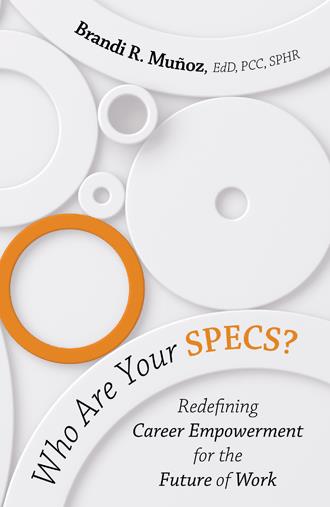
Who Are Your SPECS?
Redefining Career Empowerment for the Future of Work
by
Book Cover & Preview Text
Chapter 3: From Theory to Practice — Introducing the Five Pillars of SPECS Why a Multi-Dimensional Framework? For decades, career development has been described through frameworks that highlight important but partial truths. Mentorship programs have long been heralded as essential to advancement. However, research shows they often fail to provide access to decision-making tables where careers are truly accelerated. Coaching has gained prominence for helping leaders reflect, align, and grow, yet without sponsorship or advocacy, even the most self-aware professional can remain invisible in promotion processes. Peer circles and networks promote a sense of belonging and resilience. Still, without systemic advocacy, they can become islands of support without organizational influence. The reality is that single-dimensional approaches, no matter how well-intentioned, fall short. That’s where the SPECS Framework breaks new ground. Based on my research and decades of organizational practice, SPECS offers a multi-dimensional model that integrates five distinct roles into a Circle of Success: Mentor, Peer, Sponsor, Coach, and Advocate. Unlike traditional programs that operate in silos, SPECS is deliberately designed as an ecosystem. Each role stands on its own, but the most extraordinary power emerges through interaction, reinforcing one another to create sustained, scalable growth. One participant in my research summarized this vividly: “Advice from my mentor helped, but it was my sponsor who got me in the room, and my coach who gave me the confidence to speak once I was there.” This layered dynamic, where guidance, advocacy, reflection, and solidarity combine, is precisely what SPECS captures. Nothing like it currently exists in a comprehensive, adaptable framework. Career Development Theories That Support SPECS SPECS is not built in a vacuum. It stands on and extends foundational theories of career development: Super’s Life-Span, Life-Space Theory (Super, 1990) reminds us that career development occurs across stages and roles. SPECS recognizes that needs shift over time: early-career professionals often rely on mentorship and peer support, while mid-career leaders frequently require sponsorship and coaching. Holland’s Theory of Vocational Personalities and Work Environments (Holland, 1997) emphasizes the concept of person–environment fit. SPECS extends this by demonstrating how mentors, peers, and advocates help individuals navigate environments that may not always be welcoming. Social Cognitive Career Theory (Lent et al., 1994) highlights the role of self-efficacy and social supports in shaping career paths. SPECS operationalizes this: coaches build confidence, peers normalize struggles, and sponsors create tangible opportunities. In short, SPECS synthesizes decades of theory and adds something new: a holistic, practical model for today’s complex workplaces. Organizational & Leadership Development Foundations SPECS is equally grounded in organizational and leadership development literature: Transformational leadership theory (Bass, 1990) emphasizes leaders inspiring and empowering others. Sponsors and advocates embody this by leveraging their influence to advance others. Adult development theory (Kegan, 1994) posits that adults progress through distinct stages of meaning-making. Coaches, in particular, support this reflective growth. Senge’s concept of the Learning Organization (1990) highlights collective growth and systems thinking. Peer support and advocacy within SPECS reflect these same values, reinforcing cultures that foster continuous and systemic learning. Taken together, these theories affirm that careers don’t unfold in isolation; they flourish within intentional systems of support. SPECS provides the scaffolding to bring those systems to life. The Circle of Success Think of SPECS not as five separate interventions but as a network of relationships: A mentor provides expertise and guidance, while a coach helps translate that knowledge into personal growth and action. Peers offer empathy and collaboration, reinforcing lessons learned from mentors and coaches in day-to-day contexts. A sponsor leverages their influence to create opportunities that are inaccessible on one’s own. An advocate ensures that voices are amplified and systems evolve to support equity and justice. Each role is distinct, but together, they form a professional ecosystem — one that sustains both individual advancement and organizational resilience. Intersectionality in Action Although SPECS is a professional development model, rather than a DEI program, it acknowledges that a series of layered experiences shape careers. Professionals who live at the intersection of multiple challenges (e.g., early-career professionals and first-generation individuals; remote workers and new parents) often require more than one type of support. For example, a woman of color may require a sponsor to navigate systemic barriers, a mentor to offer culturally relevant advice, and a coach to address imposter syndrome exacerbated by microaggressions. A new graduate entering a competitive industry may rely on mentorship for technical learning, peer circles for resilience, and coaching to set goals. Conversely, an experienced professional transitioning into leadership may benefit more from advocacy and executive coaching to refine their strategic vision and influence organizational culture. This responsiveness is what makes SPECS versatile across industries and climates. Whether an organization brands it as leadership development, workforce well-being, or talent strategy, the framework remains flexible without losing its core intent: providing layered, sustainable support. Preparing for the Pillars In the chapters that follow, each of the five pillars will be explored in depth. Each chapter will: • Define the role and explain its unique contribution. • Show how it interacts with other roles. • Identify challenges in implementation. • Provide practical solutions and illustrative cases. By situating SPECS within classic theory and organizational practice, and by naming its novelty, this chapter establishes the foundation for what’s to come. The following five chapters explore each role in turn, demonstrating how, together, they form a Circle of Success that is not just aspirational but actionable. SPECS is more than another professional development program. It is a career ecosystem, one designed for resilience, adaptability, and real-world impact in a rapidly changing workplace.
Formats

Book Details
About the Book
Success is never a solo journey. Yet too often, professionals are told to “find a mentor” or “work harder” without being given the full support system necessary to thrive. Drawing from more than 15 years of coaching, consulting, and organizational leadership experience, Dr. Brandi R. Muñoz introduces the SPECS Framework, a groundbreaking model that integrates five critical roles: mentor, peer, sponsor, coach, and advocate. Through research, real-world examples, and practical strategies, this book reveals why traditional approaches to career development fall short and how a holistic, future-ready framework can transform both individual growth and organizational culture. Readers will learn how to build their own Circle of Success, tapping into intentional networks that foster resilience, equity, and lasting advancement. Written for executives, managers, educators, and professionals at every stage of their careers, this book offers actionable tools for navigating complexity, leading through change, and creating environments where all voices are valued. Whether you are striving to advance your own career, develop inclusive leadership programs, or strengthen your team, the SPECS Framework provides a blueprint for shared success. Empowering, research-driven, and deeply practical, this book reminds us that leadership and growth are not built in isolation but within circles of connection, support, and shared purpose.
About the Author
Brandi R. Muñoz, EdD, PCC, SPHR, is an executive coach, consultant, and facilitator specializing in leadership, conflict resolution, and organizational change. With 15+ years of experience, she created the SPECS Framework to help leaders and organizations build resilience, foster inclusion, and achieve success through circles of support.