
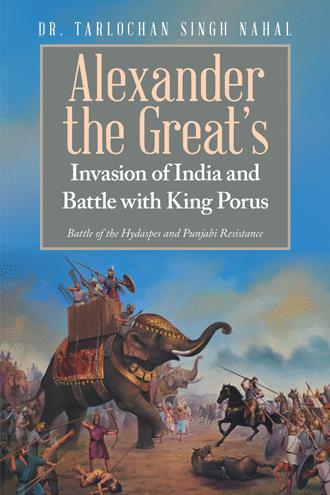
Alexander the Great’s Invasion of India and Battle with King Porus
Battle of the Hydaspes and Punjabi Resistance
by
Book Cover & Preview Text
Formats

Book Details
About the Book
This work represents the first comprehensive study and analysis of Alexander’s invasion of India by a researcher of Indian origin. It has 120 illustrations including more than 30 maps to help the reader. The account not only describes the battle led by Punjabi King Porus of the small kingdom of Jehlum, but also highlights Alexander’s clashes with other prominent tribes from Swat, Punjab, and lower Sindh. The Indians [Punjabis], as per Plutarch, “blunted the edge of the Macedonians’ courage.” His army mutinied and he was forced to make a U-turn in Punjab. Alexander’s greatness is marred by the massacre of almost 500,000 people in Europe, Persia and India. The events of his personal life and massacre of his entire family in an internecine war resemble the drama of a classic Greek tragedy. “Author has made a comprehensive study of the subject by delving deep into both ancient and modern sources. With his deep insight, he has presented a new perspective on the fierce historical battle that took place between Alexander the Great and the brave Punjabis led by Porus. It is an immensely valuable addition to the less-known period of ancient Indian history. He has accomplished his very valuable, documented stupendous task with great passion.” —G.S. Dhillon Former Professor of History, Panjab University, Chandigarh
About the Author
Dr. Tarlochan Singh Nahal is an independent research scholar with expertise in Sikhism and the history of Punjab. He earned his M.A. in English literature from Guru Nanak Dev University in Amritsar. He moved to the US in 1979 and completed his Ph.D. in Political Science at Senior University International, USA in 1999 under Prof. Noel Q. King, then Professor Emeritus at UC Santa Cruz. He wrote a comprehensive volume Religion and Politics in Sikhism: The Khalsa Perspective, published by Singh Brothers, Amritsar in 2011. Dr. Nahal has worked in Silicon Valley in technical communication for the last four decades.