
INTERSECTIONS 2023
by
Book Cover & Preview Text
The news was jarring! That morning, in a small conference room in Alexandria, Virginia, glances ricocheted around the table. “Ladies and gentlemen, Mars does indeed have a pulse.” The Chairperson of the National Investigative Committee of Unknown Phenomena—known in familiar circles by the acronym NICUP—needed only fifteen minutes to review the latest findings concerning the Red Planet’s magnetosphere and plate tectonics. Dr. Stephan Krejvic highlighted the patchy auroras in the polar regions, along with the swelling on Olympus Mons’ southern slope, associated with swarms of local Marsquakes. These observations could only mean one thing—a geological revival. Indeed, Mars, once thought irreversibly dead, was waking up. To say that Krejvic had raised a few eyebrows would be a colossal understatement. Krejvic laid his pen down alongside a half-empty coffee cup. The Chairman and his pen? Stefan Krejvic seldom took notes. All but the most recent additions to the panel knew that. His ever-present pen was not much more than a prop—sometimes tapped to get attention, sometimes used to keep his hands busy. After centering his coffee cup on a folded, partially stained napkin, he leaned back to gaze leisurely at the dated analog clock above the door: 10:20. He would allow his panel of scientists a few more moments to ponder the implications of an awakening Mars. There had been rumors about the Red Planet since 2021—imagination-stirring but also concerning. What those sitting around the conference table had just heard, however, was no rumor, tall tale, conspiracy theory, or idle speculation. Krejvic had related recent, classified NASA reports—compelling, scientific evidence that any thinking person would quickly lend an ear. Evidence had come from various directions. Not only was there evidence of geological activity, but there had also been unexplained breakdowns of NASA’s Mars rovers and orbiters. Questions were unavoidable. Dr. Krejvic had aged noticeably over his four-year tenure. His wiry hair alone—cast in tight, brown-shaded curls—remained unchanged. The panel members, who knew him best, took that as a sign that their chairman could be farcically vain while appearing awkwardly modest. Yet, whatever his idiosyncrasies, Stefan Krejvic enjoyed a mostly undoubted ability to manage people. This was primarily due to a seemingly natural aversion to conflict. More than once, he had to put that skill to good use to protect relationships among panelists separated by strong opinions. Yet, he was more than just a fence-mender, more than a competent arbitrator; he was the consummate administrator. Krejvic was about rules. Not only rules but also procedures. Not only about rules and procedures, but also protocols. Not only rules, procedures, and protocols, but also consequences. Accordingly, he enjoyed a high reputation for conscientiousness. Simultaneously, he suffered a correspondingly low standing for creativity and boldness. Such a diversity of attributes undoubtedly contributed to his longevity in civil service, but none more so than his reputation as a careful man. Krejvic has notified all ten current panel members of this unscheduled meeting. Six were present. Perfect attendance was rare since NICUP members came from all over the country, and post-COVID air travel remained a hassle. Yet, Krejvic was pleased that three of the four legacy members were among those sitting around the table—scientists he had personally recruited at NICUP’s inception. They were the ones he trusted the most. No one could say coaxing scientists to join NICUP was easy. The individuals invited were otherwise gainfully occupied with real scientific questions. It was no small feat to get them to contribute time and effort to understand something as mystical and mythical as UFOs. Yet, NICUP’s chairperson was not without persuasive power. Truly, his success in enlisting people reflected what many jokingly thought of as a mostly hidden personal appeal. Yet, though it was not his fault, the committee has changed over the years. Some later-added panelists had politely resigned for one reason or another. In most instances, he recruited replacements from the list of NICUP consultants. However, the White House recently strongly urged Krejvic to add a particular person to the panel. Meet Labbe Fromme. Not only was Dr. Fromme strongly endorsed by White House officials, but he also received a most supportive letter of recommendation from a top-level NASA administrator, lauding him for his unequaled expertise in satellite design. None of the veteran panelists was more than barely acquainted with the slightly rotund, baggy-jowled newcomer. Krejvic introduced the NASA engineer at the previous meeting. By all measures, Dr. Fromme’s debut was a success. He had impressed others as knowledgeable and confident, a man of solid opinion yet ample charm. No wonder that he had been warmly welcomed and granted instant credibility. Despite that single instance of being strong-armed, Krejvic found great satisfaction in being left alone to pursue answers about extraterrestrial visits. He also felt a good deal of satisfaction from holding the panel together. Dealing with what seemed to be an endless stream of perplexing UFO sightings was challenging. Although these scientists, by their very nature, would undoubtedly be credited with having boundless curiosity, the frustration of trying to explain the unexplainable was exhausting. By every measure, these phenomena behaved in ways that violated the laws of physics, confused minds and sophisticated instruments. No question, an intelligence lay behind them. Nothing could be more motivating than that.
Formats

Book Details
About the Book
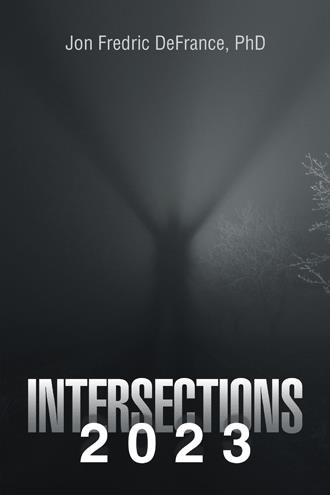
“INTERSECTIONS 2023” is a science fiction tale that weaves together allegorical themes, exploring the tension between moral values and inherent human biases. The story goes beyond cinematic classics like “Close Encounters of the Third Kind” to delve deeper into these enduring conflicts. Within the pages, a vital message emerges: the survival of our civilization likely hinges on our willingness to seek mutual understanding of others—a challenge that could very well become existential in the future (literally). Serving as a sequel to “INTERSECTIONS 2021,” the central plot revolves around humanity’s responses to an existential threat looming over Earth. For civilization to have a chance, the government has to find a way to reach an agreement with the extraterrestrials while keeping the public in the dark through denials and cover-ups. Throughout the narrative, intense debates arise over whether to put faith in those who are fundamentally different, leading to the key theme of the significance of truly understanding one another. Rich in intrigue, the story is also infused with emotion, ranging from lighthearted humor to moments of great sadness. Characters demonstrate courage and determination as they navigate the frustrations stemming from mistrust and conflicting agendas. The varied themes not only spark the imagination but also resonate with the essence of the human experience. Although fictionalized, these themes highlight empathy as foundational for mutual understanding and raise significant questions concerning our current climate of fake news, conspiracy theories, and social divisiveness.
About the Author
Dr. DeFrance is a highly regarded clinical neuropsychologist and neuroscientist. A popular lecturer and author of numerous scientific articles, he draws on his background to provide a rich, factual context for “INTERSECTIONS 2023.” Like his prequel “INTERSECTIONS 2021,” Dr. DeFrance delivers an educational and entertaining story.