
Stories From A Curious Life
by
Book Cover & Preview Text
The Footprints of Change Pedro E. and Angel Herrera stood at my side in a small empty storefront. “Don’t you need more space?” asked the landlord who was showing us a vacated space with peeling walls. “It would be easier, but we can start here,” I said. Pedro had musical talent and played the saxophone. Angel wanted something to happen in his neighborhood besides the perpetual drug dealing, whistling prostitutes, deteriorating apartments, and traffic-interrupted stickball on the narrow, garbage-prone streets. “This is going to be great,” said Angel, “our own theater.” Once the landlord collected the $125 rent plus security deposit, we were good to go. Pedro looked over the walls with the eyes of Mexican mural painter. “Stripes is what I see,” he said. “Broad stripes, black and white, when you enter. The stripes get narrower as they reach the stage.” He walked to the back of the store, turned, and faced an imaginary audience. “Guess we can seat about thirty,” he said. “Forty in a squeeze.” Before you knew it, we had fashioned footlights from discarded food cans, created a foot-high stage from discarded plywood and painted those walls with zebra-like vertical stripes like Pedro had envisioned. We even put out a call for new plays to encourage local playwrights. Hugh, an amiable AFSC volunteer with musical and theater experience, agreed to be our director. El Pequeño Teatro opened after two months – first with the mystery, Sorry, Wrong Number, then two short plays, one in Spanish, one in English. A new AFSC volunteer, Laura, took the role of lead actress in Sorry, Wrong Number, playing a vulnerable, bed-ridden woman casting her net for someone to intervene and stop her threatened murder. A thin soft-spoken young woman, she settled into the stage role as if it were made for her. What I remember most is Angel as a precinct police chief. Although we could only see his face, lit up by a desk lamp, he milked every moment, enjoying his chance to be a man “in charge.” Audience ticket fees, a dime or so, were not paying for the costs so my mother, always interested in matters creative, stepped in to cover the rent and keep us going. We were able to do several different productions including a comedic excerpt from Shakespeare’s Midsummer Night’s Dream. El Pequeño Teatro awoke my love of theater, which would follow me the rest of my life. After the last performance of the Shakespeare excerpt, I had to walk around the lake in North Central Park a good ten times, just to come back to earth. Out of nothing but willing hearts we had created a cultural event. My two-year term as volunteer with AFSC soon ended, as had my alternative service as a conscientious objector. But I didn’t want to leave the East Harlem team and I needed a job. Along with Pedro E. I began working for a painting contractor who specialized in apartment fire escapes and office buildings. Fire escapes were fine. It took intricate handwork to fully cover the many rods and railings and landings. Somewhat clumsy at hand-eye coordination, I invariably covered my work clothes with layers of orange base paint or the black finishing coat. Seeing me at the end of the day, my co-workers joked that I should join the circus. One day the boss transferred me to painting the window frames of a downtown high rise, suspended on a scaffold thirty floors above traffic. Now I was amongst professionals, who jiggered and adjusted pulleys, cinched rope and had the precision to paint the frames and not the glass. Visions of losing my balance from that high perch unnerved me and I soon resigned, leaving the high-rise gig to more sturdy workmen. I noticed that a Kingdom Hall of the Jehovah Witnesses had just begun construction eight blocks from my home. Could I sign on here as an apprentice carpenter? I approached an official-looking gentleman in a long black coat, who turned out to be the construction supervisor and architect. “I have experience,” I said and gave him the name of a construction company that had briefly hired me to renovate apartments. An older craftsman took me under his wing. Hauling boards soon gave way to nailing joists into place and sawing braces with a skill saw. All the workers were members of the Jehovah Witnesses except me. A fellow named Bill, just my age, became a friend and subtly suggested I attend some of the weekly lectures. During lunch breaks, the workers gathered on the recently installed rafters of the building and played Twenty Questions. One would think of a Bible character and it was the job of the others to figure out who it was. From assemblies back in school days, I knew a few such names: Moses, Jesus, Peter, Noah. That was about it. The experience gave me a window into the faith-centered culture of the construction crew, a far reach for someone with leanings to be a Quaker.
Formats

Book Details
About the Book
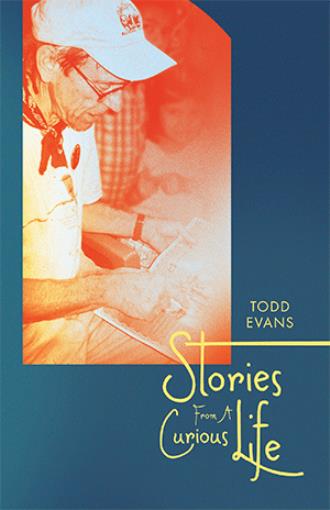
Stories From A Curious Life will take you far beyond the ordinary. Through these pages, you’ll follow one man’s quest to live a life of purpose, exploration, and discovery. Todd Evans’s journey began in the gritty neighborhoods of New York City and Cleveland, where he learned firsthand about resilience and struggle. His path took him to the halls of a religious seminary, into a soul-searching retreat in Switzerland inspired by Carl Jung, and onward to Czechoslovakia, where he sought to understand the tensions between East and West. In Switzerland, he pioneered a recreational therapy program in a psychiatric clinic before returning home to an America wrestling with its own identity — marked by Vietnam, the drug crisis, and shifting gender roles. Settling in rural California with his family, he founded a retreat center for those yearning for connection with nature. Outraged by U.S. support for the Contras in Nicaragua, he joined a protest that landed him in jail for a night — an experience that led him to help start a nonprofit building schools in Nicaragua and El Salvador. Join the author as he recalls a life emerging from a privileged life and finding joy in service to others.
About the Author
Todd Evans, who was brought up with unusual privileges, felt compelled to defy social expectations. He lived in East Harlem, attended religious seminary, and pursued Jungian studies. Settling down to country living, he raised goats, founded a retreat center, and fathered two boys. He spent his later years building schools in Central America.