
Realistic Optimism
The Greatest Threat in AI Isn’t the Technology—It’s How We Choose to Adopt It!
by
Book Cover & Preview Text
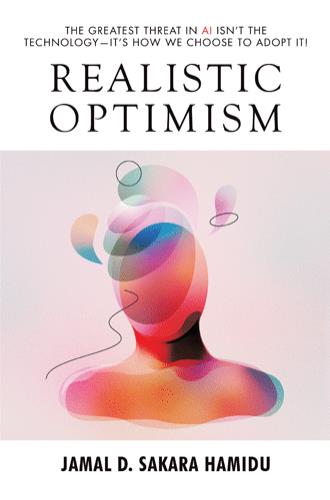
Prologue “The problem is not the problem. The problem is your attitude about the problem.” - Pirates of the Caribbean: The Curse of the Black Pearl (2003) Imagine being handed a packet of extraordinary seeds—each one capable of growing into a tree that offers shade, nourishment, and lasting beauty. Yet that promise means little without deliberate care—knowing when to water, fertilise, and prune. Without it, they may wither long before their potential is realised. AI, like those seeds, holds extraordinary potential—but without thoughtful stewardship, that promise risks being wasted—or misused in ways that harm people, systems, and trust. Beyond the hype and the fear lies a more grounded question: How do we cultivate an AI future that is both powerful and people-centred? AI is one of the most consequential technologies of our time—but its rise brings a mounting dilemma for organisations: move fast and risk instability, or proceed cautiously and risk falling behind. What’s needed is not speed or caution alone, but balance—an approach that enables innovation without sacrificing stability, ethics, or long-term alignment. While many now recognise AI as more than a technical upgrade, the transformation models guiding adoption haven’t caught up. They remain static, siloed, and poorly equipped to handle AI’s systemic complexity—overlooking foundational needs like organisational readiness, cultural integration, ethical design, and governance alignment. The consequences are familiar: fragmented strategies that chase short-term wins while ignoring long-term strategic coherence. Success is still measured by narrow, legacy metrics—missing AI’s deeper behavioural and trust-related impacts. And most critically, people are brought in too late—treated as end-users rather than early partners. This erodes trust, fuels uncertainty, and compounds resistance. Even when ethics are addressed, they tend to be retrofitted—treated as checklists or reputational safeguards rather than embedded capabilities. Beneath this sits a deeper issue: oversight structures are reactive, inconsistent, or missing altogether. All of this is made harder by the polarised narratives that dominate the conversation. On one side: utopian hype—AI as an unstoppable force to be embraced uncritically. On the other: dystopian fear—AI as a threat to jobs, fairness, and stability. Stuck between these extremes, many organisations are paralysed—what emerges is not strategy, but strategic decision paralysis. A New Approach to AI Adoption To bridge this gap and address the strategic decision paralysis, organisations need an approach that is dynamic, inclusive, and grounded in responsibility. It must incorporate continuous feedback, cultural readiness, and governance from the outset. It must centre human experience—recognising that trust, emotional readiness, and meaningful engagement are just as important as technical capability. Above all, it must integrate organisational, technical, cultural, and regulatory dimensions holistically. AI adoption must be fast—yet equally strategic and sustainable. This understanding became deeply personal during an unexpected encounter—not with technology, but with a factory worker I met in a London café. He feared losing his job to automation. His anxiety was met with a vague corporate response, not genuine understanding. That moment stayed with me. Not as a failure of communication, but of leadership. It underscored a core truth: successful AI adoption is not about tools—it’s about trust. It’s about transparency. It’s about the courage to confront discomfort. Reflections like this led me to one of the foundational principles in this book: The Emotional Cost of Change—the pain people experience when their sense of role, identity, or value begins to shift. Recognising this cost is not a side issue—it’s a strategic imperative. But discomfort doesn’t only come from within organisations—it also arises from the narratives shaping how we talk about AI. Too often, the public conversation swings between extremes: on one end, utopian hype; on the other, dystopian fear. What’s missing is a posture that can hold both promise and risk in the same frame—without denial, distraction, or delay. That’s why I’ve called this book Realistic Optimism: a lens that acknowledges AI’s potential while confronting its risks with clarity, maturity, and responsibility. In these pages, I introduce a new approach that reconciles the urgency of rapid AI adoption with the responsibility of sustainable transformation. Drawing on years of consulting and hands-on industry experience, I present The RAPP Way™—a future-ready strategic change management methodology for responsible AI adoption, anchored in four guiding philosophies: Responsible, Adaptive, People-Centred, and Purpose-Driven. At its core is The RAPP Implementation Framework™—the execution engine of The RAPP Way™—which provides a structured, four-phased pathway for translating its philosophies and principles into practice. This framework aligns technical execution with cultural readiness, ethical governance, and long-term strategic ambition. Unlike books focused solely on technology, compliance, or abstract change theory, Realistic Optimism tackles the most overlooked barriers to AI adoption—including the strategic misalignment, organisational resistance, capability gaps, poor data quality, explainability, and ethical complexity that traditional change management models often fail to address. These are not just technical hurdles—they’re leadership challenges. The timing could not be more urgent. By 2025, an estimated 89% of small businesses will have adopted AI—but many still lack the structures to do so responsibly. At the same time, global regulatory shifts—like the EU AI Act—are demanding that organisations rethink their approach. The risk of inaction or mismanagement has never been higher. Who This Book Is For – In 300 Words Realistic Optimism is for those ready to move beyond AI’s hype-versus-fear divide. It offers a grounded, strategic, and human-centred path to adoption. For business leaders, it’s a guide to adopting AI without losing cultural or strategic focus—combining innovation with ethics and long-term value. For policymakers and regulators, it offers frameworks for forward-looking governance that protects trust while supporting responsible progress. For change professionals, it introduces a methodology to build AI-ready cultures and navigate the emotional impact of transformation. For academics and students, it offers insight into the societal and leadership shifts AI demands. Across audiences, Realistic Optimism connects AI to real-world systems—offering clarity, strategy, and a model for adoption that prioritises both speed and responsibility.
Formats

Book Details
About the Book
In the age of AI, leadership does not follow technology. It shapes its trajectory. Artificial intelligence holds extraordinary potential. Yet without thoughtful stewardship, that promise risks being wasted or misused in ways that erode trust, destabilise systems, and harm people. The question is not whether AI will transform our world, but how leaders choose to shape that transformation. How do we harness AI in ways that are powerful yet people-centred? How do we move at pace without sacrificing trust, cultural readiness, or Inclusive AI by Design? Grounded in enterprise experience and lived insight, Jamal D. Sakara Hamidu offers a practical guide for leaders determined to act with urgency, not haste; to lead with inclusion by intention, not exception; and to embed ethics, culture, and sustainable value at the core of AI transformation. Drawing on deeply transformational work with global organisations, from EY to Deutsche Bank, and on his experience building Barika Intelligence, he presents a compelling alternative to hype-fuelled manifestos and fear-driven narratives. At the heart of this book is The RAPP Way®, a future-ready methodology designed to help organisations confront the real challenges of AI adoption: ethical complexity, evolving regulation, cultural resistance, workforce readiness, the emotional cost of change that accompanies transformation, and the short-term pressures that too often derail long-term success. Realistic Optimism offers a bold and balanced path forward for executives and policymakers seeking to lead with purpose, foresight, and integrity in the competitive age of AI.
About the Author
Jamal D. Sakara Hamidu is a strategic change leader and the architect of the RAPP Way™, a strategic change methodology for responsible AI adoption. He is the founder of North Sakara Consulting and of changeportal.ai, a platform equipping organisations with practical tools and frameworks to lead enterprise-wide AI transformation. Originally from Ghana, Jamal began his career with Newmont Mining Corporation in Accra before launching his consulting career at EY in London, where he advised financial services clients on large-scale transformation. He went on to serve as global culture and capability lead at Deutsche Bank’s Chief Data Office and has since worked in partnership with organisations including Shell and AstraZeneca to strengthen cultural readiness and lead digital adoption in complex regulated environments. Jamal holds a bachelor’s degree in computer science from RMIT University in Melbourne, holds an MBA from the University of Dundee in Scotland, and has completed executive training in design thinking at the MIT Sloan School of Management. He is also a proud alumnus of Tamale Senior High School (Tamasco) in northern Ghana. Jamal is the author of Realistic Optimism: The Greatest Threat in AI Isn’t the Technology—It’s How We Choose to Adopt It, where he argues that AI’s future will be determined not by algorithms but by how leaders choose to adopt and govern AI.