
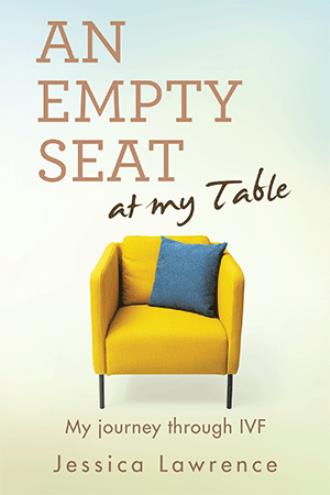
An Empty Seat at my Table
My journey through IVF
by
Book Cover & Preview Text
On July 29, 2021, just a day after Rosie’s 12th birthday, Joe and I attended a pivotal meeting with Dr. Michael Glassner, our fertility specialist. It had taken years to get to this point—a meeting I had dreamed of yet feared might never happen. For me, the day carried a weight of significance. It wasn’t just another appointment; it was the culmination of years of longing, compromise, and heartbreak, all channeled into a single opportunity to move forward. I had meticulously prepared for this moment, both practically and emotionally, determined to approach it with the seriousness and care it deserved. Earlier that morning, I had a rare weekday hair appointment—something I typically reserved for weekends but had scheduled to align with the meeting. Walking into the meeting later that day, I felt polished and confident, ready to present the best version of myself for what I believed was one of the most important discussions of my life. I had even shared the significance of the meeting with Rosie, who was at summer camp. Though I didn’t delve into the details, I wanted her to know that this was a step toward fulfilling the dream of giving her a sibling, a dream she had once innocently shared when she was younger. Sitting across from Dr. Glassner, I could feel the layers of my emotional investment pressing against my composure. He outlined the process with the precision of someone who had guided countless families through similar journeys. The remaining embryo would first be thawed and transferred. Before the transfer, I would undergo a series of rigorous preparations, including an Endometrial Receptivity Analysis (ERA), to pinpoint the optimal timing for implantation. Bloodwork, a hysteroscopy, and clearance from my perinatologist were also required, particularly given my advanced maternal age of 53. While the logistics were overwhelming, the statistics provided a flicker of optimism. According to Dr. Glassner, the success rate with our remaining embryo stood at an encouraging 65%, significantly higher than the 45% associated with adopting a embryo. He emphasized the importance of focusing on one clear path rather than splitting efforts across multiple options, a recommendation with which Joe seemed to agree. I clung to those numbers, letting them fuel my resolve even as I mentally braced for the grueling road ahead. The meeting ended with plans laid out, a list of medical and procedural steps that I eagerly began tackling. Despite the challenges and my lingering fears about Joe’s reliability, I left the meeting that day feeling cautiously hopeful. For the first time in years, the path toward expanding our family seemed tangible, within reach. I allowed myself to dream, if only for a moment, that this time would be different, that this effort might finally bridge the gap between my hopes and reality. In the days following our meeting with Dr. Glassner, I dove into the extensive preparations required for the embryo transfer. The checklist was daunting—bloodwork, a hysteroscopy, scheduling the ERA test, and securing clearances from my perinatologist and cardiologist. Each step felt like a small victory, a tangible marker of progress toward a dream I had long held. Yet, even as I meticulously worked through these tasks, Joe’s participation was minimal at best. While Joe had agreed to proceed with the plan outlined during the appointment, his involvement was perfunctory. There was no shared excitement or collaborative effort, just his quiet compliance. I tried to take comfort in his lack of active resistance, telling myself that his agreement—however reluctant—was still a step forward. But deep down, the fragile nature of his commitment left me uneasy. This imbalance in effort wasn’t new. Over the years, I had grown accustomed to carrying the emotional and logistical weight of our family’s plans. Still, I couldn’t shake the hope that this time might be different, that perhaps his passive agreement was a signal of latent support waiting to surface. I clung to that hope, fragile as it was, and used it to propel myself through the relentless pace of medical preparations. With every form submitted and every test scheduled, I allowed myself to dream about what this journey could mean for our family, for Rosie, and for me. At the same time, I carefully managed my expectations, keeping my emotions in check to guard against the inevitable disappointments that came with years of navigating Joe’s unpredictability. It was a balancing act—hope and realism, optimism and caution—all woven together into the fragile fabric of my resolve to move forward. Two months into the process, just as I began to feel the faint stirrings of hope, everything unraveled in the most unexpected and devastating way. Joe had changed his mind. It wasn’t Joe who informed me of his change of heart—there was no conversation, no explanation, not even a terse acknowledgment of his decision. Instead, it was a phone call from the clinic that shattered the fragile sense of progress I had built. Terri Jamison, the clinic coordinator, delivered the news in a measured tone, but the words struck like a hammer. “We’ve received written instructions from Joe to halt the proceedings,” she said. My breath caught as the weight of her statement sank in. I couldn’t believe what I was hearing. Joe had written to the clinic not once but twice, unilaterally deciding to stop the process without so much as a word to me. My immediate reaction was disbelief, quickly followed by a wave of anger and heartbreak so profound that it left me stunned. The betrayal cut deeply, not just because of his decision but because of how I had found out. Joe’s choice to communicate with the clinic instead of me spoke volumes about his disregard for my feelings and the shared journey we were supposed to be on. After months of meticulous planning, tests, and emotional preparation, I was blindsided, left to process the magnitude of his actions on my own. The lack of communication was more than just a lapse in courtesy—it was a cruel dismissal of everything I had invested in this process. Joe knew how much this meant to me, and yet he had chosen a method that left me not only excluded but humiliated. The man I had trusted, the one who had agreed to move forward, had pulled the rug out from under me without even the decency of a conversation. It was a rejection of my dreams, my efforts, and, most painfully, my worth as a partner. In that moment, the marriage felt irreparably fractured. I sat in silence, the phone still in my hand, as the weight of the betrayal settled over me. The sense of isolation, of being completely alone in this marriage, deepened to a point I hadn’t thought possible. Joe’s actions weren’t just a refusal to proceed—they were a statement that my dreams and my voice didn’t matter. And that realization was devastating. As I processed his response, I felt a wave of helplessness and anger. His rejection of the option of adopting an embryo, and then of the affidavit, and finally of the process of implanting our own embryo felt like a rejection of me—of my agency, my desires, and my ability to create a future that brought me joy. It was yet another reminder that my journey, as deeply personal and meaningful as it was, would never find support or understanding in him. And with that realization came an unshakable certainty: if this dream were ever to become a reality, it would have to be on my terms, without him.
Formats

Book Details
About the Book
An Empty Seat at My Table is a memoir rooted in longing—for a second child, for love, for autonomy—and the often silent sacrifices women make in pursuit of all three. At its heart, this is a story of motherhood earned through relentless determination and deep personal cost. When I left the UK at 35, I believed I was heading toward a bright future: a career in the U.S., a promising relationship, and the possibility of becoming a mother. Instead, I encountered a toxic marriage, an unplanned pregnancy I was coerced into ending, and a long, emotionally brutal struggle with IVF. I wrote this memoir for every woman who has made sacrifices she could not take back, for anyone grappling with infertility, reproductive choices, or emotionally manipulative relationships. It’s a story of how dreams bend but don’t break, how love for a child can anchor you, and how reclaiming your story—even later in life—is an act of profound power. This isn’t just a story of motherhood. It’s a reckoning with regret, a love letter to resilience, and a guidepost for those navigating the murky waters of fertility treatment and marital coercion. My hope is that it becomes both mirror and map: a place where others see themselves, and a path forward they can claim.
About the Author
In her very private life, she felt the most powerful when she gave birth to her daughter in 2009, created as a result of her 4th round of IVF. Now, for more than one decade, her mission has been to provide a sibling and to become a mother again. This journey has been challenged by an emotionally manipulative relationship with her partner however the author has never given up hope. She is an athelete who has been ‘training for life’ since her late 20s and in the last 5 years has found support and motivation through the Peloton community, without whom the courage to tell her story would not have been possible.