
Cloak and Dagger
The Verndari Origin
by
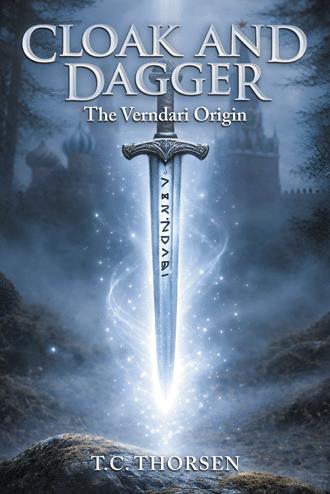
Book Cover & Preview Text
As they removed the shield, setting it aside for protection and preservation, the breastplate was exposed, now bringing attention to the markings revealed on its surface. Brendan could still see the strange silver glow coming from just beneath the breastplate, to the right side of the giants remains. He was more eager to discover the origin of the glow than he was what secrets the breastplate might disclose; however, his archeological training forced him to take the excavation slowly and catalog everything as it was removed. Everyone’s attention turned to the rune markings carved intricately into the breast plate. The breastplate was ornately designed with gold and silver accents bordering the edges, and the rune engravings appeared to be inlaid with gold. The design of the breastplate indicated it belonged to someone of stature more than a typical warrior. Brendan took a brush to the breast plate and carefully swept away the accumulation of dust and sand from centuries underground. The breastplate was in pristine condition, as if it had been buried just yesterday. The rune markings were clearly legible, and translations began from memory as much as possible. Natasha had the most experience with her studies of rune translation, so she made the first attempts at reading the markings. “I can read this inscription for you,” Natasha started. “Name at the top in larger rune marking, I am not certain but marking after say husband to another name I cannot recognize. This is most important marking. Next, it says father to Gerd, wife of Freyr. This marking I am certain. Below this inscription is final rune saying Verndari, Sword of Freyr. This word verndari is from old Norse and translate as, protector.” Brendan and Lionel stood almost speechless at Natasha’s translation. “Are you certain of this last part?” Brendan asked. Natasha continued, “Da, I have seen marking for Freyr on rune stone we find at the start of dig. I also did research in life about sword named Ingrid. The Ingrid sword was forged by dwarves in Norse mythology and had been passed down to several warriors throughout history. It said that blade so sharp that it cut through any material and give warrior special ability. I find connection that Ingrid sword is actually Sword of Freyr. It known as protector of gods. It given to Freyr by Odin. This word in old Norse language, verndari, is referenced in sagas from Iceland and Norway referring to Freyr’s sword.” Brendan, on a hunch, took out his cell phone and quickly did a search for any rune markings that could be translated as Gymir. He found a reference that confirmed the name on the top of the breastplate as Gymir. Next he searched for Gymir’s wife’s name Aurboda. This search also came back, confirming Aurboda, who was the mountain giantess, wife of Gymir and mother to Gerd. Brendan’s heart was racing. He shouted in excitement, “We have found Gymir!” He showed everyone the results of his search on his cellphone. “This is his rune marking. Gymir is the husband of Aurboda, the mountain giantess, and father to Gerd who was the wife of Freyr. Gymir is the warrior interred before us, the Frost Giant, Gymir, of Jotunheim. Now we have proof of the existence of the Hrimthursar, the race of Frost Giants from Viking mythology. Or should I say now, Viking history.” ********* RFS Kopye Captain Ponomarev was eager to start on his westerly track across the Atlantic. He was a true, red-blooded Russian patriot and was eager to find himself in a position to protect his countries interests. “Comrades, this is where we make our departure from the fleet. Helmsman, make your new heading two-seven-zero degrees, ahead full. Make our depth one-hundred-fifty meters.” The helmsman responded, as is customary, with a repeat of the orders from the Captain, “Coming to two-seven-zero degrees, ahead full. Down bubble to a depth of one-hundred-fifty meters, aye.” USS Mississippi On military vessels, it’s traditional for official communications between the command and navigational structure to be called out with the department being called to be named first, then to identify who is calling. In this example, the Conn, or commander of the watch being referred to as Conn. Then the person calling identifies himself by his position. In this case the sonarman Petty Officer Grey. “Conn, Sonar. Captain, our Borei contact is making a turn to port and increasing speed. Increasing depth as she goes.” Captain Roy knew that prudent Russian submariners often would make course changes without warning, just to see if they could shake loose anything or anyone who may be following. It was an old tactic used during the Cold War to flush out anything that may be hidden in their baffles. Exactly the position the Mississippi was in now. The maneuver was called a Crazy Ivan. It was, however, unusual for them to increase their depth at the same time. He had to think fast and decided how to follow her lead. “Helm, Conn. Come to port ten degrees rudder, and five degrees down plane. Match her speed.” “Aye Captain, coming port ten degrees, five degrees down plane, increasing speed.” “Sonar, Conn. Report current depth of the Borei boat as she descends. Helmsman, maintain position in her baffles.” The reply came from both the sonar and helm to follow the Captain’s orders. Captain Roy thought to himself. “Just what is our friend doing?” He took a headset for himself to listen in on the sonar for any subtle changes. Again, thinking to himself, “I just got into a perfect spot, we’re not going to give up our position now. Keep calm and patient until we know what he’s up to.” Petty Officer Grey on sonar reported, “Conn, Sonar. She’s settling on a heading of, two-seven-zero degrees, sir. Due west. Speed steady at twenty-five knots. Depth passing ninety meters and still descending… ninety-five meters… one-hundred meters… “Helm, Conn. Match her heading at two-seven-zero degrees and continue down plane. Increase speed to match hers at twenty-five knots and maintain distance in her baffles.” “Aye Captain, two-seven-zero degrees steady. Passing ninety-five meters, maintaining a down bubble. Steadying speed to twenty-five knots.” It wasn’t long before the Kopye settled at one-hundred-fifty meters depth and maintained her steady course to the west. The U.S.S. Mississippi also settled into a comfortable, but close distance of only fifty meters astern of the Kopye, perfectly hidden in her baffles, as they crossed the Atlantic Ocean together. Captain Ponomarev was never aware of the U.S. attack submarine, directly on his tail.
Formats

Book Details
About the Book
“Cloak and Dagger” is far more than a non-stop adventure. It’s a thrilling blend of history, mythology, family, science, and political intrigue with a touch of romance woven in. Perfect for fans of stories that merge ancient legend with modern intrigue. What if the myths of the Viking gods were not mere stories, but memories of real events, and the weapons they wielded were forged with technology far beyond their time? Dr. Brendan Watkins, an archaeologist specializing in early Viking history, never expected to uncover proof. He discovers the grave of a Frost Giant named Gymir and unearths a weapon unlike any other; the legendary Sword of Freyr. The weapon is said to fight on its own and grant invincibility to its wielder. When the Russian president–possessed by the spirit of Loki–steals the sword, he plans to use its powers along with other advanced technology to dominate the world. Brendan’s sister discovers he has a secret weapon of his own–an inherited talent that gives him unique abilities. With the aid of his cousins, who each have their own specialized skill set, and his grandfather, a former mission planner for military special operations whose lineage connects him to the ancient Viking kings, they break into the Kremlin vaults and steal back the sword, protecting the world from Russian domination. Together, they become the Verndari – the Protectors.
About the Author
T.C. Thorsen is the direct descendant of many early kings from Norway. He served in the U.S. Air Force with the First Special Operations Wing as a Combat Readiness Specialist and had a career as a ship captain for almost forty years, affording him a lifetime of adventures.