
BUILDING MATHEMATICAL POWER THROUGH UNDERSTANDING ARITHMETIC
by
Book Cover & Preview Text
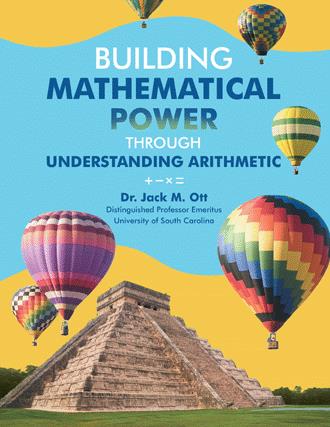
Feeling frustrated with math? Does it seem like a jumble of rules you just have to memorize, with no logical reason behind them? You're not alone. For countless individuals’ math is a source of anxiety—a series of disconnected steps performed without ever truly understanding the "why." But what if there was a better way? What if you could build a strong, lasting foundation in math that empowers you to not just get the right answer, but to truly understand and apply the concepts? This book is your gateway to that understanding. It will transform your approach to mathematics by moving you beyond rote learning into a place of genuine confidence and competence. Written by Dr. Jack M. Ott, a distinguished professor emeritus with a Ph.D. in Mathematics Education and over 40 years of teaching experience, this book presents a proven methodology for mastering mathematical skills. Dr. Ott's background, from public school teacher to professor at universities like USC and Toronto, gives him a unique perspective. He understands the challenges faced by learners at every level and has crafted this resource to address them directly. It’s an essential tool for anyone looking to conquer their math anxieties and build a deep, unshakable understanding of the subject. ________________________________________ The Problem with Rote Learning: A Picture Puzzle Analogy The first chapter of this book tackles the most fundamental issue in math education: the difference between rote learning and genuine understanding. To illustrate this, Dr. Ott uses a powerful analogy of a picture puzzle. Imagine you dump a box of 1,000 puzzle pieces on a desk and are asked to tell me what the final picture is. You would, of course, say it's impossible. All the information you need is there, but without any organization, the pieces are meaningless. Your mind is overwhelmed by a chaos of disconnected facts. Now, imagine a different scenario. I show you that same puzzle, but it's already mostly completed with just a few pieces missing. Suddenly, everything clicks. You can instantly see the big picture. You know what the puzzle is about and can even predict what the missing pieces look like. The same information is present, but because it is organized and connected to a larger whole, you have immense power to understand, retain, and predict. Mathematics is no different. When we learn math through rote, it’s like being handed a pile of puzzle pieces. We can follow instructions to perform a task, but we have no concept of why it works or how it connects to the greater picture. This book, however, is your guide to assembling the puzzle. It helps you see the beautiful, logical relationships between concepts, giving you the power to apply your knowledge to any new problem you face, even those you've never encountered before. ________________________________________ Making Arithmetic Click: Understanding vs. Rules The core of this book, in Chapters 2 through 17, applies this philosophy to the very foundation of math: arithmetic. While traditional instruction often focuses on memorizing abstract algorithms, this book emphasizes understanding as the key to true proficiency. The skills are crucial, of course, but without understanding their purpose, their usefulness is blunted. Consider adding fractions. Most students learn a rule: "Add the numerators and place the result over the common denominator." This rule works for a problem like 1/8+5/8, but it provides no insight into why it works. For a student, this is just a memorized action, a piece of a puzzle without any context. This book offers a more intuitive approach. It teaches you to see fractions as a unit of measure. The denominator tells you the size of the unit (the kind of piece you have), and the numerator counts how many of those units you have. For example, 1/8 is simply "one eighth," and 5/8 is "five eighths." Adding them becomes as straightforward as adding any other unit. One apple plus five apples equals six apples. In the same way, one eighth plus five eighths equals six eighths. No rote rule is needed—the logic is intuitive and immediately clear. This method extends to more complex problems like 1/3+2/5. This book explains that you cannot add unlike units directly, just as you can’t add apples and oranges. You must first find a common unit of measure—a common denominator—that allows you to convert the fractions into equivalent pieces that can be combined. By teaching the why behind every step, the book turns a complex, multi-step problem into a logical sequence of decisions, rather than a frustrating series of memorized rules. ________________________________________ The Simplicity and Power of Mathematical Language Throughout the book, a consistent theme is the language of arithmetic. Just like any language, math has its own vocabulary, grammar, and syntax. When you learn math through memorization, it’s like trying to speak a foreign language by repeating memorized phrases you don’t understand. You can say the words, but you can’t have a conversation or express your own ideas. This book teaches you to speak the language of arithmetic fluently. It reveals the simplicity and power of its logical structure. When you truly understand the fundamental "sentences" of addition, subtraction, multiplication, and division, you gain the ability to express and solve far more complex problems. This foundational understanding is the basis upon which all advanced study in math and science is built. It’s the difference between being a passive observer of math and an active, powerful participant in the world of numbers. ________________________________________ The Crucial Role of Units of Measure A unique and powerful element of this book is its repeated and thorough treatment of units of measure. Chapters 3, 4, 5, 13, 14, 15, and 16 consistently return to this vital topic, teaching you about the creation, properties, and manipulation of units. In the real world, a number is almost always tied to a unit: 10 miles, 5 gallons, 3 hours. Ignoring units makes numbers meaningless and mathematical problems confusing. By emphasizing the role of units, this book gives you a framework for understanding not just arithmetic, but its application to real-world problems. This focus also lays a solid groundwork for higher-level mathematics. Concepts in algebra, geometry, and especially calculus become instantly more accessible when you understand the foundational role of units in their construction. For instance, calculus is fundamentally the study of change and accumulation, which are impossible to grasp without a firm understanding of rates (like miles per hour or gallons per minute). ________________________________________ The Journey to Mathematical Power The final chapter of this book, Chapter 18, is the capstone of your learning journey. It goes beyond the "how-to" and discusses what mathematical power truly is and why it's so important. Mathematical power isn't about getting a perfect score on a test; it's the ability to reason, to think critically, to solve new problems creatively, and to communicate your ideas mathematically. It's the confidence to tackle new challenges, both in math and in life. This book won't just teach you arithmetic—it will teach you how to think mathematically. It provides the tools and strategies to transform your understanding from a fragile, rote-based knowledge to a robust, deeply rooted ability. For home school parents and students alike, this book offers a complete and cohesive path to mastering mathematics. It’s time to stop struggling and start understanding. Get ready to take the first step toward unlocking your full mathematical potential.
Formats

Book Details
About the Book
Tired of feeling frustrated with math? Do you want to not only understand mathematical concepts but also apply them in a practical, meaningful way? This book is for you. Authored by Dr. Jack M. Ott, a distinguished professor emeritus with a Ph.D. in Mathematics Education, this guide is designed for anyone seeking to master mathematical skills, particularly those in the homeschool community. Dr. Ott brings over 40 years of teaching experience, from public schools to esteemed universities like the University of South Carolina and the University of Toronto. His extensive background ensures that the methods you’ll learn are not just theoretical, but proven to work in real-world educational settings. This book is more than a simple textbook; it’s a practical “how-to” manual crafted to build confidence and competence. Dr. Ott’s previous work includes authoring mathematics materials for major publishers like McGraw-Hill and Glencoe, which were used by countless students across the United States. His expertise in creating clear, effective curriculum shines through on every page. You’ll discover straightforward, easy-to-follow methods that demystify complex topics, helping you to finally “get” math. Whether you’re a parent teaching your child or an adult looking to refresh your own skills, this book provides the tools and strategies you need to succeed. Get ready to transform your understanding of mathematics from a source of anxiety into a source of accomplishment.
About the Author
Dr. Ott is a Distinguished Professor Emeritus of Mathematics at the University of South Carolina, where he taught for 26 years. With a 40-year career that includes roles at the University of Toronto and Ohio State University, he’s also recognized for authoring mathematics materials widely used in U.S. middle schools.