
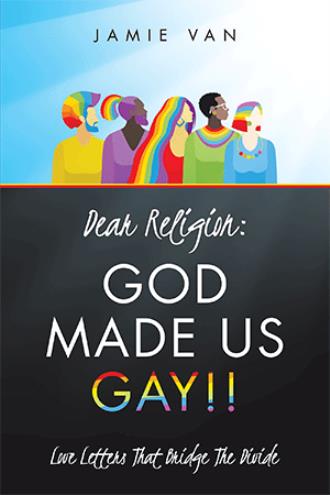
Dear Religion: God Made Us Gay!!
Love Letters That Bridge The Divide
by
Book Cover & Preview Text
Recently, I was invited to supper at the home of a longtime married couple who would definitely consider themselves conservative Christians. Kind, compassionate, and caring folk who knew I was gay. They decided to buck the trend of dispassionate dissidence and, thereby, invited me into their home to “break bread.” And from my side of things, it was an opportunity to “break intolerances.” I live for these interactions, these moments. We have become so entrenched in our take-your-side, “us versus them” perspectives in modern society. Why is that? What happened to making peace with others of opposite opinions? At any rate, whenever I’m lucky enough to find such generosity of spirit combined with a want to understand something that is, historically, such a taboo topic—well, I jump at the chance. Irrespective of their opinions, these people are very courageous, and I wanted to honor that. Dinner was a feast for a king. They had spent hours trying to make everything “just right.” And it was after this lavish spread that the pleasant small talk stopped, and we got down to brass tax. “Why do you choose to be gay,” was the carefully worded question. Resisting the urge to answer with the pat, “Why do you choose to be straight,” I took another path. “I didn’t,” I said, carefully selecting my words, “God chose that for me.” Awkward beat. “But that can’t be; the Bible clearly sees homosexuality as an abomination. God’s mind hasn’t changed on this. The writings in the Bible are as relevant today as they were thousands of years ago—just because we don’t like what it says doesn’t change what is written!!” And then this. “If being gay isn’t a choice, it would mean the Bible got it wrong. Where would that end? Everything we understand to be truth would be in question. The Bible can’t be wrong on this, but right on everything else!” Rarely do these interactions go this far, where the person is opening up so authentically. These people were making themselves truly vulnerable by letting down any guard of pretense. They were baring naked their souls to me. This could have easily turned into an argument, a nice evening that ended on a tragic note. Except, I needed to honor their truth. “And how do you treat your slaves?” Noting their confusion at my seemingly “red herring,” I jumped right in. “Well, for 250 years, African Americans, among many others throughout history, toiled in bondage as devout Christian slaveowners believed that slavery was a God-blessed, biblically ordained practice.” Beat. “Isn’t it funny how—unlike the anti-gay biblical “clobber” passages—these Bible passages, clearly espousing slavery, just aren’t touted around as much anymore?” Awkward beat. “So, how do you treat your slaves,” I further queried. “Are you a harsh master? Don’t get me wrong, such is fine and biblically ordained. Passages such as 1 Peter 2:18—Slaves, in reverent fear of God submit yourselves to your masters, not only to those who are good and considerate, but also to those who are harsh—clearly show God’s approval of such.” Silence. “Or perhaps are you more of a modern, progressive slave owner? Perhaps what Paul said in Ephesians 6:5—Slaves, obey your earthly masters with respect and fear and sincerity of heart, just as you would obey Christ—would seem to reinforce a gentler “new age” version of God-approved slavery.” And then I brought it home. “Would it be fair to say that those Christian white slave owners of two hundred years back just got it really, really wrong? When they used 1 Peter, they cherry-picked the verse as proof that God championed human bondage. But looking at 1 Peter in context, it’s about suffering for God, not an endorsement of slavery. Would it be fair to say, with our present-day understanding of the horrors of slavery, that we’ve finally arrived at where God was all along?” And finally. “I don’t think God has changed Her mind on queer persons at all; I don’t think God ever had an issue with Her gay children. Rather—and here’s a mind-bender—what if we are now just catching up to where God has been waiting for us to arrive all along? What if our loving acceptance of God’s gay children is holy and not sacrilege?” The discussion went on; when the evening came to an end, it was on a good note.
Formats

Book Details
About the Book
Caring members of faith communities are afraid to question queer theology or accidentally use wrong pronouns. Parents of gay kids are catatonic with terror, dread-stricken about their child’s damnable relationship with their Creator. Homophobia is branded on the church that is deemed to practice hate while preaching love. Really? Meanwhile … gay couples seeking God’s blessing on their marriage are deemed lewd and sinful. Drag queens are cast as the new pariahs endangering our children while the horrors of conversion therapies are forced on gay youth. Non-binary individuals are coerced into one of only two genders, and trans people are vilified for embracing their authentic selves. Really?? Amidst all this, where is God? Is there any place in “religion” for us queer folk? Can we ever bridge the divide? Dear Religion: God Made Us Gay!! is a thought-provoking memoir exploring author Jamie Van’s experience as a non-binary gay teacher who has navigated the challenges of bullying, bigotry, hatred, and religious trauma. Through a series of personal reflections and hopeful letters, they share the encouraging lessons they’ve gleaned from these experiences. A lifeline for both the church and queer people, this memoir affirms queer spirituality through letters of God’s unconditional love, lived experience, and spiritual reclamation.
About the Author
Jamie Van is a multiple award-winning high school teacher and author. They have spent decades advocating for gay and questioning kids, through challenging an educational system that was dedicated to the silent destruction of anything “queer.” They would pay with their career, but would none-the-less change many young lives.