
THE BEST LITTLE PRISON IN THE WORLD
(OR FIVE PRISONS)
by
Book Cover & Preview Text
CELEBRATING CHANGE Over many years, I have taught a management course in a master’s degree program at John Jay College of Criminal Justice. We are located right in the center of Manhattan. My course focuses on understanding and improving management of systems to protect assets; that is, how managers work through others to achieve their goals. I love this course. Prison transformation is a topic that I sometimes mention with my students (I call them scholars). This topic has interested me for years. After all, prisons need to be improved (they really do!). And changes in management can do it. How can this goal be achieved? A holistic management approach could reach that goal, though a legislative appetite to support better incarceration would have to be the enabler. Sometimes my scholars have written reports on how they would transform these gigantic dystopic institutions. Then in one class I created a group exercise on the topic. The goal would be to revolutionize management of incarceration to achieve better results. This solution would derive from my scholars who generally have no specialized experience about prison operations. Using management thinking and doing some research, they would come up with a model that would vastly improve the results from incarceration. Or could they? I thought, tell the story of what happened from the classroom. The following tale is based on true events. Certain language and circumstances are created for the purposes of dramatization. The scholars’ names are actual but quotations attributed to them are willy-nilly. The metagenesis of a high-security prison was the goal. I’ll get into details soon about how the process enfolded. Something needs to be explained about John Jay. All colleges and universities are unique in their own ways, but John Jay is quite different from others. Its genesis began as a kind of joint venture in the 1950’s between the New York City Police Department and the Baruch College division of the City College of New York. Policing always is in constant flux, especially in cities. In the 1950s and early 60s, the NYPD brass determined that policing would benefit from developing officers who possessed more than a high school diploma. Times were changing. Education at the new police college program initially was offered only for actively serving police officers. Classes were scheduled at an ad hoc faculty at the Police Academy. Many of the same classes were scheduled in the morning and late in the day. That way police officers could attend class after completing a night shift or after a full day’s tour. If their shift changed, they’d still make class. Those precious two or three hours in a classroom would provide rigorous post-secondary education. Standards would be no less demanding than in regular liberal arts curriculum. This made for a long, intense day of work and study. But most police officer-students found the experience exhilarating. The NYPD clearly also benefitted. From a tenuous beginning the academic program gained political support. With the tumultuous, disruptive times beginning in the early 1960’s, the need for a cadre of better educated police officers grew clearer with each passing day. Educated officers performed better on the job. Research established that. Why not create a dedicated College of Police Science as a few other nations already had envisioned? The City and State formally approved the new institution in 1964. The curriculum included police-related topics, of course, but also a full spectrum of liberal arts courses, like in any liberal arts college leading to an accredited baccalaureate degree. Then a change occurred. Open admissions widened opportunities for all comers interested in criminal justice and its related subjects. Police studies expanded to encompass criminal justice and related instruction in forensic science and psychology. The name of the institution was changed to celebrate the achievements of a neglected Founding Father of the nation: an author of The Federalist Papers, a seasoned diplomat, a governor of the state, and the first chief justice of the Supreme Court. The institution now became John Jay College of Criminal Justice. Disciplines that support public risk reduction like mine, security management, were later introduced. Master’s degrees were added. Then doctoral degrees. These graduate degrees attracted generally older, experienced and more independently-minded student-scholars. By the third decade of the 21st century, John Jay enrolled about 13,000 students, including around 2,000 in post-baccalaureate study. It was in one of those master’s degree courses—my course—where this journey begins. In our Protection Management degree program, we educate student-scholars to become inspired risk reduction-centered managers, directors, and executives for the private, public sectors, and non-government organizations (NGOs). Quite a few entrepreneurs emerge as well. Whatever the students’ vocational or intellectual direction, we seek to inspire them to be “fierce advocates for justice” wherever injustice occurs. Our motto.
Formats

Book Details
About the Book
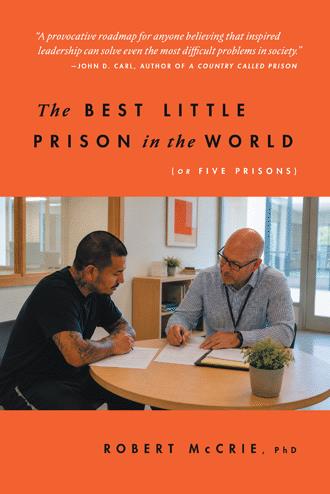
America is the Great Incarcerator. The United States locks up more men, women, and children than any other major nation in history. And then after serving time, so many ex-prisoners are quickly rearrested and most re-incarcerated. Other countries do better. Something has to be wrong. Granted that jails and prisons play a role in public safety, couldn’t the results be better? Wouldn’t better prisons save taxpayers money, but also improve lives, and society as a whole? The author’s graduate students set out to accomplish something unfamiliar for them: how management principles can be used to reduce recidivism (return to prison). Often with humor as they discuss their research, the students engage in a process that produces a novel economic argument and a practical management strategy for prison improvement. Five “admirable” prisons are selected and the context for their development is described. While on his site visits, the author provides some culinary discoveries.
About the Author
Robert McCrie, PhD, is a historian long interested in prison improvement. He is a professor of security management at John Jay College of Criminal Justice, New York City, and has visited over 200 criminal justice facilities in 15 countries. Five prisons in different nations are cited where policies, programs, and results are “admirable.” The author provides context about how these successful institutions evolved, despite obstacles, and how there could be a new day commencing for American corrections.