
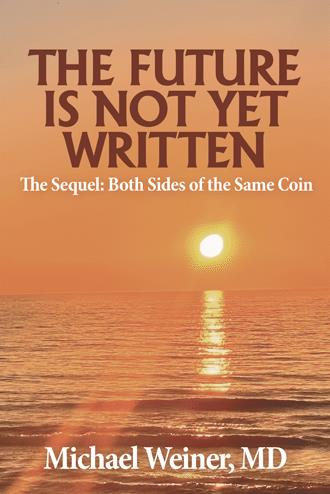
The Future is Not Yet Written
The Sequel: Both Sides of the Same Coin
by
Book Cover & Preview Text
Excerpts from Chapter 1 The terrorist attacks of September Eleven, 2001, had profound, long-lasting consequences both within the United States and internationally. More lives were lost as a result of the destruction of the Twin Towers of the World Trade Center in New York City, the Pentagon, Department of Defense headquarters in Arlington, Virginia, and United Airlines Flight 93, in a field in central Pennsylvania than on the Japanese attack on Pearl harbor on December 7, 1941. The attacks by nineteen al-Qaeda extremists resulted in the deaths of three thousand people: passengers and crew aboard the airplanes, firefighters, police officers, emergency medical personnel, volunteers, investment bankers, bond traders, stock brokers, office workers, visitors, and innocent bystanders. The deceased were not defined by occupation, but rather because they were fathers, mothers, sons, daughters, family and friends. The aftermath of the September Eleven attacks had far-reaching effects, shaped domestic and foreign policy decisions of the United States, and redefined global alliances and events. The United States launched the “War on Terror” against al-Qaeda and the Taliban, invaded Afghanistan, and subsequently Iraq, in search of weapons of mass destruction and potential links to terrorism. Elizabeth Klein lost her husband, Richard, and Greg Josh, Dina and Erica Klein their father. Richard Klein, business leader, entrepreneur, dead; his remains never identified. With a new foreign policy focused on combating terrorism and extremism, the U.S. Congress passed the PATRIOT ACT (Providing Appropriate Tools Required to Intercept and Obstruct Terrorism), which broadened surveillance capabilities to thwart suspected terrorist activities. Marissa Goldstein Carbone lost her husband, Michael, Daniel and Zelda their father. Michael Carbone, brilliant, innovative, dead; his remains never identified. The events of the day curtailed civil liberties, individual freedoms, caused economic disruptions, adversely affected financial markets, negatively impacted air travel and tourism, not to mention the billion-dollar cost of the cleanup and reconstruction. Christine Brown Doyle lost Margaret, her lover and companion, Ellis Williams his wife. Beth and Alex Peabody Doyle, and Stefan and Aisha Williams their mothers. The remains of Margaret Doyle, businesswoman extraordinaire and Olivia Doyle Williams, philanthropist, never identified. The psychological effects of the attacks were profound. Individuals, communities, and the country experienced symptoms of post-traumatic stress disorder (PTSD), a psychiatric condition in people who have experienced a life altering catastrophic event and experience harmful, often severe emotional, physical symptoms that affect mental, physical, social, and spiritual well-being. Lauren Smith Roth lost her husband, Michael, Maribel Roth her father. Zachary Bartell his wife, Rene Roth and Vicki and Denise Bartell their mother. The remains of Rene Roth a dynamic creative architect, designer and industry leader, and her brother, Michael a compassionate physician, oncologist, thought leader were never identified. Recognition of the dead was of paramount importance, families needed closure. Local, state and national authorities employed extensive efforts to identify victims at the World Trade Center site, Pentagon, and Shanksville, Pennsylvania. Forensic pathologists and medical experts painstakingly utilized every available tool, reviewed dental records if available, and DNA analysis whenever possible. The identity of forty nine percent of the victims were never reconciled, Richard Klein, Michael Carbone, Margaret and Olivia Doyle, Michael and Rene Roth among them. Excerpts from Chapter 36 The offspring of the Klein, Doyle, Carbone and Roth families were resilient survivors. They survived the catastrophic deaths of Richard Klein, Michael Carbone, Michael and Rene Roth, and Margaret and Olivia Doyle in the September 11th, 2001, terrorist attack on the World Trade Center Towers. They resurrected their lives as best they could, tried to move on, even when they experienced numerous challenges, including depression, anorexia, cancer, autism, and death. Many of the children graduated from college, began careers, married, and had their own children. During the two decades that followed the terrorist attacks. The country engaged in a war on terror, perpetuated armed conflict in Iraq and Afghanistan. The objective in Iraq was ostensibly to rid the world of weapons of mass destruction and to remove Saddam Hussein’s regime from power. In Afghanistan it was to annihilate al-Qaeda, and kill Osama bin Laden, the terrorist leader responsible for the mass destruction on the World Trade Towers. On the home front, the United States experienced economic turmoil, a severe recession known as the Global Financial Crisis the most severe financial crises since the Great Depression., Lasting from 2007 to 2009, it had far-reaching effects, impacting economies, financial systems, and job markets around the globe. Despite two wars and economic collapse, the Bartells, Williams-Doyles, Kleins, Goldstone Carbones, and Roths were not prepared for what was about to overwhelm not only their families, but the world. In early January of 2020 the World Health Organization became aware of a new coronavirus, SARS-CoV-2, that was first identified in Wuhan, China. The novel virus spread between people, the disease was named COVID-19. The disease spread rapidly, until every continent and most of the world’s countries were involved. The World Health Organization declared the global outbreak a pandemic, and countries around the world implemented measures to limit the spread of the virus. Lockdowns, travel bans, quarantine measures, school closures, and health screenings at airports were implemented. Countries took drastic steps to control the virus, quarantining entire cities, closing borders, and enacting emergency measures to protect vulnerable populations. These measures caused widespread disruptions. Information about the virus was misleading and inconsistent information about mitigation and treatment. governments, the Centers for Disease Control, and other health agencies were in uncharted territory. Despite the uncertainty, health experts emphasized the importance of hygiene, masks, and social distancing to mitigate the spread.
Formats


Book Details
About the Book
The Future is Not Yet Written, the sequel to Both Sides of the Same Coin is a contemporary novel that continues the story of the living members of the Klein, Goldstone-Carbone, Doyle-Williams, and Roth families. It is a generational story that takes place between September Eleventh, 2001, and the COVID-19 pandemic of 2020. These events shaped, molded, and directed the actions and relationships of the fictional characters and families and combines real events with personal drama. The narrative includes many twists and turns, that highlight the unexpected randomness of life as the characters confront and manage common, everyday challenges, such as homosexuality, terminal cancer, anorexia nervosa, depression, post-traumatic stress disorders, and autism.
About the Author
A native New Yorker, Dr. Michael Weiner is a pediatric oncologist, philanthropist and author. He served as the head of Pediatric Oncology and Vice Chair of the Department of Pediatrics at Columbia University Irving Medical Center, New York Presbyterian Hospital. He has written 50 peer-reviewed medical articles and is the editor of Secrets in Pediatric Hematology/Oncology, first and second edition. He founded the Hope & Heroes Children’s Cancer Fund a 501(c)(3) charitable organization that supports research and patients with cancer. He authored The Images of the Babies Hospital; Living Cancer: Stories of an Oncologist, Father, Survivor; Bad Behavior in the Workplace, A Career in Jeopardy; Both sides of the Same Coin.