
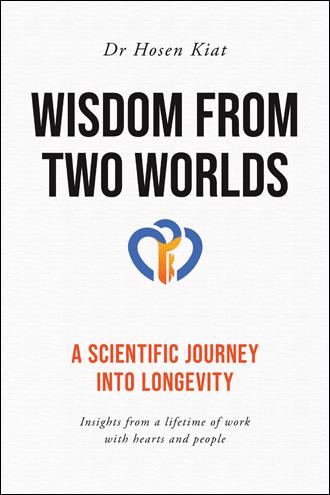
Wisdom from Two Worlds
A Scientific Journey into Longevity
by
Book Cover & Preview Text
My father lay motionless on the cold, sterile table. Tubes snaked in and out of him, leads strewn across his chest. Monitors beeped, their blinking numbers broadcasting his body's silent struggle. The ventilator hissed, forcing air into his lungs – a reminder that even breathing was no longer his own. Nurses, paramedics and staff moved with practised efficiency. It seemed like the entire Emergency Department had converged on this moment. I felt detached and focused, my medical training subliminally clashing with the raw fear of losing the patient, my father.
‘100 mg lignocaine. Prepare for another shock – 200 joules. Another bolus, 1 mg adrenaline, followed by magnesium. Ready for re-shock – 300 joules.’
My voice was steady, clinical, as if it weren’t my own. Another blood draw – ‘pH, lactate, potassium, base deficit, anion gap’. Orders spilled from my mouth, each one a desperate attempt to wrestle him back from the brink.
Beside me, the young medical resident moved fast, relaying orders, hands steady, voice firm. A nurse logged every action with mechanical precision – every drug, every shock, every desperate attempt to pull him back. Time warped. Fifty minutes collapsed into a single moment. I stayed locked in, absorbing every number shouted across the room, every reading from the machines. Heart rate, oxygen levels, acid-base balance – my mind processed them all at rapid speed. My fingers pressed against his femoral artery, searching. My eyes scanned his face, his cyanotic skin, the rigid movement of his chest under the compressions. The team worked with unwavering focus. Every second felt like the edge of something – teetering between hope and the unthinkable.
Despite everything – the shocks, the adrenaline, the relentless effort – his heart refused to hold on. We brought him back nine, maybe ten times, but each revival was shorter, weaker. He was slipping away. Minutes stretched as his heart stiffened, locked in its final grip. Just after 2 am, I made the call. Stop. The nurses stepped back. The scribe noted the time. The beeping sounds gone. The ventilator switched off. The rhythmic hiss that had filled the room for the past hour fell silent. The fight was over. Silence. Just stillness, thick and absolute. I stood there, caught between duty and loss.
I walked out, down the hall, into the waiting room – moving on autopilot. My mother and sister looked up, their eyes clinging to hope. I gave them the news. They crumbled. My sister wept into my brother-in-law’s arms. My mother wailed. I stood still, expressionless. Years of training had taught me to hold it in, to stay composed. That night, sleep never came – not from grief but the adrenaline still coursing through me. Not a single tear fell. That would come later, when the walls finally gave way. For years I found myself replaying that night of resuscitation, wondering if I could have done something differently – another drug, a different dose, a better sequence of shocks and medications.
Lessons in prevention
Medical science has progressed considerably since then – but catastrophic damage to the heart is as permanent today as it was 40 years ago. Once interrupted, the delicate dance of the heart and the rest of the body loses much of its grace. Though the patient who has suffered a large heart attack might survive the ordeal and live longer than my dad did, they will likely experience a major reduction in quality of life, for the remainder of their life.
This prospect often comes as a shock for patients, who, having come out the other side of a heart attack, begin to take much better care of themselves. They make dramatic changes to their lifestyle and diet, but their cardiovascular function remains severely impaired. I have seen heart attack patients go on to achieve incredible things, but they do these things despite their cardiovascular impairment, which is with them for life. They can expect to live considerably longer than those who go back to the same high-risk diets and lifestyles that got them in trouble in the first place but must make do with the damaged equipment they have.
When a heart attack damages the heart muscle, part of the heart essentially dies and turns into scar tissue. That damaged area can no longer contract or pump blood. It’s a bit like a six-cylinder car that suddenly loses four cylinders – the engine still runs, but very poorly. And unlike a car, you can’t replace the broken parts. Those cylinders in your heart are gone for good.
From that point on, your body relies on whatever healthy heart muscle remains. The heart keeps beating, but with less strength and efficiency. While we can’t revive what’s already lost, the goal is to help the remaining cylinders do their job as well as possible – for as long as possible.
Indeed, with today’s medical advancements, my father might have lived longer and with a better quality of life. Implantable defibrillators, advanced cardiac devices, improved procedures and innovative medications now help patients like him extend their years and stay out of the hospital. These treatments can slow the progression of heart failure and may improve longevity for selected patients under specialist care. Although it is true that with modern medicine my father may have lived longer, longer doesn’t always equate to better.
There is a crucial difference between a long life and a full life. We can keep the heart beating, but those extra years often come at a cost. A heart patient who might have died in their sixties decades ago can now be kept alive into their seventies, but the final stretch is often fraught with limitations – frailty, hospital stays and a body that is failing despite medical intervention. More time doesn’t always mean more living. The best time to do something for my father would have been decades before his first heart attack.
Formats

Book Details
About the Book
What if your best health is still ahead of you? In Wisdom from Two Worlds, internationally recognised cardiologist Dr Hosen Kiat draws on decades of clinical practice and lived experience to show how small, consistent habits support vitality and a long, active life. From his early years in Jakarta to medical leadership in Los Angeles and Sydney, he brings Western medical science into conversation with Eastern wisdom. With practical guidance on movement, nutrition, rest and human connection, Dr Kiat provides a clear, chapter-by-chapter path to fortifying purpose-driven mental and physical resilience at any stage of life.
About the Author
Professor Hosen Kiat is an Australian- and US-trained cardiologist featured by Forbes for his global medical leadership. He has cared for more than 100,000 patients worldwide.