Boardroom Perspectives
The Challenges and Risks With Generative AI
by
Book Cover & Preview Text
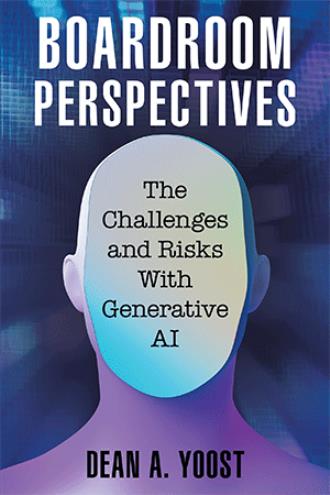
Generative Al is the next iteration of digital transformation. It automates not physical labor but cognitive effort, creating a new era in which the boundaries of human and machine intelligence increasingly converge. The advances and possibilities of artificial intelligence and generative Al are no longer distant concepts confined to science fiction. The technologies are a transformative force reshaping businesses and industries, driving innovation, and introducing new paradigms for decision-making. Generative Al offers tremendous opportunities and poses significant risks that require the board's oversight. As stewards of the organization's governance and risk management, directors need to approach the technology with both a strategic intent and the commitment to ethical practices. For those in the boardroom, overseeing the challenges and risks with generative Al is not just a matter of good governance but critical for the organization's resiliency and sustainability. The rise of generative Al is characterized by systems capable of creating text, images, code, and other outputs that mimic human creativity. It is a turning point in the relationship between technology, humans, and business outcomes. Directors need to understand the possibilities and how the models work, even though the outputs that they create are not always explainable. While generative Al can drive efficiency, enhance the customer experience, and foster innovation, the technology carries concerns around biases, potential misuses in disinformation campaigns, legal and regulatory uncertainties, data privacy violations, potential reputational damages, and more. The pace of the technology's development outstrips the legal and regulatory frameworks, leaving directors and management to navigate largely through uncharted territories. The board's responsibility goes beyond the development of strategy and risk management. Generative Al creates challenges about the future of the workplace, the integrity of the information, and the equitable distribution of the technology's benefits. Board members need to guide management with a commitment to transparency and accountability. Directors are at the epicenter of the organization's governance, strategy, and risk management. Board members do not need to be experts in artificial intelligence but they do need to be knowledgeable and informed. Their role is not to dive into the granular technicalities of generative Al but ensure that management deploys the expertise and processes to harness the benefits and the risks. Board members and management need to embrace the opportunities to innovate and drive business improvements while addressing the challenges and risks, measuring the returns on investment, and adhering to the organization's goals and principles beyond maximizing the profits. The fiduciary responsibilities of the board extend to anticipating and mitigating the threats that could materially impact the company's performance, reputation, and compliance. In the context of generative Al, this duty takes on added importance. The board's oversight of generative Al includes foreshadowing the future and considering what is next. As the applications of generative Al expand from text and image generation to autonomous decision-making, strategic forecasting, and other sophisticated uses, directors need to maintain a broad and informed perspective, ensuring that management anticipates not only the next AI frontiers but beyond. A future centric approach positions the board not merely as a risk mitigator, but the company's steward of responsible Al usage. Boardroom Perspectives: The Challenges and Risks With Generative AI is the GPS map for board members and management seeking to enhance their oversight and management of the challenges and risks with generative Al. It explains the technology in non-technical terms, highlights the potential risks and opportunities, and provides actionable insights for effective governance. By bridging the gap between the technical experts and those in the boardroom, this book equips directors and executives with the information and context necessary to ask the right questions at the right time, foster productive boardroom discussions, and ensure the organization is positioned to effectively navigate this progression with artificial intelligence. The book lays the foundations for directors and executives to learn, emphasizing that effective oversight of the challenges and risks with generative Al requires a blend of curiosity, critical thinking, continuing education, accountability, and forward-leaning governance. As guardians of the organization's values and sustainability, the board and management need to shape the future of Al within the business, ensuring that the organization is both innovative and responsible. This book provides directors and executives with information at the right level to engage with the key concerns and address the top threats. Board members will find this book extremely helpful because it can provide them with the information needed to anticipate the emerging risks, understand the ethical and regulatory implications, and ensure that management is implementing robust governance frameworks. As generative AI reshapes the risk landscape, board members can and should play a pivotal role in safeguarding organizational resilience, protecting stakeholders, and guiding responsible innovation. Directors need to approach generative Al not as an abstraction but the driver of transformation. Their oversight of generative Al requires the ongoing commitment by each director to learn, adapt, and respond. In today's world framed by the internet, digital and smart devices, the cloud, and ever-increasing connectivity, mobility, and massive computing power, directors and executives who are rooted in the analog age will find their knowledge fossilizing and fast becoming extinct. Whether the business is exploring Al, piloting solutions, or scaling its implementation, Boardroom Perspectives: The Challenges and Risks With Generative AI will provide board members and executives with the background to make informed decisions, fulfill their fiduciary responsibilities, and find antidotes to the challenges and risks with generative Al. It also can be used as a guide for academicians, the regulators, investors, policymakers, and others interested in expanding their knowledge on the risks associated with the use of this exponential technology. Directors and executives are heading toward an indeterminable and unpredictable future that will be heavily influenced by advances in AI technology. Many of them, perhaps all, will need additional preparation for what is next. This is nothing new. Uncertainty has been their frequent companion.
Formats

Book Details
About the Book
Generative AI is a transformative force that is a redefining businesses, industries, markets, and societies. Its potential to mimic human creativity by producing text, images, and code, signals an inflection point in our relationship with technology. Yet, for all its promise, generative AI poses a host of challenges and risks that are as profound as the opportunities. Navigating this duality is an enormous undertaking, which is why Boardroom Perspectives: The Challenges and Risks With Generative AI is such as crucial and timely source of information. Generative AI is unlike any technology previously encountered. It operates at the nexus of creativity, data, and computation, enabling businesses to push boundaries that once seemed insurmountable. However, as this book describes, with great power comes tremendous responsibility, particularly for those in the boardroom. What makes this book so powerful and useful is its balance of sophistication and simplicity. The author communicatees very complex ideas in understandable, compelling language, making the content both engaging and actionable. The key themes are more than a checklist, but a call to action. Board members and management will find this book useful because it can provide them with the information needed to anticipate the emerging risks, understand the ethical and regulatory implications, and ensure that management is implementing robust governance frameworks. This book is a requisite tool. Those in the boardroom will gain not just information but the confidence to lead their organization through one of the most transformative periods in commercial history.
About the Author
Dean A. Yoost is an experienced director and global executive. He is one of three advisory committee members of American Honda Finance Corporation. For many years, Dean was a board member of both a large foreign-owned bank and a global insurance company as well as two companies listed on the New York Stock Exchange. He is the past executive chairman of Vicara Health, a health care software company. Dean retired as a partner with PricewaterhouseCoopers after thirty-three years, where he held numerous client service and leadership positions. He lived and worked in Tokyo and Beijing for sixteen years, serving the needs of clients as well as establishing and building PwC’s businesses in Asia. He was elected as a director to the eighteen-partner Global Oversight Board of PwC International Limited, the top governing body of the global network of firms. At his retirement, Dean was the firm’s managing partner in Orange County and the regional leader of its advisory services practice. Dean has authored seven previous books on corporate governance and published over one hundred essays and editorials in leading business journals and newspapers. He is a trustee and executive committee member of the University of California, Irvine Foundation. Dean is a founder and the emeritus chairman of the Corporate Directors Roundtable of Orange County and an emeritus board member of the National Association of Corporate Directors in the Pacific Southwest. Dean lives in Irvine, California with his wife, Mei Chiang, and their two German shepherds, Helga and Oscar. He can be reached at dean@deanyoost.com.