
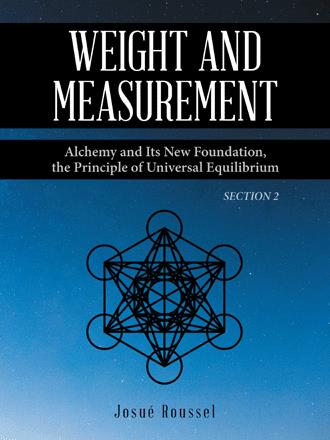
WEIGHT AND MEASUREMENT
Alchemy and Its New Foundation, the Principle of Universal Equilibrium
by
Book Cover & Preview Text
ENDNOTES
1 METATRON, THE PRINCE OF THE PRESENCE
Gematria is a system that assigns numerical values to letters and, by extension, to words and phrases.
2 ALCHEMY: UNDERSTANDING THE SYMBOLISM
Baruch Spinoza’s works include Tractatus Theologico-Politicus, published in 1670, and Ethica, Ordine Geometrico Demonstrata, published posthumously in 1677. These writings addressed topics such as religion, politics, and philosophy, challenging conventional beliefs. Spinoza argued that God is not an invisible man in the sky; rather, he argued that everything that exists is part of God (Deus sive Natura—"God or Nature"). Broadly considered a pantheist, he believed that God and the universe are identical, with the divine present in all things. Spinoza’s ideas were considered controversial at the time, as they dealt with sensitive issues that society struggled to resolve, many of which remain unresolved today.
3 THE SIGN THAT DEFINES UNIVERSAL EQUILIBRIUM
Foundation of Mathematics and Calculus
A formula in calculus can describe the relationship between variables and help predict rates of change. In calculus and mathematics, the derivative, denoted as f’(x) or dy/dx, represents the instantaneous rate of change of a function y = f(x) with respect to x.
The linear function, expressed as y = f(x) = mx + b, with m as the slope and b as the y-intercept, is the simplest type of function, forming a straight line on a graph. As a polynomial of degree 1, the slope of the linear function (which is also the derivative) is constant and represents the rate of change in y with respect to x. This slope is calculated as the change in y over the change in x: m = rise/run = Δy/Δx = (y2 – y1)/(x2 – x1).
The rate of change of a function can be represented as a limit. For an average rate of change over a finite interval (large or small), it is calculated as Δy/Δx. For the instantaneous rate of change (derivative), it is defined as the limit of Δy/Δx as Δx → 0. As the interval of change approaches zero, the derivative measures the instantaneous rate of change. A practical application of the derivative is determining instantaneous velocity, expressed as v(t) = ds/dt = dx/dt = lim Δt→0 Δx/Δt, with the limit indicating the change in position (Δx) over an infinitesimally small change in time (Δt) [SI/metric units: m/s].
When the slope m is positive (m > 0), the line described by the function f(x) at a point x, moving from left to right along the x-axis, ascends. A steep slope indicates a large positive value. Conversely, when the slope m is negative (m < 0), the line descends as it moves from left to right. A sharply declining slope indicates a large negative value. When the slope m equals zero (m = 0), the line remains flat, indicating no ascent or descent.
The slope of the tangent line represents the derivative of a function at a specific point. At that point, the tangent line touches the curve and matches its slope. Derivatives of derivatives are known as higher-order derivatives. The second derivative of f is derived from the derivative of f’ (or dy/dx), expressed as f’’ = (f’)’ = d[dy/dx]/dx = d2y/dx2. There are rules that assist in finding derivatives. For instance, basic derivative examples include d[5]/dx = 0 (constant rule) or d[x5]/dx = 5x4 (power rule). If a function is y = f(x), its derivative is defined as dy/dx = f’(x). A partial derivative of a function with respect to one of its variables is calculated while holding the other variables constant. The notation ∂f/∂x (or fx) represents the partial derivative of a function f(x, u1, …, un) with respect to the variable x. A differential equation involves a function and its derivatives, where the derivatives reflect the rate of change of continuously varying quantities.
The point-slope form of a line is (y – y1) = m(x – x1), where m is the slope and (x1, y1) is a point on the line. A normal line is perpendicular to the tangent line at a point of tangency, and their slopes are negative reciprocals (provided neither line is vertical). Thus, the slope of the normal line to f(x) is −1/f’(x), and its equation at (x0, f(x0)) is (y – f(x0)) = [–1/f’(x0)](x – x0). For a function F(x) of one variable, the derivative is dF/dx. For a function F(x, y, z) of three variables, the derivatives dF/dx, dF/dy, and dF/dz form the gradient vector ∇F, which points in the direction of the maximum rate of change. Contour lines (or level curves) represent constant values of the function and are perpendicular to the gradient.
...175 Rosh Hashanah and Yom Kippur
The Jewish New Year begins with Rosh Hashanah, meaning “head of the year.” This two-day ritual marks the beginning of a ten-day period of reflection and repentance known as Teshuva, culminating in Yom Kippur—the Day of Atonement. Yom Kippur is considered the holiest day in the Jewish calendar and is often referred to as the “Sabbath of Sabbaths.” In mystical vision, Enoch was no longer flesh and bone, but fire and lightning, enthroned beside God and bearing the name Metatron.
Formats

Book Details
About the Book
SECTION 2: The universe is not a fruit of a series of random, chaotic, and blind accidents. Instead, nature is a manifestation of a noble architecture full of flawless, intelligent, and enduring wisdom and design. In search of the origin of the self-sufficient and true universe, only alchemy, the great science founded on the premise that everything works as a whole and in close unity, has the power to expose the forces of life and death.
In Weight and Measurement, author Josué Roussel explores the principle of universal equilibrium with the intuition of a physician searching for the universal panacea that will ultimately cure all diseases. The aim of this progressive study of the world is to refine our knowledge of the nature of balance and imbalance in our lives. Rather than being a vague inspiration, the science of alchemy gives an exclusive interpretation of the multiple facets of good and evil where truth is set on one side and myth is cast on the other. This science of the absolute establishes an inseparable dual connection between the physical world (the philosopher’s stone) and the invisible dimension (good and evil).
Every single phenomenon we see and experience means something. How can we make sense of it all? This innovative path to understanding both science and the inner soul through alchemy will serve as the cornerstone for a series of investigations on subjects associated with applied sciences. Alchemy is the definitive blueprint for building the philosopher’s stone, which will become the ultimate lever for demystifying the unknown like never before.
About the Author
Josué Roussel holds a degree in electrical engineering, a master of business administration, and a bachelor of education. The eldest of a large family, he has spent most of his life in Canada and has lived in both the English and the French speaking regions of the country. He considers Weight and Measurement to be an introduction to the topic of alchemy.