
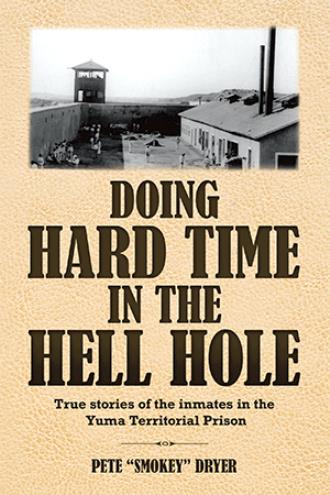
DOING HARD TIME in the HELL HOLE
True stories of the inmates in the Yuma Territorial Prison
by
Book Cover & Preview Text
In November 1872 in Yuma, Arizona, then called Arizona City, Michael “Rawhide” McCartney owned a General Merchandise store on Gila Street where he had a large and diverse inventory. He was known as somewhat of an eccentric but a fair and honest businessman and well respected by the citizens of Arizona City. He had a habit of occasionally going on a solitary drinking spree for a couple days during which time he would not transact any business or appear noticeably in public. This being understood, no one was visibly surprised when he disappeared on November 30 leaving his business locked up. When he had not showed up at his place of boarding by the 2nd of December though, some of his customers thought it prudent to check on his welfare. Going to the store on Gila Street they beat on the door loudly for an extended period of time and raising no answer went to the rear of the business where they removed a log to gain entrance. Upon entering they made a grisly discovery. McCartney was stretched out on his counter, head on a bolt of calico, in a horribly mutilated condition. He had been killed, in his stuporous sleep by many vicious blows from an axe which lay nearby. It was known that “Rawhide” kept a large sum of money on hand all of the time and the object of his murder was obviously theft. It was grimly satisfying to see that the murderer had not been able to access Mr. McCartney’s safe and had to content himself with a few dollars that were in the till. November 7, 1872. Manuel Fernandez was arrested in conjunction with the murder and imprisoned in the Yuma County Jail. While confined therein, jailer Lyman Smith engaged him in conversation and extracted not only the facts of the murder but the name of his accomplice in the deed, Canuto Soto, who was then quickly invited to join his cohort in jail. January 5, 1873. Fernandez and Soto made their escape by digging through one of the old adobe walls of the jail with a broken file. (The ease of their escape, due to the instability of their stockade, made just one more addition to the Territorial Legislature’s eventual decision to build a new penitentiary.) Still shackled, the two desperados hobbled their way a short distance to the home of some local Indians where they endeavored to remove their restraints. The Indians were a lot more law abiding than their two uninvited visitors and one of the family members slipped out the back door, ran all the way to town, informed the law officers of their missing guest’s whereabouts and they were soon re-captured. On February 1st during the daily search of the prisoners, it was discovered that one of the prisoners had almost sawed off his irons in preparation for another “run at the wall”. When the cell was searched the guard found an old razor converted into a saw. March 29, 1873, at 10:00 the District Court of Yuma County was convened and Manuel Fernandez was convicted of murder in the first degree and sentenced to “be confined in the County Jail until the 2nd day of May 1873, on which day between the hours of 10 a.m. and 12m, he shall be hanged by the neck until dead.” On that date at fifteen minutes to eleven o’clock, the drop fell and at ten minutes after eleven the body was cut down. Manuel Fernandez was the first legal execution in Arizona. Soto was now serving his sentence in the Yuma County jail, designated as the territorial prison. Sunday October 28, 1873 six prisoners confined in the jail made their escape through a hole dug in the wall. Again. Four who went through the hole that night were murderers including Que-cha-qua a Yuma-Mohave Indian and Canuto Soto. Five other prisoners being held in the jail declined to escape. The escapees crossed the Colorado River and some of them were sighted on their way to San Diego. Soto would disappear for thirteen years. March 19, 1886, Deputy U.S. Marshall H.D. Underwood had been tracking Soto for better than a year and on this date, he had received a lead and traced Soto to a holding corral south of Tucson. He found Canuto in the company of 15 well-armed Mexicans who had brought in a herd of horses they were hoping to sell. Returning to Tucson, Underwood enlisted the aid of a posse of three men, Ed Boyle, Dick Marabell and James Powell and quickly returned to the corral. Pretending to be interested in purchasing some of the horses, the men circulated among the Mexicans until Underwood identified Soto. Taking advantage of an unguarded moment, the Marshall seized his quarry from the back and called for Boyle’s assistance while Powell and Marabell held the other Mexicans at bay. Hustling their prisoner into the wagon, they all jumped aboard and rattled off to Tucson. Dr. Goodwin who was Sheriff in 1873 when Soto escaped, was called in to identify the old bandit and Sheriff Tyner was notified of his re-capture. Soto had been at large for 13 years until he made the mistake of visiting Tucson once too often. On May 26, 1886, he entered confinement as prisoner #369, to finish the 98 years remaining on his 99-year sentence. At 62 years old and assuredly facing the rest of his life inside, he became one of the faceless number of inmates quietly serving out their time. In 1886 the prison had 18-foot walls, 15 guards, 40 cells and 160 fellow inmates and Canuto Soto must have found it far more intimidating than the Yuma County Jail of 1873. His only recorded single offense was gambling, a victimless but forbidden pastime for which he did 12 hours in the dark cell in 1891. At the time of his gambling infraction the guards found 15 packages of tobacco on his person, apparently his winnings. October 20, 1894, Canuto Soto, now 70 years old and almost completely blind, was pardoned by the Governor as a result of petition signed by many influential people from Arizona and Los Angeles.
Formats


Book Details
About the Book
From 1876 to 1909 the Yuma Territorial Prison was home to some of the most vicious and violent criminals in the Arizona territory. They were incarcerated for every imaginable crime known, and spent months, years or the remainder of their lives locked away from the sight of the world. Denied all but the necessities required to sustain life, they were required to labor daily in the continuous construction and refurbishment of the very enclosure that held them. The environment in which they lived suffered summer temperatures in the triple digits, and the prison was carved out of a hilltop of granite and gravely clay without a tree or bush to break the searing sun. It wasn’t long before the prison on the hill next to Yuma was labeled the “The Hell Hole”. Although future improvements did ease the hardship of their environment, the reluctant residents paid dearly for their unfortunate choice of profession. The pardon or parole was one way to escape the grim surroundings, but some suffered quicker and less fortunate ways to end their confinement. There were murders, suicides and medical deaths which shortened the sentences for 111 inmates over the years. These hapless few lie in the barren and windblown cemetery east of the prison. Their stories provide insight into the criminal lifestyle in a then untamed Arizona territory. Their crimes, the way they were hunted down, their subsequent life in the territorial prison and for a lucky few, life after the Hell Hole.
About the Author
Dryer lives in Yuma and has become very involved in the history of Arizona. He gives tours and historic presentations at the Yuma territorial prison. His research into the lives and personalities of the actual convicts led to the addition of stories of individual inmates in his tours and this, his second book on the historic prison.