
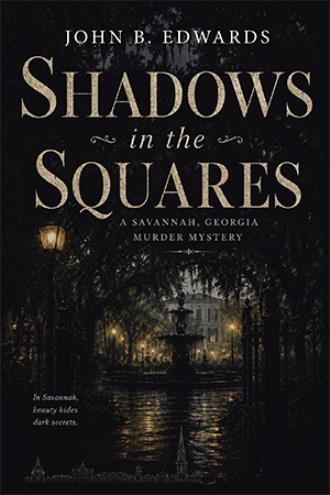
Shadows in the Squares
A Savannah, Georgia Murder Mystery
by
Book Cover & Preview Text
Barnes Jacsaint moved to Savannah from Bamburgh, England. He had recently retired from MI-6, a branch of the British secret service that handled foreign relations and the UK's national security. At 57, Barnes had the physical qualities of a 35-year-old. He possessed superior intellect and charm. His English accent accentuated his alluring character. His handsome looks and sharp dress only added to his mystique. Barnes had spent over a year researching and studying locations across the globe to retire. He wanted the perfect place that would ensure his past life, filled with uncertainty and dynamic dangers, was over. He wanted a place to provide a quiet, suspenseful, and stress-free home environment where he could be left alone. Barnes loved the arts, architecture, fine dining, and premium spirits. He also reserved the space in the back of his mind for the opportunity of a relationship. He had never been married. Age had changed his perspective; the absence of a mission changed his attitude. Savannah had come up as a pitch by Ocean Aeronautics and Aviation, an aircraft manufacturing company that had made an offer to Barnes as a part-time security consultant. The company offered a few hours and big money. Such met Barnes’s vision in retirement, where he had time and an additional source of income to supplement his pension and live comfortably. Barnes took the job, received a special immigrant status for a green card and moved to Savannah. Nelson Miller, a retired C.I.A. agent, dear friend and professional associate, assisted Barnes in navigating the requirements to assimilate into the states. Nelson had retired to nearby Beaufort, South Carolina, in the heart of the beautiful Low Country. Both agents shared a common dream of easy living and slowing time down before it crossed over the final horizon. Nelson had used an old F.B.I. contact in Savannah to find Barnes a home in the heart of the historic district. A unique rental property that was walking distance from everything, with all the benefits of Southern living. He also helped Barnes find a great car deal in Hilton Head for a 300-horse BMW three Series. Nelson drove down from his home in Beaufort to help his friend Barnes acclimate to Savannah’s exclusive geography and temperament. The sun shone brightly from the beaming light-blue sky, only filtered by the ceiling of the thick nest of limbs, leaves, and moss of the oak trees that lined Calhoun Square. The shade that resulted created a cool, comfortable environment on the square below, enhanced by a gentle morning breeze. Barnes sat quietly on a wooden park bench, waiting for the arrival of his dear friend. Barnes was intrigued by the squirrels and birds that seemed to reach out to him. He looked around him at the diverse, historical Greek Revival styles of the many homes that flanked the square on either side. Most notable was what Barnes did not hear. No horns, sounds of brakes squealing, or engines revving. Unlike London or New York, Savannah was quiet. Only the sound of the birds dominated the morning. Barnes was relaxed and mystified. “Enjoying the piazza Barnes?” Barnes turned and looked up, surprised to see his friend. “May I join you?” Nelson asked. “Absolutely old chap!” Barnes snapped. Nelson sat beside his friend. They passionately shook hands, demonstrating their joy in being together again. “This was the last square in the city. It also leaves us the best picture of what the city looked like in 1851. Most of these homes were here back then. That beautiful church came later, before the turn of the 19th century.” “Named after our man Wesley, a true English hero.” “That’s right, the founder of Methodism.” “Mr. Wesley would have disagreed. He was an Anglican priest until his last breath.” “So, his minions created a better way…totally American, wouldn’t you say?” “Bloody right, a typical American perspective.” They both laughed loudly. “Tell me about your drive, Nelson?” “Beautiful, I came down on South Carolina 170 to 46 and then on in on US 17 across the river. It’s about an hour’s drive. No traffic, just pure pleasure.” “Right. This coast is certainly different from what we are used to. I’ve got to get out and visit you there.” “Yes, you must.” “I could remain on this bench. It reminds me of the country at home.” Barnes said. “Well, I came down to ride you around and show you the city. Then you’re going to buy me some dinner and drinks.” Replied Nelson. “Really?” “Really.” “Well then, let’s go,” Barnes shouted. The two walked across Abercorn Street to Nelson’s car and left on their journey. Nelson drove Barnes around the squares, pointing out the different bars and restaurants and what they offered. He showed him the regal city hall and drove him down the touristy river street. He warned him about the overseas sort that frequented the Irish pub. Barnes took it all in. Nelson drove out to Tybee Island and showed Barnes the quaint beach town along the sea. That afternoon, Nelson carried his friend nine miles southeast of the city to a place off the beaten path that only the locals knew. Nelson drove Barnes across the Solomon Bridge onto the Isle of Hope. Stationed on a high bluff on a horseshoe bend of the river below. Nelson drove Barnes along the narrow Bluff Road, flanked by the river on one side, with rows of houses representing Greek Revival, Gothic, Victorian, Italianate, and plantation-style architecture. All had in common their vast porches or patio shaded by majestic live oak trees that lined the road in front. The other side provided a spectacular view of the Skidaway River and its connecting tributaries that snaked through the vast marshlands that dominated the horizon, meeting where the Atlantic lived. From Chapter two
Formats

Book Details
About the Book
Shadows in the Squares is the story of the entitlements and privileges of a select group of aristocrats, who are anxious about the influence of Northerners and Westerners moving into their community. They become vulnerable to the manipulation of a corrupt South African smuggler, Colonel Richard Dunlevy, who uses murder as a means to an end in his nefarious world of organized crime. Barnes Jacsaint, a retired British MI-6 agent, retires to Savannah and meets Abigail Grant, a wealthy widow and local socialite. Through her faith and influence, along with her beautiful young niece Seabrook, the two partner together in an attempt to turn the tide in this fast-paced and suspenseful mystery thriller surrounding murder and steeped in romance, set in Savannah, where a unique bastion of architecture, tradition, and culture emerges on the pages within.
About the Author
John B, Edwards is a retired Georgia Bureau of Investigation agent and former Chief deputy sheriff. During his career, he worked on many narcotic cases, working undercover to infiltrate street networks, gangs, and major smuggling rings. He also worked on public corruption investigations involving state and local officials. Most of his career involved investigating and managing many major homicide cases.
John has a Bachelor of Science degree from Georgia Southern University. A Master of Science degree in strategic leadership from the University of Charleston. He is an adjunct professor at the Georgia Law Enforcement Command College graduate school at Columbus State University.
John is the author of six books, co-author of one, and has published numerous national and international works on criminal investigation, public safety operations, leadership, and management.
John currently travels throughout the United States, lecturing for many federal, state, and local law enforcement and public safety agencies, colleges and universities, and private sector and corporate associations regarding leadership and management, and on seminars based on his books, “The Burden of Command” and “Homicide Investigative Praxis.”
John is also the author of four novels: “Sunlight over the Marshes,” focusing on drug smuggling in coastal Georgia in the 1970s; “Darkness under the Oaks,” about organized crime in coastal Georgia; “Winds through the Pines,” about politics and corruption; and “Shadows in the Squares,” a suspenseful murder mystery.