
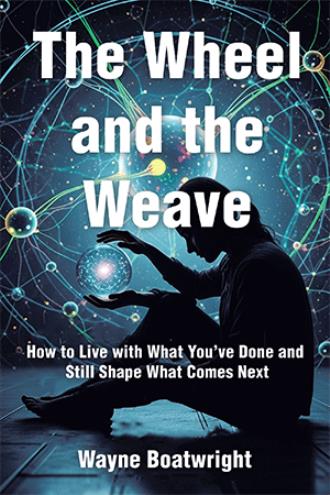
The Wheel and the Weave
How to Live with What You’ve Done and Still Shape What Comes Next
by
Book Cover & Preview Text
You turned the wheel. That choice was yours. There are different kinds of hitting bottom. One kind arrives suddenlyŠin a single moment. The crash. The phone call. The moment you realize you've crossed a line and can't uncross it. Mine came on a road I didn't plan to drive drunk, heading for a head-on collision with a car carrying a woman I would kill. That moment splits your life into before and after. But there's another kind of bottom. It doesn't announce itself. It arrives quietly, in a thousand small surrenders. You wake up. You do the thing. You go to bed. You repeat. And somewhere between the repetition, you stop recognizing the person doing it. That was me, years later, sitting on the I-5 heading south to Los Angeles every two weeks. My mother was dying. Not suddenly. Slowly. The kind of slow that doesn't feel like dying at firstŠit feels like managing. Putting her in hospice. Finding a place for my brother, who has special needs. Finding a facility that would take them both so they could spend her last days together. Driving back and forth between a life that still pretended to be normal and a death that refused to hurry. And underneath all of it, grinding every waking hour, was the question of money. How was I going to pay for the hospice care? The insurance didn't cover what he needed. The government programs had waiting lists that stretched for years. Each call from the facility coordinators brought new costsŠequipment, medications, specialized care. Each conversation ended the same way: Let me check and call you back, knowing full well I had no idea where the money would come from. The thing about money-related crisis is that it's never just about money. It's about worth. If you can't provide what your family needs, what does that say about your value as a son, as a brother, as a man? Somewhere on that I-5, I started self-medicating. RedBull and vodka. Simple equation: Stay awake. Stay numb. Repeat. The ritual was simple: crack the RedBull first, take a pull from the vodka second, chase it with the energy drink third. By the time I hit the Grapevine, I was numb enough to handle another visit. By the time I got to LA, I had convinced myself this was normal. This was coping. This was what adults do when they carry weight and can't make it lighter. It wasn't. But I didn't know that yet. I had the perfect story to justify it all: My mother is dying. My brother is alone. I'm doing the logistics of loss. I was depressed for a long time. I can't afford the care they need. That story is true. But I need to be clear about something, because this is the foundation of everything that follows: Understanding why I did something is not the same as being excused for doing it. No one poured the drinks down my throat. No one forced me into that car. No one made me turn the ignition. The grief didn't do it. The weight didn't do it. The financial pressure didn't do it. The depression didn't do it. I did it. And the moment I turned that wheel drunk, I became responsible for every consequence that followedŠfor the woman who died, for her nine children, for the family shattered, for my own family torn open. This distinction is everything. It's the difference between understanding and excuse. Most people, when they carry this weight, reach for a redirect. They point at someone else's failure. They claim they were just following the system. They find ways to feel like victims instead of agents. These aren't lies. They're ways of managing unbearable feelings. But none of them move the needle. The weight stays. And now it's doubled, because you're also carrying the story you told yourself about it. I know this works because I learned it the hard way. Behind San Quentin's walls, under harsh fluorescent lights and the weight of my own crime, I was forced to unwrap every story I once used to protect myself. In the circle inside San Quentin, ten men started. Four finished. We all brought irreversible harm into that roomŠa wife stabbed twenty times, men beaten with bats, a drunk driver's destruction, the crack and meth dreams that ended lives. In that circle, we learned something that changed everything: the armor you wear to protect yourself from judgment doesn't actually protect you. It just numbs you. It keeps you from seeing the wheel in your own hand. The work took eighteen months. Not a weekend. Not a quick revelation. But the slow, careful unwrapping of every story until nothing shielded us from our own choices. What I discovered was not freedom from the weight. The weight stayed. What changed was my relationship to it. I stopped trying to escape it and started asking a harder question: What if I could use this guilt as fuel instead of letting it destroy me? Here's what that looks like in practice: Guilt creates specificity. It tells me exactly who I hurt and where repair might begin. Instead of I'm not good enough, guilt becomes I was not present when my child needed me. Now I have something to work with. Now I can identify the repair. Guilt moves everyone around me. When I choose repair instead of disappearance, my children witness something. My ex-wife witnesses something. Everyone in my orbit witnesses the capacity to live with what you have done and choose differently anyway. This book is not a redemption story. It's not about becoming pure again or earning forgiveness or getting back to who you were before. Those are fantasies for people who haven't actually destroyed anything. This is a field manual. It's built on a framework that changed everything for me: You are not trapped in a single future. You are moving through a landscape of branching possibilities. Every choice you makeŠtoward connection or isolation, honesty or numbness, repair or avoidanceŠmoves you closer to some futures and further from others. Your pain is real. Your responsibility is also real. They don't cancel each other out. Your feelings are your most honest sensor for what's happening. But we've been taught to obey them as truth. They're not. They're telling you what your map thinks is happening. And your map can be wrong. You have more agency than you thinkŠnot because your circumstances disappear, but because you're still choosing. You can't control outcomes. But you can choose one honest policy, one small rule about how you'll show up, and test it for ninety days. You can loosen the tight weaves that are suffocating you. You can build repair on repair on repair. If you've caused harm and you're looking for a way to live with thatŠnot as redemption, not as forgiveness, but as actual living with accountabilityŠthis book is for you. If you're in relentless, slow-motion crisis and you're drowning in weight and wondering if disappearing would be easier, this book is for you. The question isn't whether change is possible. It's what will you choose next?
Formats

Book Details
About the Book
You turned the wheel. That choice was yours. But it’s not the end of your story. This book begins where most self-help ends—with the weight of real harm. No quick fixes. No forgiveness guarantees. Just one truth: you’re still here, and your next choice still matters. After causing a death while driving drunk, the author spent six years at San Quentin, sitting in circles with men who had done the irreversible. There, he learned that guilt doesn’t go away—but it can be used. It can become fuel for repair. You are not trapped in one future. You are moving through a landscape of possibilities. Every act of honesty, connection, or care shifts what’s possible for you—and for those you’re woven with. This is not a redemption story. It’s a field manual for staying. For showing up. For making meaning where none was promised. The question isn’t whether change is possible. It’s: what will you choose next?
About the Author
Wayne Boatwright is a lawyer, former tech executive, and returning citizen who spent six years in San Quentin after causing a fatal accident while driving drunk. Inside, he led the prison newsroom and helped others navigate the hard work of accountability and repair. His writing offers frameworks for living with what you’ve done without letting it destroy you—or the people still woven with you. He now lives and writes in San Francisco.