
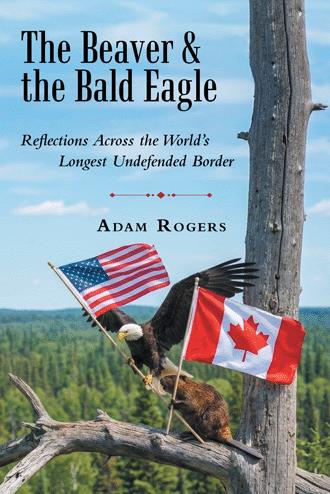
The Beaver & the Bald Eagle
Reflections Across the World's Longest Undefended Border
by
Book Cover & Preview Text
Let’s start with a simple question: What separates Canada and the United States?
Geographically, not much. A few massive lakes, some easily crossed rivers, and what President Trump once described as a straight line “drawn with a ruler” along the 49th parallel. “Somebody drew that line many years ago,” he joked in the Oval Office in 2025, “just a straight line right across the top of the country.”
It was perhaps meant as humor, or a jab, but it captured something real. From above, the border is almost invisible. From the ground, it’s anything but.
Margaret Atwood once described the world’s longest undefended border as a “one-way mirror.” That metaphor endures because it illuminates an asymmetry at the heart of the relationship. When Americans look north, they tend to see a reflection of themselves — colder, quieter, more inclined to apologize, but still recognizable. Canada feels like a familiar extension: shared language (mainly), shared entertainment, shared sports, and similar values.
When Canadians look south, they see something different entirely. They see the world’s cultural engine and political accelerant — a superpower in constant motion, a nation whose turbulence, innovation, and contradictions spill across the border whether they want them to or not. They see fascination, opportunity, risk, and, increasingly, apprehension.
This asymmetry — one country seeing a mirror, the other seeing a window — is the starting point for this book.
In 2025, that asymmetry sharpened. Tariff threats rattled supply chains; partisan rhetoric strained diplomatic instincts; and offhand jokes about Canada becoming the “51st state” landed less like punchlines and more like a punch in the gut for many Canadians.
Yet this book is not about annexation. That idea, resurfacing in political theatre and social-media memes, is too far-fetched to merit serious policy discussion. But as a thought experiment, it proved unexpectedly helpful—a lens through which to examine how Canadians and Americans understand themselves and how each imagines the other.
To test that lens, I conducted a survey in September 2025, paired with an open-ended analysis of thousands of comments on Facebook, LinkedIn, and other digital platforms. The full results appear in Annex 1, but a few patterns shape the arc of this book.
Canadians mostly expressed confidence in their identity and sovereignty. They did not see themselves as an appendage of anything. Their attachment to parliamentary governance, multiculturalism, and collective responsibility surfaced again and again — not in abstract terms, but in the everyday logic of how they believe society should function.
Americans, by contrast, were curious and often warmly disposed. Many saw Canada as a calmer, more predictable alternative to their own political volatility. Some saw it as a hypothetical escape hatch; others admired it. But almost no one framed Canada as incomplete. The idea of absorbing an entire nation, culture, and history felt to most Americans not just unrealistic, but unnecessary.
International respondents viewed Canada even more distinctly — as cooperative, moderate, equitable, and consistently sovereign. To them, annexation would not be unification; it would be erasure.
These views reinforced something essential: Canada and the United States are not two halves awaiting merger. They are two parallel experiments in democracy — distinct, interdependent, occasionally exasperated with each other, but bound by geography and history in ways no other pair of countries is.
This book seeks to understand the two experiments and what they reveal about the future of North America.
Why this book, and why now?
Because the moment demands it.
The U.S.–Canada relationship is experiencing one of its most strained periods in decades. Public opinion has hardened. Trust has eroded. Misperceptions are rising on both sides of the border. Canadians increasingly view the United States with a mix of anxiety and resignation. Americans remain broadly favorable toward Canada, but shifting trade priorities, domestic polarization, and political rhetoric have introduced a new layer of uncertainty.
At the same time, the significant challenges of our era — climate disruption, democratic backsliding, technological upheaval, migration, and global polarization — require cooperation at a scale North America has not yet attempted. And cooperation is impossible without clarity. Misunderstanding the neighbor next door weakens both nations at a time when neither can afford the luxury of complacency.
This book does not argue that Canada and the United States should be more alike. It argues that understanding their differences is the only path to a healthier partnership — one based not on nostalgia or habit, but on sober recognition of what each country is, what each is becoming, and what each could learn from the other.
Who am I to write this?
When I was ten, my family left Arizona and moved to Faro, a mining town in the Yukon, where the North became my anchor. Later, my academic and professional life took me across North America and around the world, before leading me back to Edmonton, where my mother and sisters still live.
I write about Canada and the United States in the third person not because I am distant from either, but because I belong—differently—to both. This is not a memoir, nor a nationalist tract. It is an attempt to understand two societies I know intimately, admire deeply, and worry about often.
I have chosen to write and publish this book in American English, largely because it is simpler—and less costly—to produce a single edition. I hope my Canadian readers will forgive this one small transgression.
My aim is not to choose sides. It is to illuminate contrasts, correct misconceptions, and offer a clearer, more grounded view of the continent we share. Each country has its own brilliance and its own failings. Each embodies values worth defending and habits worth questioning. And each holds lessons the other increasingly needs.
That is why this book exists: to explore the border not as a line, but as a vantage point— a place from which to see two nations more clearly, and perhaps to imagine what they might achieve together, by taking the best from both.
Formats

Book Details
About the Book
The Beaver and the Bald Eagle explores the growing divide between Canada and the United States—two nations that appear similar on the surface but are increasingly shaped by different values, institutions, and social contracts. Drawing on the author’s life on both sides of the border, a 25-year career with the United Nations, and original survey data, the book blends personal narrative with sharp comparative analysis.
“Rogers draws on journalistic observations, insights from comparative politics and sociology, and an original survey to examine differences and similarities between the US and Canada across a variety of areas, including governance, immigration, healthcare, sports, education, business, and the environment. Beyond an astute comparison, the book is also a deep reflection on how institutions, values, myths, and policies make a national culture, community, and ultimately a country.”
— Daniel Naujoks, School of International and Public Affairs, Columbia University
“An engaging exploration of democracy, identity, and institutional design, told through the lens of two closely linked countries. Its lessons extend well beyond North America.”
— Helen Clark, former Prime Minister of New Zealand
“Why and how are the USA and Canada such different places? Part memoir, part study in comparative politics, this book describes how institutions both shape and reflect very different underlying, deep cultural currents in the two countries. A compelling and insightful read.”
—Matthew Mulford, London School of Economics and Political Science
“Rogers provides the analytical frame I’ve been searching for, turning everyday observations into clear, compelling insights about two nations I deeply admire.”
— Thomas Barker, University of Alberta
“The Beaver and the Bald Eagle is a timely way to explore and better understand both countries, told in a style and with a touch that only Adam Rogers could provide.”
— Chris Fiscus, Arizona State University
About the Author
Adam Rogers brings a rare cross-border perspective shaped by a childhood in both Canada and the United States and a 25-year career with the United Nations in 100+ countries. Blending research, lived experience, original survey data, and policy insights, he offers an informed, accessible voice on governance, identity, and public trust.