
Understanding our Irrational Selves
A Disruptive Philosophy
by
Book Cover & Preview Text
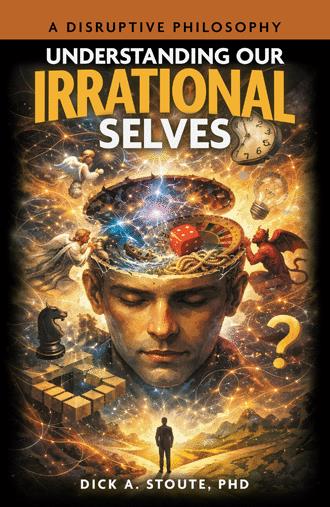
Why do we pay so much attention to our rationality and so little to our amazing irrational abilities? With artificial intelligence demonstrating the potential of our own brains, we need to replace the inaccurate, outdated, “I am a rational being” idea of ourselves with a model which recognises that we are mostly irrational, emotional, intelligent thinkers. I show how doing this helps us understand how we think, reduces aggression, improves our quality of life, and sets us up for and amazing future.
I expose an almost unbelievable history of intellectual failure. Our ancestors created the rational model we were taught and gullibly accepted. It feels indubitably true, but is, at best, misleading. We are much more than rational and when we believe we are rational we impose a very limiting self-image on ourselves. The simplicity of being rational is attractive. It gives us feelings of certainty, confidence and exclusivity we love. These feelings are so attractive we do our best to be rational but fail and blame ourselves for our failure. This leads to a negative self-image, and a feeling we should punish ourselves.
The rational self-image encourages us to assume we know the truth. Those who do not accept our truth are clearly wrong. Others feel likewise about their truth and the seeds of conflict are sown. The price we pay is unending conflict. Rationality does this by oversimplifying, misrepresenting, and misleading us about our own abilities and about our environment. Ideas that feel right to one individual are often oversimplifications which clash with the ideas of others. Our philosophical ancestors created “argument” as a way of resolving conflict and determining the truth, but this is another trap. There is no point trying to argue our way out of conflict; arguing can only sustain what we want to avoid. The emotions stimulated by the inevitable failures and clashes created by our false belief in our own ability to know the truth creates a paradigm which encourages sustained conflict.
Starting with neuroscience and information feedback theory I create models to represent how our irrational brain works. These create what I call a Build paradigm. I combine it with Fight to create Build-Fight, a suite of coherent models representing how our neural networks create what we experience, and point out that we must interpret, rather than obey, the feelings and emotions it generates. Build-Fight combines information feedback theory, communication theory and neuroscience to create models which give us a much better representation of ourselves. It encourages us to test its models and determine if a model is accurate enough for a particular application.
Neural networks in our brains are highly sophisticated but can be accurately represented by information feedback models. These models show that neural networks are excellent at detecting similarities and patterns. Like artificial intelligence, our neural networks learn from experience and sometimes get things wrong.
When our neural networks discover that an idea or model works well, they generate a “feels right” feeling we interpret to mean “this model is right”. This feeling can be so strong we believe the model is indubitably true and treat it as such, but information feedback theory shows that such feelings should not be trusted. Unfortunately, our ancestors trusted the feelings convincing them they were rational and championed the idea that humans were the only rational animals. They convinced themselves that rationality was a gift from God and we should celebrate our rationality and do our best to be rational. They were so overwhelmed by this idea they created prejudices against non-rational ideas and did their best to avoid being influenced by the feelings their brains generated to guide them.
Build-Fight models explain why our ancestors adopted the aggressive-defensive Fight belief system our brains create for us when we feel threatened. In the turmoil of our emerging civilization, threats were abundant and Fight thinking “felt right”. Our brains create this paradigm to help us survive dangerous situations. When immersed in a Fight paradigm our brains adopt a simple binary paradigm which helps us think quickly and respond to danger. It includes feelings like, “Those who are not with me are against me”, “what is not true is false”, “we are right, and they are wrong”. Internally, the neural networks in their brains were locked into very resilient feedback loops which generated strong, but misleading “feels right” feelings. Conflict dominates when this happens. It becomes a trap.
Although it may feel counter intuitive, please accept that Fight is just one of several paradigms our brains create for us. There are alternatives. I describe Build and show how it explains our experiences. Each of us is unique, but we are all similar and I expect my Build models will help you create your own unique set of models to represent your own conscious experiences. I won’t be using reason or argument; those are tools created within the Fight paradigm and keep their users in the Fight paradigm. Instead, I will be using information feedback theory and neuroscience to create and evolve models representing how we think.
To get started I only need a simple, approximate model. This is one of the big advantages of the Build paradigm. It allows us to start with simple models and adjust them, using an error correction routine based on feedback. I describe the models I create, test them to see how well they explain away several of philosophy’s conundrums, then test them to see how well they explain some scientific incoherencies. They pass these tests with flying colours, establishing their credibility.
I also discuss what it is like to adopt Build and show how doing this decreases self-blame and improves quality of life. This journey into myself has become a fascinating, highly rewarding adventure, leading to revelations which give me a much better understanding of myself. Build is, at first, counter intuitive, so one of the first tasks is to understand how and why our brains create the strong intuitions which make some ideas feel right and others feel wrong.
Formats

Book Details
About the Book
Understanding Our Irrational Selves reverse engineers neuroscience models to understand how our brains create consciousness.
Dick A. Stoute, Ph.D., presents a model based on neural networks using information feedback, not reason, to create the scenes, sounds, smells, and tastes that define consciousness.
Brains assess the models they create and use feelings to inform us of their assessments. When a model conforms to what it represents, brains make the model feel right. In this book, the author considers questions such as:
Is there a more accurate model that recognizes both our irrational and rational abilities?
Is the rational model we normally embrace too simple?
What similarities does the brain have with artificial intelligence—and what are the implications?
The author contends that the idea that we are rational gives us feelings of certainty, confidence, and exclusivity, which can cause people to blame and punish themselves for failures.
He proposes an alternative model called “Build-Fight,” which recognizes both our irrational and rational abilities. This new model can help humanity move from conflict to cooperation.
About the Author
Dick A. Stoute, Ph.D., is an analytic philosopher with a background in engineering who asks, “Why do we think we are rational when there is so much evidence showing that we are not?” What he discovered is astounding.