
Confessions of a Heretic
VOLUME 3: ECCLESIOLOGICAL CONSIDERATIONS
by
Book Cover & Preview Text
While theological determinations and definitions are what makes a church, a church, such determinations are institutionalized within the church as a spiritual, religio-theological community, which is therefore too, inherently, an authoritative community. Given the structure of the theological endeavor within Temporality, there has always been theological disagreements and debates. I addressed the issue of authority already above in Chapter One. There I noted that it was the imperial authority of Constantine that called the Council of Nicaea in 325 CE, which then condemned Arius, issued the Nicaean Creed, and set the canon of the Bible. During medieval Christendom, there were seemingly constant conflicts between princes, kings, and the Emperor, on one side, and bishops, archbishops, and the Pope on the other regarding who had the highest authority. Theologians took sides, offering theological arguments for both the papal and the imperial positions. Often the Reformation has been seen as Luther’s standing up for individual authority in opposition to the authority of the pope, usually joined with his assertion of the authority of Scripture over human authority. The problem was, the Scripture had to be interpreted. Luther’s opponents, Prierias and Eck, knew the Scripture as well as Luther. Yet Luther in no way advocated for the authority of the individual. And his assertion of the authority of Scripture was based on his own interpretation of Scripture. Before long, theologians whom Luther would label his “false brethren” would likewise oppose Rome, but also opposed Luther, asserting their own interpretations of Scripture. And thus began the “denominalization” of The Church, which has simply continued ever since, leading to what can be seen as an “indiviudalization” of The Church, whereby individuals have the authority to “pick and choose” which church to go to, based on their own understandings and their own “tastes”. Perhaps Jenkins is right: the Church is dead, at least within Temporality. Individual “faith communities” as Jenkins asserted could provide the basis for a “post-modern church”, increasingly de-emphasizing theological differences and issues, and focus on individual “experience”, seeking, as argued above, to gain an increasing share of the “church marketplace”. It seems with respect to the church, we have returned to a Hobbesian world of individual sovereignty, in which, though, life is poor, nasty, brutish, and short. Perhaps such a condition has been a factor behind the rise of a so-called “Christian Nationalism”, the perceived need for something larger than the individual and the individual religious experience. Idolatry is such a seemingly easy answer, especially when it is based on idolatrous conceptions of God in the first place. But is that all we are left with? If we assert the reality of Atemporality and therefore the reality of the mode of Perfect and Perfected Being, then The Church is a reality, the community of perfected souls at peace in the joy of Perfect Being. The question though then becomes, what, if any, is the relationship between The Church and temporal churches? Does The Church have any authority at all within Temporality? Does ‘God’ have any authority at all within Temporality? If one makes the leap of faith that ‘God’ is, one can only answer such questions in the affirmative, and do so based on absolute conviction, even as God, that is, human conceptions and conceptualizations of God, must always be contradicted by ‘God’. ‘God’ and the Truth that is ‘God’ contradicts and “smashes” the idols of human conceptualizations, whereby The Church stands always, necessarily, in opposition to temporal churches, to “The Church” in hoc saeculo, as Augustine put it. As referenced above, in book eight of his Confessions, leading to his own conversion, Augustine related the story of Victorinus. Victorinus had translated the works of the Platonists Augustine had been reading. He was a well-known scholar, and a pagan. Augustine though had heard that he had died a Christian. The story behind Victorinus's conversion, Augustine heard from Simplicianus, who had known Victorinus extremely well; they had been good friends. Victorinus had read the Scriptures thoroughly and had studied them deeply, and finally said to his friend Simplicianus: “’Did you know that I am already a Christian?’ Simplicianus replied: ‘I shall not believe that or count you among the Christians unless I see you in the Church of Christ.’ … This scene then set up the final emplotment culminating in Augustine’s own conversion. As Augustine himself put it: “As soon as your servant Simplicianus told me this story about Victorinus, I was ardent to follow his example.” For Simplicianus, for Victorinus, and for Augustine, being a Christian was only possible within the Church, and the Church for Augustine was not only the context for his own Christian life, but was in many ways the summary of his entire theology. Augustine’s theology was thoroughly an ecclesiological theology, and can only be understood as such; for Augustine there was indeed no salvation outside the Church. Yet the Church of Augustine’s day was by no means a unified entity; it was as diverse in some ways as is the Church today. Diversity is in vogue, or at least it was until more recently it has become the “enemy of the state”. It was trendy, fashionable, and it had been ever so “politically correct”. Moreover, diversity is, or should be, a foundational principle of Christianity, the acceptance of people, all people, as ‘God’s’ creation, as ‘God’s’ children, irrespective of race, gender, political beliefs, nationality, ethnicity, socio-economic status, or morality. Yet the opposite, it would seem, of diversity is unity. Unity is a hope and a goal, a dream; something to work for, and to work towards. How, though, do we balance and/or combine unity and diversity? Are they not irreconcilable?
Formats



Book Details
About the Book
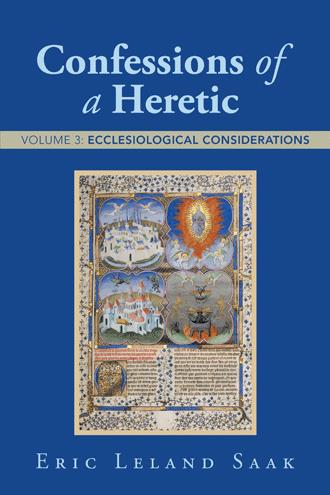
This book is the final part of my Confessions of a Heretic. Though this volume is based on and presupposes volumes 1 and 2 (v. 1: Philosophical considerations; v. 2: Theological Considerations), volume 3, Ecclesiological Considerations, can too stand on its own. Whereas the focus of volume 1 was on ‘God the Creator’, and that of volume 2 was on ‘God the Perfector’, here the focus turns to ‘God the Performer’, to complete the trinitarian vision of what in traditional terminology is God the Father, God the Son, and God the Holy Spirit respectively. Yet Augustine has been behind the project all along, and here simply more explicitly so, whereby the entire work can be seen as a radical attempt to apply Augustine’s major doctrines, particularly as seen in his The City of God, to the Church today within a postmodern context. In volume three, the concept of the Church comes to the fore, with the argument being that what makes the Church the Church, is not the Church as a moral community, a political community, or a social community, but only the Church as a religio-theological community. As such, the Church then is too, necessarily, an authoritative community, and in this light, an argument is made for the primacy of the Roman Catholic Tradition. Thus, the volume strives to approach ecclesiology anew based on anthropological and sociological analysis, which forms the basis then of ethics, which finally leads back necessarily to The Church as part of ‘God’s’ Divine Symphony.
About the Author
Eric Leland Saak (PhD University of Arizona, 1993) is Professor of History at Indiana University Indianapolis. He has published widely in the area of late medieval and Reformation theology and religion. The focus of his research is the Augustinian Tradition, and his most recent contribution is A Medieval Introduction to Theology. The Prohemium to the Lectures on the Sentences of Giles of Rome, OESA (d. 1316)—Introduction, Text, and Translation (Leiden, 2026).