
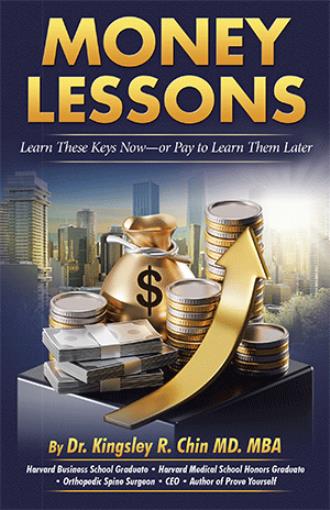
MONEY LESSONS
Learn These Keys Now—or Pay to Learn Them Later
by
Book Cover & Preview Text
Formats



Book Details
About the Book
This is not a book about budgeting or frugality. It is a book about how money behaves, how people behave around money, and why access to capital changes everything—from how your ideas are received to how much respect your voice carries.
In these pages, you will learn:
- Why money is more reliable than jobs, titles, or institutions
- Why people with capital think differently—and give different advice
- Why chasing small money traps big thinkers
- How lack of money is often mistaken for lack of credibility
- What it takes to think, plan, and raise capital at scale
This book is written for entrepreneurs, professionals, and builders who are tired of playing small—not because they lack ambition, but because they lack leverage.
“People aren’t rejecting you. They’re reacting to your lack of money—and the power that comes with it.”
About the Author
Dr. Kingsley R. Chin is an orthopedic spine surgeon, entrepreneur, investor, and author whose work focuses on leadership, capital formation, and long-term value creation. Raised in Buff Bay, Jamaica, Dr. Chin grew up in poverty and learned early that opportunity is not evenly distributed—but preparation and endurance matter. His journey led him to earn degrees from Harvard Medical School and Harvard Business School, complete engineering and business training at Columbia University, and serve as Chief of Orthopedic Spine Surgery at the University of Pennsylvania. Over more than two decades, Dr. Chin has raised over $30 million in private capital, built and led multiple healthcare and technology companies, completed acquisitions, navigated regulatory scrutiny, and founded KIC Ventures, a physician-led private equity and health technology platform. Money Lessons is drawn from lived experience—not theory—and reflects hard-earned insights into how money behaves, how investors think, and what it takes to build at scale when the margin for error disappears.