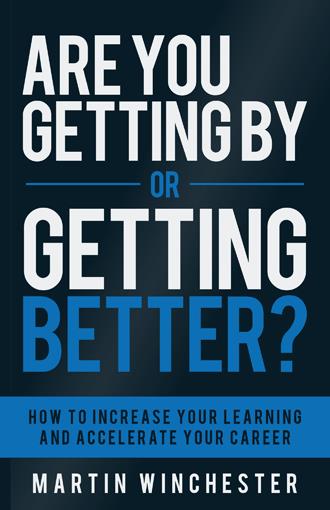
Are You Getting By or Getting Better?
How To Increase Your Learning and Accelerate Your Career
by
Book Cover & Preview Text
I’m certain you’ve made mistakes in the past and you’re probably beaten yourself up over them. But have you made a mistake as big as Mount Rushmore? In 1927, American sculptor Gutzon Borglum set about creating a national monument to four presidential icons. It would be so big and beautiful that people would drive from all over the country to admire its majesty and meaning. The site would be in the Black Hills of South Dakota with mountain sides big enough to fit the sixty-foot faces that would tower over visitors 500 feet away. The cost would be the equivalent to $17 million in today’s money and require nearly 400 workers over the course of a decade with 90% of the carving done using dynamite. There’s not a lot of room for error when you’re working with dynamite so Borglum and his men would need to be very careful. First up was George Washington’s face with work commencing in 1927 and completion three years later. Next was Thomas Jefferson, originally intended to be on Washington’s right side. After eighteen months of work tirelessly blasting away with dynamite to create the image of the author of our Declaration of Independence, Borglum realized he’d made a mistake. The rock quality was too difficult in that area of the mountain. But he’d already sculpted half of it. Whoops! Now how do you explain to your bosses that kind of mistake? Remember he’s not working with an old school pencil and a rubber eraser. He’s using dynamite for crying out loud. Borglum wasn’t going to let a mistake like that stop him from his vision of a true American monument. What does he do? He blasts away his mistake – literally. Borglum orders his men to dynamite the half-constructed face of Jefferson down to a smooth finish and start Jefferson’s face from scratch on the other side of Washington, adjust the other two faces later and pray nobody ever notices. And few people ever did notice, unless you’re like me and read the fine print in the visitor center with this tiny detail that I found particularly fascinating. Now every time I try painting an interior room in my house and make a mistake, I remind myself, “This is not Mount Rushmore!” The takeaway here is that everyone makes mistakes and if you think yours is the worst one ever, think again. There are hundreds of bigger mistakes that have been made and if others can bounce back so can you. How about you? How do you handle mistakes? Are you quick to put them behind you or do you tend to beat yourself up and fall into negative thinking after a blunder by becoming even more pessimistic about your own abilities telling yourself, “I’ll never be good at…. ? If you do, resolve to change your ways. What I want to teach you is to ensure your self-talk and the way you process mistakes is conducive to self-reflection, growth, and development. We’ve all heard it said before to “learn from our mistakes,” but who has ever taught us how to do that. Those are hard lessons to learn and often we’re too overcome with emotion, frustration, disappointment or resentment when we make mistakes to effectively reflect and capture our learnings. Here is a three-step process to do that in a much more positive and productive way The Three R’s of Learning from mistakes or failure: 1. Take responsibility 2. Rebound 3. Reflect in writing “If you point a finger at someone else, there are 3 other fingers pointing at yourself” - anonymous Step 1: Take Responsibility: this is probably the most often missed step that can truly derail if not outright prevent productive processing from failure or setbacks. We all make mistakes, that’s inevitable, but one thing I’ve noticed in the leaders I admire the most is their ability to “own” their mistakes, learn from them, and not let those mistakes prevent them from moving forward. If you don’t take responsibility for mistakes that you’ve made you can spend far too much time wallowing in the victim mentality or placing blame on others in a way that is unproductive not only in the short-term but can be a lifelong impediment to improving. It’s important to take this first step right away to accelerate the learning process. When I make a mistake or experience a setback I first try to “own it” with either what I did or didn’t do to create the situation or at least contribute to the unfavorable outcome and take responsibility for it. This can and should include apologizing where and when applicable. Even when there are legitimate things outside of my control or caused by others, I always try to begin within my own “locus of control,” and work from there. Focusing on what’s within your own control means you’re spending the bulk of your time and personal energy on what you can do about your situation, which means your future actions will have a higher likelihood of being productive. People who focus on what’s outside of their control tend to sink even further into negativity and unproductive patterns of behavior. This doesn’t mean you spend all your time apologizing and focusing on your own shortcomings. In fact, this should be a brief step where you ‘own’ it, accept responsibility and quickly move on to the next steps. Before we move on to the next step, let’s pause to reflect on your own tendencies when it comes to dealing with mistakes. Turn the key to unlock the learning • How do you handle mistakes in general? • What are examples of times when you HAVE taken responsibility for your role in the mistake and times when you haven’t? • What made the difference?
Formats

Book Details
About the Book
You're working harder than ever as an educator — but are you actually growing, or just getting by?
Most teachers are trained on what to do. Almost none are ever taught how to keep getting better on their own. And that's the real difference between the educators who plateau and the ones who keep leveling up, year after year, role after role.
It isn't talent. It isn't luck. It's a skill — and you can learn it.
If you feel the pull toward something more, whether that's mastering your current role or preparing for your next one, this book gives you the roadmap.
In it, you'll learn how to:
- Take ownership of your growth — so you stop waiting on a mentor, a coach, or a training calendar to develop you
- Learn from experience with intention — so every year in the classroom makes you sharper, not just older
- Turn your mistakes into mentors — with a clear, repeatable framework instead of vague reflection
- Tap into the people around you — so you unlock one of the richest, most underused resources for your own growth
You don't have to figure this out alone. The roadmap is right here.
Stop settling for getting by. Start getting better — every day. Scroll up and grab your copy now
About the Author
Martin Winchester is an award-winning educator with over thirty years of experience at the classroom, campus, district, nonprofit, and state levels. He is a Teach For America alumnus, former National Board Certified Teacher, and served as the Deputy Commissioner of Educator Support for Texas. Visit his website at www.martinwinchester.com.