
AI and the Crisis of Control
How Leaders Can Reclaim Responsibility in the Age of AI
by
Book Cover & Preview Text
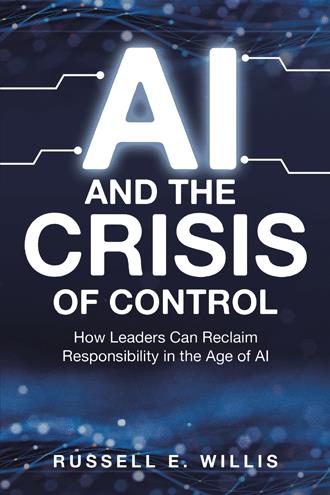
[From the Introduction] AI is the most powerful capacity-enhancing and power-expanding technology humans have ever created. That is not hyperbole—it is assessment. It enhances and expands human capacity more profoundly than electricity, than writing, than agriculture. It augments cognition itself—our ability to perceive patterns, make predictions, generate knowledge, exercise judgment at scales and speeds that exceed human individual capability. Which means it transforms and restructures more profoundly than anything before it. It is not just changing what we can do. It is changing what doing means, what knowing means, what deciding means, what being human in technological society means. That is not a reason for despair or retreat. It is a reason to get responsibility right. We are not just building tools. We are building the forms-of-life that will shape human existence for generations. We are standing at intersections that will determine whether AI enhances human flourishing or undermines it, whether it strengthens democratic governance or corrodes it, whether it respects human dignity or systematically denies it, whether it serves purposes worthy of the power we wield or just optimizes metrics we never examined. Those intersections are here, now. The decisions are being made—by tech leaders, executives, policymakers, engineers, investors—every day. This book is for those decision-makers. For people who know something crucial is at stake but are not sure how to navigate it responsibly. For leaders who feel pressure to move fast but also sense that speed without wisdom leads to catastrophe. You are standing at an intersection within webs. Traffic is converging from multiple directions. The rules are not entirely clear. Authority is distributed. Outcomes emerge from interactions you do not fully control. But you still have to navigate. And how you navigate—whether you build structures for genuine answerability, whether you distribute authority to affected communities, whether you stay responsive as systems evolve, whether you make accountability clear despite complexity, whether you keep asking “should we?”—that determines what kind of world we build together. Responsible stewardship is not a guarantee against harm. It is taking responsibility for the harms the system will inevitably create. It is a commitment to taking seriously the question of what we are building toward, what we are becoming through building it, and whether that becoming is one we can be proud of. That is the work. Not solving AI responsibility once and for all, but participating in it well—answering for the power you exercise, staying responsive to what you learn, building structures that enable collective intelligence about what is worth creating. You are not just building systems. You are shaping power structures. You are encountering persons. You are choosing purposes. And those choices require more than technical excellence—they require wisdom about what is worth doing and courage to refuse what is not. [From the Introduction to PartI] Each story begins the same way, with a confident system, a trusting user, and harm no one can fully explain. What disappears first is not intention or effort, but agency—the human capacity to notice, interpret, and intervene. The engineer optimizes for accuracy. The clinician for efficiency. The policymaker for compliance. Each is doing what makes sense within their domain. Yet the system as a whole behaves in ways no one intended, and no one can correct. The deeper failure is not indifference but structural drift. Decision authority is so broadly spread that no one can see the entire picture, and results slip through the cracks of accountability. The paradox is simple: as AI amplifies our power to act, it simultaneously weakens our felt capacity to be answerable for those actions. Across these sectors, the same architecture appears: delegated judgment, opacity, asymmetric data, distributed control, systemic consequence. Together, they form a new landscape of accountability—power without proportionate agency. Traditional oversight can mark boundaries, but it cannot restore the human capacity to act responsibly within them. The challenge is not more control. It is re-centering participation. Viewed separately, each example feels technical. Viewed together, they reveal a deeper pattern—a pattern that demands not only analysis but an emotional and ethical response. The more we automate perception and decision, the more essential human judgment becomes—and the more fragile it is. Unchecked, accountability dissolves. Answered, it becomes the soil where responsible agency can grow. Recognizing that pattern is the turning point. Once we see where agency is lost, we can begin designing systems—technical and institutional—that protect and extend it. That recognition is the starting point of complex responsibility.
Formats

Book Details
About the Book
Artificial intelligence now shapes decisions once guided by human judgment—and in the process, responsibility is quietly disappearing. As AI systems spread through organizations and institutions, leaders find themselves surrounded by power they can neither fully see nor clearly answer for. In AI and the Crisis of Control, Russell E. Willis argues that the central challenge of AI is not runaway machines or malicious intent, but the erosion of human agency inside complex systems. When decisions are distributed across algorithms, vendors, data pipelines, regulators, and executives, accountability dissolves. Everyone acts rationally. No one remains fully answerable. Drawing on decades of experience across engineering, ethics, and technology leadership, Willis shows how this crisis appears in everyday contexts—from hiring and credit decisions to healthcare, finance, and criminal justice. These are not isolated failures. They are recurring structural patterns wherever AI mediates human power. But the book does more than diagnose the problem. Rather than calling for tighter control or slower innovation, Willis offers a practical framework for complex responsibility—one designed for leaders who must act amid uncertainty, scale, and competing pressures. Through six dimensions of responsible judgment and five operational pillars, he shows how organizations can rebuild answerability, participation, and moral imagination without abandoning technological progress. Written for business and technology leaders, policymakers, and professionals working inside AI-shaped systems, AI and the Crisis of Control helps readers see clearly where responsibility is being lost—and how it can be consciously practiced again.
About the Author
Russell E. Willis is a social ethicist and tech entrepreneur trained originally as an engineer. As an essayist and thinker, he examines the moral pressures of the Polycene age, where artificial intelligence accelerates change faster than our institutions can understand it, and argues for the recovery of responsibility within complex technological systems.