
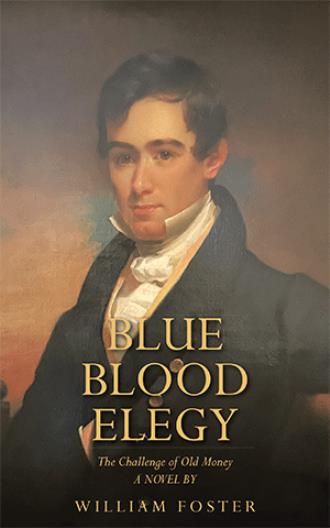
Blue Blood Elegy
The Challenge of Old Money A NOVEL BY
by
Book Cover & Preview Text
"We are rapidly approaching the day in which there will be few remaining occupational preserves exclusive to people like us…. In fact, one could argue, that day has already arrived. Your own family has witnessed how someone of a very different background—Mr. Kasprzyk, your brother-in-law—graduates from college today and hasn't any fear whatsoever of having to break new ground in an occupation that only a generation ago would have been considered off limits to all except people in our crowd.” So spoke Benjamin Rawle Price in his office on Walnut Street in Philadelphia. Handsome and in excellent shape from perhaps at least an hour each day in the squash court, he was sitting beneath a Thomas Birch oil of a sailing ship in a dramatic tempest with towering waves. His beautiful wife, in jodhpurs and holding a riding crop, was featured in a monogrammed silver frame on the windowsill. When the telephone interrupted, I read the engraving on a silver plate that seemed to act as a sort of in-basket on the corner of his massive desk: Sugartown Horse Show, Working Hunters Won By Leighsylvania, Bond Street Ridden By Mrs. Benjamin Rawle Price 1940 "Is that your wife's name engraved on the platter?” I asked when hed hung up the phone. "No, mother…Hope Hopkinson Price. My wife was only ten years old in 1940. Your grandfather had that champion horse, Bond Street, and my mother was the only one capable of riding him.” "My grandparents' house is full of silver won by that horse.” Ben Price was an old friend of my father from their days in the First City Troop, a unit of army reserves. A number of its original volunteers were also members of Philadelphia's first hunt club, so since its founding in 1774 it has been as much an exclusive but rowdy men's club as a detachment of army reserves. "This city is changing. It used to be a city of families, like the great merchant families of Amsterdam or Geneva from the history books. But those families are selling out because we're no longer a local economy, we're a national economy. We're even more than that: we're now a global economy. And it's way, way more competitive out there than when I was your age” Ben Price rambled on, not responding to any specific question. Then unexpectedly he partly hummed and partly sang some verses from Pinafore: When I was a lad I served a term As office boy to an attorney's firm— I cleaned the windows and I swept the floor, And I polished up the handle of the big front door— I polished up that handle so carefullee That now I am the ruler of the Queen's Navee! "I was in my share of Gilbert and Sullivans," I proclaimed with a big, comfortable smile. This bit of levity made me feel very at home but was short lived. Ben abruptly scowled across the desk for a long minute of silence. Perhaps he was recognizing that I was indeed too comfortable and that he had therefore not successfully delivered his message. Maybe he was also seeing a little of himself in me and didn't like what he saw. In a scolding voice he exclaimed: “You see… it's not like it was in the old days. That's what I'm trying to say!” Irritated, and with a tone of sarcasm I woulnd't have dared use on a family friend of his generation, I asked: “Oh? It's not as easy today as it was for Sir Joseph Porter, KCB, First Lord of the Admiralty?” My sarcasm took him aback, and shortly he responded in a more patient voice. "The right prep-school used to be a ticket. But it's the early eighties. If an employer finds out you've gone to a prestigious boarding school, he's probably not going to hire you because he'll think you're not going to fit in. Companies are looking for people who are going to fit in with the diverse work force of today and tomorrow.” Ethnic exclusivity, he warned me, is over. I would apparently not be competing with my fellow WASP boarding school grads. The people running the show in this country now don't have names like “Hopkinson and Biddle…it's names like Iacocca or Shapiro.” Indeed, until 1970 the patrician DuPont Company, he explained, had never been headed by anyone outside the family, much less a Jew. Meanwhile, Robert Abboud of Lebanese ancestry was heading up one of the ten largest banks in the United States. “You're a fellow Episcopalian. We account for less than three percent of the population. Did you know that in the fifties about a third of the Fortune 500 chief executive officers were Episcopalian? We don't control the institutions around here like we used to. Philadelphia is for sale, and other groups have been making inroads. Today a young man of your age with an Italian or Jewish last name is not afraid to apply to firms that were previously WASP preserves. The ground has already been broken….” He then abruptly fell silent, perhaps feeling a little guilty for being so blunt. When he spoke again, he wasn’t looking at me in the eye, and the excitement in his voice diminished to a soft apologetic tone. I sat in silence while he wistfully rambled on to the wall or the window. He knew he couldn't help me the same way he had been helped thirty years before. Ben was another from the list of what Clay called my family's "old boy network' around Philadelphia that I could supposedly rely on to get a start. Nothing came of these meetings. I usually met with such contacts downtown at various private clubs, their walls crowded with oil portraits of past presidents, antique lithographs and copperplate engravings of old Philadelphia, and wooden boards covered with brass name plates of club officers or racquet sport champions. I wondered if some of these men didn't actually possess an office but, rather, came in from the Main Line or Chestnut Hill just for a squash or “real-tennis” match, then a large lunch followed by a trip to the broker or money manager. “Looking at the big picture, Tom, what was called the 'establishment' was wounded badly by some failures on our watch. Bay of Pigs, Vietnam fiasco, Gulf of Tonkin, the Watergate mess. The sixties upheaval infested our class with self-doubt, and we've been stepping back.” He concluded our meeting with an offer to pass my resume to his human resources department. “But be ready,” he warned, “an accounting or finance degree from even Podunk U or West Chester State will get you an audience. Liberal arts, the humanities will not, even if you're from Princeton. In fact, the latter school might work against you—they'll assume you're privileged and be here today, gone tomorrow, always on a quest for something better. Your generation has to hit the ground running. My major was in the humanities. Kids can't be like me and get away with reading just Chaucer, even if they got all A's.”
Formats

Book Details
About the Book
While the literature of today often focuses on the long journey of marginalized Americans toward the halls of power, Blue Blood Elegy explores the other side of the same coin: the quiet, atmospheric retreat of a class that has lost its grip on American leadership. In this elegant Philadelphia novel of manners, William Foster introduces the Whittle family—a dynasty profoundly aware of its aristocratic heritage but in a country that has been at war with itself over issues of class since its inception. In the late 1970s the sun is setting on the era of the WASP ascendancy, and America is transitioning to diversity and a meritocratic managerial class. Tom Whittle, a young man starting out in the world, finds that he does not fit in professionally because of his aristocratic heritage, and socially he feels alienated as friends and family turn against, surrender, or betray that heritage. At every turn he must struggle to reconcile it with mainstream democratic values. The struggle turns intimate and high-stakes when Tom falls for Katalin, an aspiring lawyer whose presence at the family estate, Leighsylvania, unearths shadowy secrets. As calculating cousins move to protect their inheritance, questions and rumors emerge about the true nature of the family wealth and the viability of Tom's and Katalin's love. Part coming-of-age romance and part sociological autopsy, Blue Blood Elegy is a story of "Old Money" facing an inevitable demise and a poignant reflection on the fragility of legacy. It is the story of a young man forced to reinvent himself and his journey to learn that in a democracy, true nobility is not a birthright—it is a choice.
About the Author
William Foster grew up in the world of old money on the Philadelphia Main Line and has an intimate understanding of that culture in the final decades of the 20th century. He spent 35 years in marketing at a Fortune 50 company where he managed brands and opened new markets around the world.