
Orders of Battle
by
Book Cover & Preview Text
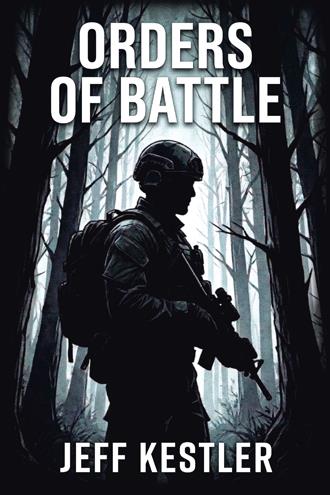
In Eastern Bosnia, the helicopter carrying Lieutenant David Levine of the United States Marine Corps to his first and last forward duty station strained hard to clear a rocky scrub-covered mountain peak and dropped toward the densely forested valley below. The pilot scanned the terrain for any sign of hostile activity. He couldn’t see much beneath the canopy of evergreens, and he listened closely for the sound of small-arms fire or the ominous chatter of antiaircraft guns. Hand-held Stinger-type missiles were also a threat. Although NATO aircraft hadn’t been fired on recently in this sector, he was taking no chances. There would be little time to react and even less opportunity to maneuver if they were attacked. All the while, Levine, dressed in freshly pressed and starched utilities, was aware that he was being closely scrutinized by the burly crew chief for even the slightest sign of fear or discomfort. He showed neither, although he had no love for helicopters. The noisy craft made large, slow-moving targets. They couldn’t take much punishment and were easy for even an inexperienced enemy marksman to bring down. You didn’t have to be a crack shot to put a rotor blade out of commission or puncture a gas tank. There was ample cover and concealment in the woods and rocks beneath them to hide an enemy sniper. To make matters worse, the enemy could be found among any of the three factions fighting for control of Bosnia, depending on the political crosswinds of the day, or even the whim of a drunken militiaman with a World War II vintage rifle. If he was going to be killed by hostile fire, he resolved long ago that he wanted to die on the ground. The crew chief continued to eye him, looking for an opportunity for a laugh at the expense of a green junior officer. “Not to worry, sir,” he declared, “we’ve made this milk run many times. We fly in crates of MREs and toilet paper, some mail, and an occasional resupply of ammo, and then we’re gone. Hell, we don’t even touch down. Done it a couple of times at night just for the helluvit. You’d really get a kick out of that ride, sir. You can’t hardly see nuthin’. Heckuva challenge. These two pilots love it, though. Say it gives ‘em a rush. I think they just wanted to be jet jockeys and got stuck in these tubs. If they’ve got a need for speed, they ain’t gonna get it in one of these buggies. That’s for damn sure.” He stopped talking, but kept looking straight at the young lieutenant. Levine just nodded, trying to appear calm as he attempted to deal with the knot in his gut. With each whine of the engine and each jerk of the straining rotors, he imagined that he would never reach his destination and would die unheroically on the rocky hillside beneath him. From the right side of the chopper, he got the first glimpse of their objective, coming up fast from below. It was a position dug into a hilltop surrounded by large fir trees. To the west he could see the smoking remains of a town. A ribbon of road ran past the hill into the devastated town center. The area seemed deserted from this altitude, but he detected some movement before the helicopter turned abruptly, blocking his view. The forest bore signs of the conflict being waged in its midst. Warfare stripped many trees of foliage and branches. Barren but still erect, they maintained their vigil like silent sentinels in the snow. Or perhaps they served as markers for the many who had died beneath them in this land of anguish and despair. These woods that so recently brimmed with life, now provided little shelter for man or beast. To the Marines occupying the hilltop, the naked forest was a two-edged sword—opening clearer fields of fire and permitting unobstructed observation of the road below but exposing their position to potential attackers. As the clumsy bird maneuvered to settle in a clearing, Levine could see two Marines emerging from a concealed position and rushing to meet them. They held on to their helmets and tried to shield their eyes from the swirling snow and dust blowing off the makeshift helipad. There would be no actual landing today. The crew chief growled a warning, “Ready, Lieutenant?” He grabbed his pack and shouldered his M-16 rifle. “Ready, Gunny!” he responded. The rear hatch of the chopper opened and extended downward. “OK, sir, you’re good to go! Go! Go! Go!” He ran out to join the waiting Marines, who motioned for him to follow them. He ran at full speed to keep up with them, despite the weight of the cumbersome pack flopping about on his back, nearly causing him to lose his balance. They paused and hit the ground about twenty yards from the hovering chopper, watching the crew chief unload several cases of food and ammunition. These cases bounced off the hard ground and one of them split open, discharging some of its contents onto the snow. As the hatch closed, Levine heard the chief shout, “Godspeed, sir!” above the whine of the engine. The bird struggled to regain altitude and momentum, rising slowly at first. It soon picked up speed and vanished. Levine found himself surrounded by an eerie calm. One of the members of his welcoming party soon broke the silence. “Good morning, sir! I’m Corporal Jensen and this here is Lance Corporal Martinez. Welcome to Bosnia and Hill 884. We hope you have a pleasant stay!” He laughed and looked for Levine’s reaction. The lieutenant smiled warily. “Lead the way, Corporal, and thanks for the kind greetings.”
Formats

Book Details
About the Book
In July 1995, Bosnian Serb forces murdered 8,000 Bosnian Muslim men and boys in an act of genocide that has come to be known as the Srebrenica massacre. Previously, the United Nations Security Council had declared Srebrenica a “safe area” and deployed a United Nations Protection Force (“UNPROFOR”) to monitor it. UNPROFOR was not authorized to use force to defend the enclave. A “demilitarization agreement” required the Bosnian Serbs to give up their weapons, but they maintained their siege and continued shelling the town. When they ultimately attacked in force, the UNPROFOR troops surrendered and NATO provided only minimal support. Inspired by these events, Orders of Battle takes us from a hillside in Eastern Bosnia, where a young Marine officer must make a fateful decision, to a courtroom on Marine Corps Base Quantico, Virginia. What is the responsibility of a military officer faced with certain genocide when his orders do not contemplate the use of force? What are the legal consequences of his actions? Orders of Battle explores the answers to these questions, which have never before been decided in a court of law, in the context of a monumental and richly detailed court-martial.
About the Author
Jeff Kestler served as a member of the Judge Advocate Division of the United States Marine Corps. He is the author of Questioning Techniques and Tactics. He was also an Adjunct Law Professor at Georgetown and Chairman of the Trial and Appellate Practice Committee of the Federal Bar Association.