
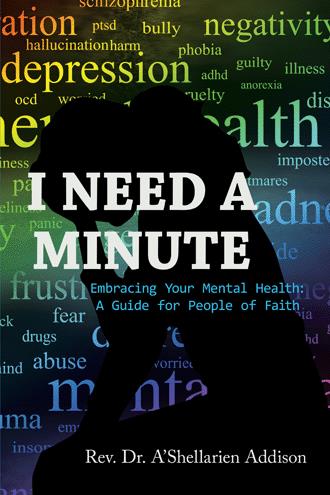
I Need A Minute
Embracing Your Mental Health: A Guide for People of Faith
by
Book Cover & Preview Text
There I was in Kuwait, a few days before it was time to come home from a nine-month deployment. I was ready to go. I was ready to see my children. I was ready to be in a place that was not 118 degrees. Then out of nowhere, COVID happens. The world shuts down. The Secretary of Defense gives the order for a 60-day stop movement. In that moment, the Chaplain (me) wanted to cuss. I know you are shocked. I know I am supposed to be above that. The truth was my trauma collided with my faith. I felt like the wind had been knocked out of me. I was the Chaplain. Surely, the Chaplain is okay. Surely, the Chaplain wasn’t falling apart. Surely, the Chaplain’s faith is stronger than the trauma that just slapped all of us in the face. I was not okay. I was falling apart. My faith had nothing to do with that. I have never doubted God’s active participation in my life, especially in Kuwait. I was not having a “Faith Crisis.” I was having a “Life is not being fair; I am ready to go home crisis.” What did that say about my faith? NOTHING. I can absolutely believe God and not be okay. I know I messed up somebody’s theology. I am okay with that. My truth is that God is big enough to handle my mental health challenges. God does not leave me when my thoughts are taking me to a place that my heart cannot handle. If you are like me, when trauma collides with your faith, you need a minute for your head and heart to come into alignment. You need a minute to calm the noise long enough to hear the Holy Spirit say, “I got you!” In this space where trauma is colliding with your faith, your thoughts may be running one way, and your heart may be hiding another way. One of the hardest places to be in life is in the meantime. Trauma throws us into the meantime. The meantime is that space between the promises of God and the manifestation of that promise. There are times when our soul gets wounded in the meantime. The pendulum swing of hope between believing God will do everything and wondering where God is in anything has the potential to cause us mental health challenges and soul injury. The soul is a noun in that it can be greatly dismayed and rescued by God. (Amplified Bible, 1965/2021, Psalm 6:2-4) The soul can be cast down and disquieted ((New King James Bible, 1982/2021, Psalm 42:5) The Bible uses the language of piercing the divide between the spirit and the soul. (Voice Bible, 1965/2011, Hebrews 4:12) I define soul as the deepest part of self. What does that have to do with faith and mental health? It has everything to do with our faith when trauma collides with it. Our soul is the essence of who we are as believers. Our soul is our direct connection to God. When our soul becomes disquieted (Psalm 42) mental health challenges become our portion. The challenge for many believers is there are limited safe spaces to talk about what we need to talk about. There are limited safe spaces for us to feel how we need to feel. Unfortunately, the stigma of asking for mental health interventions is overwhelming. It takes faith to stand up and say, “I am not OKAY!” Trauma is serious. How we manage our faith in the midst of being traumatized is important. I have faith. I have been traumatized. I am a faith-filled trauma survivor. If you have faith and you have been traumatized, you are a faith-filled trauma survivor. Words have meaning. We are on this healing journey as people of faith who have survived some things that have altered our lives forever. It is important to fill the sacred space between “knowing” that God is with us and “allowing” for God to be with us. The response to trauma may look different in the process yet the same in practice. There is a disjointed manner in which “faith” causes us to deny ourselves spiritual permission to not be okay. Wearing the mask of faith has become a normalized posture. The mask allows brokenness to settle into our lived experience without our knowledge. When brokenness takes residence in our heart, it impedes the flow of healing in our lives. Our brokenness keeps us in a continuous loop of a traumatized emotional state. In the loop our faith is consistently pushed to the periphery of our lived experience. The loop is fueled by our disengaged faith. When trauma collides with faith, we disengage temporarily due to the shock factor. Our faith was supposed to make everything okay. Our faith was supposed to shield us from hurt, harm, and danger. Our faith was supposed to keep pain, hurt, and brokenness away. It is in this disengaged state that the Holy Spirit draws us back. The Counselor leads, guides, and directs us to turn back to God. Disengaged faith is a surface faith that is disconnected from the healing power of God. Faith-filled trauma survivors need to be guided to a spiritually managed trauma recovery healing state. In the movement from disengaged faith to engaged faith, the heart and the mind come into agreement. Being spiritually managed is the agreement to embrace faith and spiritual clinical mental health interventions. Trauma recovery comes as that same faith is nestled in the power of the Holy Spirit (Counselor) to saturate our heart and mind with healing and spiritual clinical interventions have been put in place. This book you hold in your hands is that spiritual clinical intervention. In the following pages, you will find seven insightful chapters, which provide you with a roadmap to address mental health challenges without guilt or shame. The book combines practical advice, spiritual encouragement, and actionable steps, making it a unique resource for anyone seeking wholeness.
Formats

Book Details
About the Book
In clear, down-to-earth language, Rev. Dr. Addison reveals the secret to unlocking the power of prayer in everyday life. Offering practical tools, she draws on her experience as a trauma counselor to offer tools to aid in overcoming anxiety, sadness, or feelings of hopelessness, helplessness, or exhaustion in a world that can sometimes feel like it’s spiraling out of control. If you ever felt like you weren’t praying “right” or “hard enough” for God to hear, this book is for you. Rev. Dr. Addison shows you why there is no “right way” to pray—instead, she shares spiritual guidance and actionable steps to empower you to take a life-affirming journey of transformative healing.
About the Author
Rev. Dr. A’Shellarien Addison is a Board Certified Army Chaplain, spiritual clinical trauma-induced practitioner, prolific author, publisher, adult and pediatric hospice chaplain, international speaker, mentor, wife, mother, and grandmother. She hosts A Healing Moment With Dr. A’Shellarien on REACH Gospel Radio. She is the CEO of Desakajo’s Flo, which includes publishing, record production, credit empowerment, and travel. She is a Senior Sales Associate for LifeVantage, the company that provides premier health and wellness solutions.” She has a Doctor of Theology in Biblical Theology from Almeda University and a Master of Divinity and a Master of Sacred Theology from Lutheran Theological Seminary in Philadelphia. An Itinerant Elder in the African Methodist Episcopal Church, she is the CEO of Desakajo’s Flo.