
OUR CIVIL WAR FOREFATHERS
by
Book Cover & Preview Text
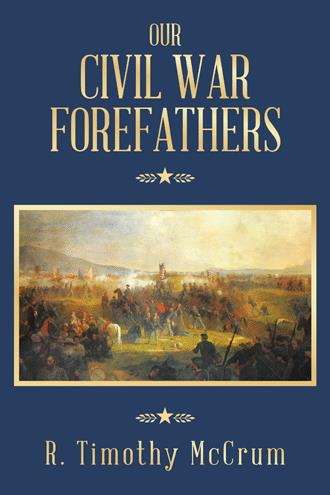
American authors have written thousands of books about the U.S. Civil War since it ended in 1865. The passage of 160 years has not lessened the fascination and interest which the history of that terrible war still holds for millions of people here in the United States. There are good reasons for this. The “War Between the States,” as it is sometimes called in the South, involved American citizens on both sides of the conflict who, absent the war, naturally would have been inclined to be friends with each other, not enemies. Yet the Civil War caused a far greater number of deaths than any other war in U.S. history. The soldiers involved came from a wide swath of our states, in the North from Maine to Ohio and Wisconsin, and in the South from Virginia to Texas. The locations of the many great battles and skirmishes are right here in the states where we and many of our friends and relatives live today, states such as Pennsylvania, Virginia, Maryland, Tennessee, Georgia, and others. In the woods of our Northern Virginia neighborhood where our young family grew up in the twenty-first century, there are still remnants of Civil War earthwork fortifications over a half mile in length that were hand-dug by Confederate soldiers in the months following their first big victory in the 1861 Battle of First Manassas, after which they occupied nearby areas for several months. In Northern Virginia, from Fairfax to Front Royal, our family has lived for decades in the region sometimes known “Mosby’s Confederacy,” where Colonel John Mosby, the “Gray Ghost,” and his raiders harassed and killed Union troops and burned train cars during the war. What if one of our own family forefathers literally chased Mosby and his men on horseback, with a Colt revolver, repeating rifle, and cutlass through the roads and valleys of Fairfax County and beyond? What if our family’s direct ancestors and their brothers participated in some of the greatest battles in the Civil War, such as Chickamauga, Chattanooga, Stones River, Gettysburg, Winchester, the Wilderness, the Atlanta Campaign, and many others? What if they served under General Ulysses S. Grant, General William Tecumseh Sherman, General George Armstrong Custer, and General Philip Sheridan, and fought in battles against men led by the Confederate General Robert E. Lee, General Braxton Bragg, General J. E. B. “Jeb” Stuart, General James Longstreet, and General Stonewall Jackson? Would that be of interest to our many grown children and grandchildren in the twenty-first century? The answer is . . . yes! I hope that the unique perspectives I give in this book, gained from firsthand accounts in little-known old regimental histories, will also be of interest to modern readers regardless of whether they have ancestors who were in the Civil War. We can be proud that our family forefathers from western Pennsylvania and Massachusetts fought for the Union and that the Union prevailed. We can know and be grateful that their heroic efforts led to the end of the horrible evil of slavery in our nation. Yes, the Civil War was ultimately about slavery, but the majority of the people in the Confederate States did not own slaves. Those Southern men fought bravely out of loyalty to the states where they lived. From their viewpoint, the Union troops were invading their homeland. This writer, originally from the North, admires the monuments to the courage of the Confederate soldiers that still proudly stand in towns such as Front Royal, Culpeper, and Winchester, Virginia, and many other Southern towns. We can all be glad for the end of the bloody Civil War and the reunification of our great nation that took place over many later decades. Some places such as Vicksburg, Mississippi, did not celebrate Independence Day until 1945, because Vicksburg surrendered on July 4, 1863, after a devasting forty-seven-day siege led by General Grant. Our ancestors were not there for that one. The accounts presented here are more personal in nature than many histories of the Civil War, which often present the “big picture” events. This series of stories will focus first on my Scots-Irish great-great grandfather Jackson Armstrong, who was born in rural Fayette County, in southwestern Pennsylvania. He was a volunteer in the 78th Regiment of Pennsylvania for three years, marching through Tennessee, Alabama, and Georgia. His younger brother, Charles Armstrong, was also from western Pennsylvania and served in the 78th Regiment in this same region. Next, I will tell of the four Irish-American Callanan brothers from Springfield, Massachusetts, who were born in Ireland and arrived in the United States as young boys in 1852, straight from the brutal Irish Potato Famine. My great-great grandfather, Joseph F. Callanan, was among the first to volunteer for the Union Army after the Confederate bombardment of Fort Sumter on April 12, 1861, and President Lincoln’s call for 75,000 volunteers in 1861. After a short time in the Army, he then enlisted in the U.S. Navy, participating in the Atlantic blockades of the Southern ports. Three of his brothers also enlisted as privates in the Army for longer terms; and his brother Jeremiah J. Callanan joined the 5th New York Cavalry, became a Lieutenant, and reportedly took part in more than 170 combat engagements and skirmishes by the end of the war! These brave patriots volunteered and were heroes in a noble cause. What they endured was incredibly hard and is truly difficult for us to fathom. They suffered through long, cold, windy, damp winters, often with limited food and typically without visiting home for years. They survived terrible contagious diseases, as well as innumerable deadly flying bullets and cannonballs! We should remember them. As we delve into their histories, we will discover that we have much in common with them. They came from Christian backgrounds, and they sought to develop virtues and ways of life that have been passed down to us. They later married and had children, and went on to lead productive lives, though their war experiences undoubtedly changed them in ways that we can never fully know. We will learn about them, and we will remember them. My summary of their Civil War experiences relies upon little-known primary historical sources as much as possible, seeking to provide in many cases firsthand accounts of the experiences of their military regiments written by other common soldiers who served with them. When these sources are quoted, italics are often added to emphasize key points. From these historical personal sources, I have tried to gain and share an understanding of what inspired our ancestors and forefathers to fight for the Union cause for years under extremely challenging conditions. Old Grandad hopes that you will enjoy this look back in time at your Civil War family forefathers!
Formats


Book Details
About the Book
This unique Civil War history book focuses upon two families from rural western Pennsylvania and Springfield, Massachusetts, who together had six sons volunteer for the Union cause. The young men participated in many of the major battles of the Civil War and in numerous skirmishes. This book relies upon obituary articles, letters and little known regimental histories from 1865 and 1905 to provide vivid first hand accounts of many Civil War combat engagements. Many of these personal descriptions of the Civil War have not seen the light of day in well over a century. This book also explores and provides answers to the important questions: why did they volunteer to fight so hard and for so long, and why should we today remember their valiant efforts? “I’ve had the pleasure of knowing Tim McCrum for a long time, and this sprightly retelling of his family’s experiences in the Civil War offers unique, personal perspectives on some of the war’s greatest battles and campaigns.” —H.W. Crocker III, author of Robert E. Lee on Leadership, The Politically Incorrect Guide to the Civil War, Triumph: The Power and Glory of the Catholic Church, and other bestselling histories and popular novels “In his book, Our Civil War Forefathers, Timothy McCrum shares colorful details of his ancestors who fought for the Union. Some fought in the Western Campaigns of the Civil War, at places such as Stones River, Chickamauga, and Chattanooga. Others took part in small skirmishes in Northern Virginia, fighting Colonel John Mosby and his Raiders, and in other major battles in Virginia and elsewhere. My wish is for you to delve into these people who sacrificed themselves in their youth for a noble cause.” —William S. Connery, The History Guy, author of Civil War Northern Virginia 1861 and Mosby’s Raids in Civil War Northern Virginia.
About the Author
R. Timothy McCrum practiced law in Washington, D.C. for 37 years, where he was a partner with a major international law firm. He litigated cases at all levels of the U.S. federal courts, including the U.S. Supreme Court. He is the author of Cases, Battles, and Blessings of a Lifetime (Archway 2022). He is a husband, father, and grandfather.