
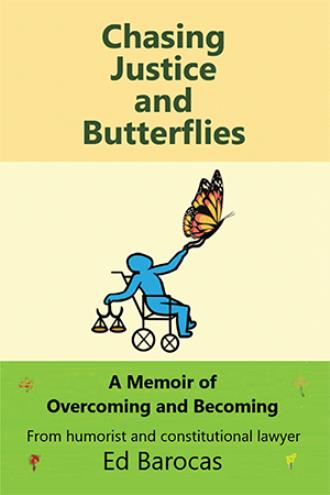
Chasing Justice and Butterflies
A Memoir of Overcoming and Becoming
by
Book Cover & Preview Text
Morris County – “Historically” Inaccessible Morristown is a historic New Jersey town known for its role in the Revolutionary War. When most people hear “historic,” they think quaint and cute with lots of old buildings, and maybe even an olde-timey Village Green in the middle of town. And yes, Morristown has all that. Heck, George Washington slept all over the place there. But when I hear historic, I immediately think “completely inaccessible.” Megan’s Law hearings for Morris County were held in the old historic Morristown courthouse, with its old historic tiny corridors, and with an old historic entranceway you reach by climbing numerous old historic concrete steps. A courthouse cannot be inaccessible to the public, including people with disabilities. But when buildings are not originally designed to be accessible, whatever is done to make them accessible is “makeshift.” And most are not “shifted” from the perspective of the person with disabilities, to figure out what actually works best. The way that Morristown’s old historic courthouse was “makeshifted” was by designating a locked entranceway on a side street near the back of the building to be the “accessible” entrance. A person with disabilities had to ring a buzzer outside a locked door and then wait for one of the police officers from the front entrance to traverse the maze of old-timey corridors to the other end of the building and let them in. For someone like me who can’t raise their arms as high as their shoulders, what makes having to wait in the cold worse is that it entails having to put on a coat. It took me about five minutes using Eddie-mechanics – in this case, leaning my arms up against a high counter or table or ledge - to get the coat over my shoulders. The only item of clothing that was harder for me to put on than a coat was a suit jacket, because it was the same mechanics, but a tighter fit. And it was impossible for me to get a coat over a suit jacket. Each time I had to wear a suit in the winter, I had a choice: Do I put on the suit jacket and no coat (and then hope someone comes to the door quickly to let me in)? Or do I wear the coat and carry the suit jacket in with me, but then get a bit exhausted spending an extra 10 minutes in the bathroom struggling to take the coat off and put the jacket on? Decisions, decisions, decisions. ... On one particular winter day, I got to Morristown courthouse with about 15 minutes to spare before my nine AM court hearing. I parked on the side street, about three cars down from the “accessible” entrance. With suit jacket and no coat, I put on my wool beanie, picked up my soft leather briefcase filled with my files, scooted over to the locked door, pushed the buzzer, and waited... And waited... And waited. I pushed the buzzer again. I gritted my teeth, shivering, and shimmying my shoulders back and forth, trying to shake away the cold… and waited. And then I waited some more. I pushed the buzzer over and over like the most impatient of people who press the elevator button over and over despite it being lit. Still no answer. Over fifteen minutes passed. I was freezing, and I was wondering whether anyone would ever come, and wondering whether I should go back and wait in my car. But then I could miss the officer if or when they did arrive. I realized I would now be late for my hearing. I called my office (I had a cellphone by the time of this particular incident) to tell someone to call the judge’s chambers, but there was no answer as it was just around nine o’clock. It took over 20 minutes, waiting out in the cold, for an officer to arrive. I’m sure I was angry, but I was too cold to show anything but relief. I did manage to ask the officer why that took so long. He simply said that it was incredibly busy at the main entranceway in the morning, so no one was free to go to the handicap entrance. By the time I got to the courtroom, I was about 10 minutes late and the judge was already on the bench. The county prosecutor was already seated at one of the council tables, waiting. My client was sitting in the courtroom, waiting as well. The judge started to castigate me and let me know in unmistakable terms that he does not tolerate lawyers being late for his hearings. He went on for a minute or two, while I sat meekly down at the other council table, taking out my papers and clenching my teeth, still trying to warm up. The judge ended by stating that I’d better have an incredibly good explanation. So (with all due respect to Arlo Guthrie’s “Alice’s Restaurant Massacre”), I recounted my last half hour of Eddie B.’s Handicap Entrance Massacre (albeit without Arlo’s four-part harmony or 8 x 10 color glossy photos). The judge stopped for a moment. His demeanor went from angry to embarrassed. Much to his credit, he not only apologized for the inconvenient, ineffective, and burdensome handicap entrance but also told me, “I will take care of that.” And he did. The next time I went to the courthouse a few months later, there was a ramp leading up to a side door near the front of the building. There was still a locked door with a buzzer, but it was about 20 feet from where police were putting people through the main metal detector, so there was almost never a delay. I felt not vindicated, but honored, given that the judge did this on my behalf (and for others that would follow as well, of course). So at least my twenty minutes of frigid frustration, along with the noble efforts of the judge, resulted in change.
Formats

Book Details
About the Book
BORN DIFFERENT. DEFYING LIMITS. The unforgettable journey of a kid with a disability who transformed every constraint into possibility through creativity, humor, and resilience. With an unconventional approach and attitude, he became a prominent constitutional rights attorney and built a life overflowing with music, outrageous adventure, spirituality, friendship, and joy. Inspiring, yes. But it’s also something deeper. A story of grit earned inch by inch. Of a passion that never let go. Of humor forged in the hardest places. This memoir carries warmth, wit, courage, and hard-won insight that will leave you smiling… and just might change how you see your own life. “Ed is a true hero of the last 40 years of New Jersey’s civil rights wars. He exemplifies the most compelling courage and resolve to dedicate himself to the law and to enjoy life despite struggles with muscular dystrophy. While the frustration of loss from both battles peeks through, Ed remains ever the optimist. The results are a career and life steeped in good works, compassion, great wit, and sharp legal reasoning. This book is an inspiration: all at once a time capsule, a very personal revelation of living with both high stress issues and personal travails, yet a warm and wonderful journey through an amazing life. I could not recommend it more highly!” — Bruce Rosen, free speech attorney and New Jersey Law Journal board member
About the Author
Ed Barocas supervised hundreds of constitutional law cases and won NJ’s Attorney of the Year award. He composed numerous comedy songs, performing them with members of well-known rock bands. He traveled the US, encountering unforgettable characters. And he’s done it all while dealing with slowly debilitating muscular dystrophy from birth.