
Sipes Mill
A Novel
by
Book Cover & Preview Text
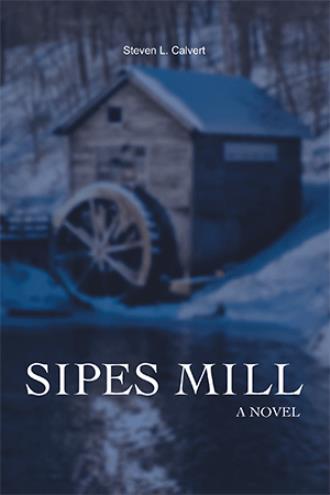
Four miles to Sipes Mill. Rod pressed on, a sailor blown too near the bouldered coast, beginning to hope that, whatever the fate of its sawyers, Sipes Mill was still—oh, he was needing it to be—inhabited. A mile he crawled, waiting for the wheels to slide again. They did. He lifted his feet from the pedals, but it was too late. The Volvo slued implacably toward the trees on his right, nosed over the edge of the road, pitched at an ugly angle, and slammed down into the ditch with a crunch of finality that threw Rod off-balance. Out came the cell phone. Twenty seconds passed without signal bars. He tried the gears again. Forward. Reverse. Nothing doing. A willing but powerless engine filled the cabin with the bass hum of distress. How far, he wondered, might such a racket travel in snowfall so dense? He shut down the engine. The wipers came to parade rest, which encouraged big snowflakes to gather on the windshield, mocking, calling reinforcements down from the canopy of swaying trees above. Sighing, saving the battery for another try in case he dug out the rear wheels barehanded, he switched off the headlamps—and his whole body flinched. A narrow bar of yellow light shone back at him from an unknown distance in front of the car, originating perhaps four feet above the level of the road but out of the trees to his right. The beam found his face, lingered, explored the rest of the Volvo’s interior and then, following the angle of the hood, settled somewhere near the right front wheel. A whoosh of wind whistled across the windshield, streaking the world outside. The yellow beam intensified, widening, closing in. A strong voice rang out, followed by the barking of a large dog. “Everyone all right in there?” Two shadowy figures, suspended in a cloud of snow, made themselves known, one human, in dark clothing, the other wolf-like. How many people there?” The voice came muffled now through a scarf tossed across all but the eyes, up and around a thick wool hat. Standing more or less at his level on the other side of the ditch, shotgun barrel extending well out in front, wooden stock behind, the figure no longer looked so large. Shorter than Rod. The voice called out again, across the wind. “Any dogs?” “Just me!” No point risking telltale grammar with gun-toting mountain folk. The dark figure absorbed this information, and stepped down into the ditch, laying aside the shovel but keeping the gun. The flashlight explored all around the Volvo’s front right wheel, and then the figure retrieved the shovel and stepped back up onto the bank. “You aren’t going anywhere tonight. Get your things and come.” “What about the car?” “Galen will be all night, plowing. He’ll make note of your Volvo, come back, tomorrow probably, tow it down the mountain to his garage.” “I should call Triple-A. Do you have phones up here?” He took a last look at his useless cell phone and shoved it back into his pants pocket. “Phones that work?” “Think we’re all trees and stone walls? You’re welcome to my phone—but in Sipes Mill, you call Triple-A, they send Galen. You have to be frozen. And hungry. I was warming stew. There’ll be enough.” She turned and moved on, flashlight pointing vaguely into the trees, its beam dispersing in snow-fog. It was impossible to tell how far she’d come to find him. By the time Rod pulled his hanging bag from the back seat, left the keys, closed the car doors, and started around the front of the Volvo, the woman, her dog, shovel, shotgun, and flashlight had all disappeared. Was it the unfamiliar hint of courage, or sheer foolishness, believing he could track her through dark and ominously waving pines in snow determined to erase any activity but its own. Urgently he pressed ahead, eventually coming upon an opening in the forest, perhaps a driveway, however disguised in dunes banked and sculpted by the wind. Across this clearing to the left loomed the dark façade of a barn, its door open perhaps four feet, suggesting no animals inside, not in this weather. Where the driveway widened, footprints of savior and dog led up three steps onto a raised, covered walkway connecting the barn to the screen porch of a log cabin style home. As Rod mounted the steps, the muffled yet unmistakable whinny of a horse raised pointed questions about the open barn door. Inside, the porch, despite its screening, was heavily powdered in white. The familiar shovel stood sentinel beside snowy boots. Woman, dog, and shotgun had gone inside. He knocked, found the house door ajar, stepped in and latched the door behind. Rooster, curled on thick bedding, looked up with some suspicion. Above the dog, a rough-planed board had been lined with dowels for coat hooks. The shotgun, broken now, stood in the corner, its exposed barrels emptied of shells. Except for wet gloves on the counter of this country kitchen, nothing appeared to be out of place. Cupboards lined one wall. A large red pot sat on the wood-fired stove that also heated the room. Above the sink, snow could be heard above the puffle of the stove, pelting the outside of the mullioned window that faced out across the driveway to the barn. Suddenly, he caught the smell of her. Not the odor of dog or of a damp winter coat, not the aroma of meat warming in the pot, and not perfume. From no previous experience he knew that this was her scent and hers alone.
Formats

Book Details
About the Book
Leaving Washington, D.C. for home in Pittsburgh, Rod Gaughan gets caught on I-70 in Southcentral Pennsylvania during the killer blizzard of January 1996. As traffic threatens to stop on the icy highway, Rod hears a voice that his dogged him for years: “Go. Now!” He follows other vehicles off the next exit onto surface roads. Consulting his map, Rod takes a big chance: state roads so small they’re numbered with four digits could take him over a mountain ridge to the rainy side of the storm and pick up I-76 home. Near the top of the mountain, with night falling on an unplowed road in Sipes Mill (population 499), Rod’s Volvo slides into a roadside ditch, breaking its left front axle. Rod is rescued by the widowed former owner of the town’s sawmill and offered a bed. In the next forty-eight hours, without television news, and then without any power at all, Rod has time, and the help of his hostess Mary Wood, to confront for better and worse all that has gone wrong with his life.
About the Author
Steven L. Calvert is a Vietnam-era U.S. Navy veteran, a graduate of Dartmouth College, and holds a Rutgers University PhD (thesis on Henry James). He is the author of Alumni Continuing Education (Macmillan, 1987); and has written an unpublished introduction and “decoder ring” to identify all fifty-two different literary allusions in Ray Bradbury’s Fahrenheit 451, and an essay that addresses the controversial ending of Adventures of Huckleberry Finn by identifying the “triple-frame” structure Mark Twain used to back out of the story after overwriting his plot. Steve and Patti live in Bristol, RI, where Steve teaches seminars for Bristol BookFest. They have two daughters—an artist and faculty chair at Washington University in St. Louis, and a NOAA ocean scientist in Juneau, Alaska. There is a grandchild too far away in each location.