
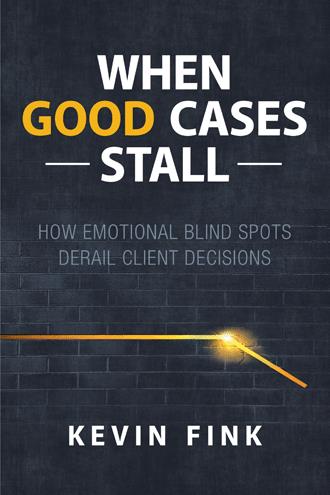
When Good Cases Stall
How Emotional Blind Spots Derail Client Decisions
by
Book Cover & Preview Text
Introduction: The Cases that Should Close…but Don’t If you’ve been in this business long enough, you know the feeling. You walk out of a case thinking you nailed it. Everything made sense, the strategy was solid, and the prospect agreed with you. There were no real objections during the conversation, and nothing felt off. When you suggest moving forward with the application or paperwork, you expect it to proceed without delay. And then it happens. “I want to think about it.” And it doesn’t happen occasionally. It happens just often enough to keep you from ignoring it. From your side, it looks like an objection. It sounds like hesitation, uncertainty, or maybe a need for more information, even though the response is being driven by something other than the facts being presented. So you do what you were trained to do. You go back through the numbers, clarify the recommendation, and handle the objection. You try to remove whatever is getting in the way, because that’s what we’re taught to do when someone hesitates. Sometimes that works, but a lot of times it does not. Something that felt like a done deal starts to slip. Follow-ups stretch out, and responses slow down or stop altogether. The case that should have closed without any problem quietly stalls. They look for a better way to present the numbers, a stronger way to handle objections, or a more effective closing technique, assuming the problem can be solved with more explanation. But it usually isn’t any of those things. What actually happened is that something was running in the background the entire time, and it finally came to the surface when the decision mattered, not as confusion, but as resistance. It wasn’t a logic problem. And if you’ve been treating it like one, you’ve been trying to solve the wrong problem. It was an emotional one, driven by experiences and beliefs that had been in place long before the recommendation was ever made. If you’ve seen this pattern, you’re exactly who this book was written for. Who This Book Is For This book is for financial advisors who: • Believe in planning • Care about their clients • Value integrity over pressure • Want greater predictability in case closure It is for advisors who are competent, experienced, and capable, and who suspect there is something happening underneath the surface of financial decisions that traditional training never fully addressed. If you are looking for scripts, objection tactics, or pressure-based techniques, this is not your book. If you want to strengthen the reliability of your planning process without compromising your standards, it is. Because most of us were trained to approach these situations in a way that no longer works when decisions get real. The Myth We Were Taught Most of us were trained to believe that good advice leads to good decisions. If the plan makes sense, if the numbers are clear, and if the recommendation is sound, the prospect should move forward. If they don’t move forward, we assume something is missing. So we explain more, clarify more, and try to remove whatever is getting in the way. So, we respond by adding more logic, more explanation, and more reassurance, assuming the issue is still being processed rationally. And when that doesn’t work, we fall back on what we were taught and attempt to overcome the objection. That approach works when the problem is a lack of information. It doesn’t work when the hesitation is coming from something deeper that is already shaping how the decision feels. Because in those moments, the prospect isn’t reacting to your recommendation. They’re reacting to their own history with money, risk, loss, and uncertainty, which is shaping their response before they consciously evaluate the decision. Unless that gets identified and addressed, no amount of additional logic is going to move them forward, because the decision is no longer being driven by logic. I didn’t fully understand that until I saw it in my own life. My Experience Changed My Perspective I’ve spent three decades in financial services, twenty-five of those as a Certified Financial Planner®. I served as the national trainer for MoneyTrax, Inc., working with advisors across the country, and I ran and taught in a Certified Financial Planning® certification program in Houston while also teaching personal finance to undergraduates at the University of Houston. Over the years, I’ve helped thousands of individuals, families, and business owners grow and protect their wealth. And for a long time, I believed exactly what most advisors believe. If I could explain something clearly enough and the numbers worked, if the plan made sense, the case would close. Then my own life forced me to confront something I had never fully examined. A belief that formed when I was eleven years old that quietly influenced my financial decisions for decades in ways I didn’t recognize at the time. Even worse, they were operating automatically without my awareness. Not because I lacked knowledge, and not because I didn’t understand risk, but because something emotional was operating beneath the surface that had never been identified or recalibrated. Around that same time, I became deeply involved in leadership development and advanced training in human behavior, including Neuro-Linguistic Programming (NLP). That work changed how I understood decision-making. Strategy and structure matter. But behavior determines whether a decision actually gets made, regardless of how strong the logic behind it is. That intersection between financial strategy and human behavior is where this book was born. For me, it took a moment in my own life that forced me to confront something I had never fully examined. I’ll come back to that. And it leads to a simple but important shift in how we think about the planning process. The Big Idea The traditional four stages of financial planning are not broken: 1. Discovery 2. Analysis 3. Recommendation 4. Implementation They are structurally sound, but something critical is often missing inside them. Cases do not fail because prospects lack information. They fail because something emotional was never identified, examined, or resolved early enough.
Formats

Book Details
About the Book
You’ve seen it before. The analysis is sound. The recommendation fi ts. The client agrees. Then the case stalls. Most advisors assume the problem is communication. They refi ne the presentation, handle objections more aggressively, or add more detail. But stalled cases are rarely about logic. They’re about what happens when a decision becomes real. In those moments, prospects aren’t evaluating your recommendation. They’re reacting to their own history with money, risk, and uncertainty. And if that layer isn’t addressed early, no amount of explanation will move them forward. In this book, Kevin Fink draws on three decades in fi nancial services and advanced behavioral training to show why agreement doesn’t lead to action, and what actually does. You’ll learn how to recognize emotional decision risk before it shows up, how to surface the patterns driving hesitation, and how to help clients experience decisions in a way that makes them easier to follow through on. This is not a book of scripts or pressure tactics. It’s a shift in how you see the planning process. Because the plan doesn’t matter if the decision never gets made.
About the Author
Kevin Fink has over 30 years in fi nancial services. He has trained advisors nationwide and taught financial planning at the university level. Today, he helps advisors improve decision outcomes and close more consistently by integrating behavioral insight into the planning process.