
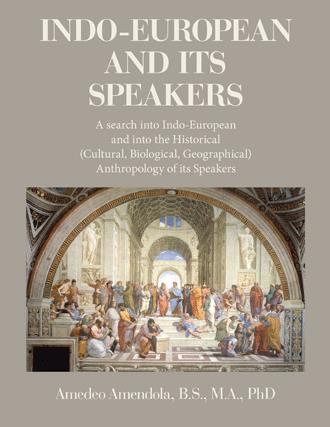
INDO-EUROPEAN AND ITS SPEAKERS
A search into Indo-European and into the Historical (Cultural, Biological, Geographical) Anthropology of its Speakers
by
Book Cover & Preview Text
There cannot be such a thing as an “absurd conception”, for a conception is, by definition, a meaning, and “absurd” means “meaningless”. (“Absurd Conception”, “Circular Square”, and “Dehydrated Water” are self-contradictions – meaningless locutions. As such, they do not denote anything.) These absurdities arise, or are intentionally constructed, from the indiscriminate use of language, and that is why Aristotle differentiated the various “linguistic” fallacies (slips or deceptions) from the various deductive reasoning processes that lead to invalid (not necessary) conclusions. (The Stoics were the most significant logicians after Aristotle.) My slip involved the use, in my speaking or type-writing, of a word (“barrow”) that sounds almost like the word “borrow” that I had used in my thinking: They are “homophones”, which deceive. Here comes what I learned from books as to what an etymologist should know.
Formats

Book Details
About the Book
This book, Indo-European And Its Speakers, is about some old European and Middle Eastern extant words, not about the artificial “Proto-Indo-European language” [PIE], or a Dictionary of its roots, or the history of researches and theories the geographically defined Indo-European languages. It is a diary of original, sporadic excursions, researches, and critiques in the field of postmegalithic Proto-European cultural anthropology and, most emphatically, an empirical archeology of some European and Mideastern words. By etymologies and analyses, it shows that the source of various languages (including Anglo-Saxon, Etruscan, Eblaite, and Basque) is Archaic Greek, its epicenter being the Pre-Semitic Levant. The speakers were or are the Caucasians who grew in *Proto-Europe, by the Euphrates, the Jordan, the Nile, the Tarim, the Hindus, the Ebro, the Danube (Istros), the Thames, and the Tiber rivers. The primordial “Greeks” created their own language, the alphabetical writing of their language, grain agriculture, viticulture, and, once in the Aegean region or, so to speak, in the shadow of Mount Olympus, the first Humanistic [“Age of Men” or Intellectualistic] Civilization of world history. This book, which is incidentally an auto-biography of a mind at work, is for deliberately slow and studious readers who believe that “nihil humani mihi alienum est” (nothing human is foreign to me). Oh, that sounds so scholarly! No, no... It is for students and for people who, having no eternal future in view, stretch their lives into the long past – antiquarians, archaeologists, and philologians! Nevertheless, it calls for new researches and lays the basis for a continued exploration, through languages, of the Pre-Semitic history of the Fertile Crescent and the whole Middle East, for archaeology in Magna Graecia, and for a new anthropogony (genealogy of humans).
About the Author
Amedeo Amendola was born in a small town in southern Italy, in a district named after Hermes, in the heart of what the Romans called Magna Graecia. The history and language of this town are dealt with in the second chapter. Since pre-school childhood, he was eager to learn how to read and to write just as grown-ups did around him. He has never stopped being a learner. Most of his high school years were spent in a boarding school in Roma, Italy, the curriculum (“Classical”) being still the one prescribed by the Sicilian philosopher and minister of education Giovanni Gentile. Thereafter, in the U.S.A., he attended college and universities and obtained degrees in science and in philosophy, but did not study linguistics; his investigations of languages and of other fields, such as music and jurisprudence, have been a private intellectual hobby of his, even though as a student in a choir, once he sang at the old Metropolitan Opera House of New York City. Later on, that venerable building was demolished but, thanks to Edison and his legacy, the great voices he loves have been preserved. On occasions he worked in stores. Once he received a philosophy teaching scholarship. He, who loved trigonometry [98% in Regents test], served as a survey artillery man (during the US-Cuban crisis, still an age of slide-rule computations) and even wrote a lesson plan for a lieutenant to teach survey. He married Alda. He taught philosophy and some languages. For class use, in 1974 he published “Philosophical Scenario and Disquisitions", one of which originally puts forth "the Age of the Recontrivance”, still our civilization since the 17th century.