
Madam Lasagna and the Dead Frog
A Novel of Life, Love, and Neuroscience
by
Book Cover & Preview Text
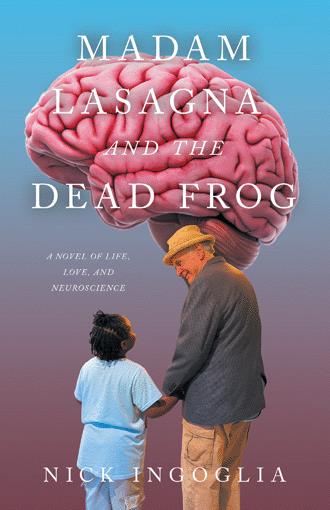
In the autumn of 1984, gunshots ring out at a Harlem schoolyard in Manhattan and seven-year-old Shiloh Johnson falls to the ground, bleeding from a head wound. The narrative shifts to a seminar two years earlier, at New York University. Reese Knightly, a famous neuroscientist, is lecturing about research on memory in rats. In the audience, Roger Bansky, a newly minted PhD, who will begin his first position as a neuroscientist that fall, and Grace Pliset, a former student of Rogers, listen attentively. Grace has studied ballet since she was four, but now at 26, after several knee injuries, is considering an alternate career. Roger leaves the lecture seeking adventure before setting up his lab, while Grace embarks on a vacation with her society mother. As Roger drives north, he picks up two hitchhikers, Rosy and Tim. The three share rock music, marijuana and life-stories ending up at “Chez Hendrix”, a ‘sketchy’ resort for singles trying to relive the carefree hippy days of the Woodstock concert. Roger meets Wanda, the hotel’s outrageous, hyper-sexual owner, Madame Lasagna, a spiritualist who conducts séances at the hotel, and Leslie, an attractive, 20 year old Australian woman, traveling across America to visit the famous rock-and-roll venues of the ‘60s. Roger becomes infatuated with Leslie and re-thinks his choice of life as a bench scientist; he considers following her back to Australia. In the lab, Roger meets Bakari Johnson, a bright, 17-year-old African-American high school student from an impoverished family (his sister - Shiloh, is the young girl shot in the opening pages), and Ridley Greif, Roger’s idealistic chairman and elder statesman, who recruited Bakari to help Roger in the laboratory and is encouraging Bakari to consider a career in science. Bakari works diligently with Roger as they attempt to discover why fish and frogs can regrow a severed spinal cord, but mammals cannot, with the goal of applying that knowledge to solving human paralysis. An unexpected, finding leads Roger to present a seminar to his colleagues. His findings are ridiculed by some and challenged by others. Roger must design an experiment that will prove their iconoclastic findings to a skeptical scientific audience. While neither Roger nor any of the senior scientists can think of an experiment, Bakari devises a simple plan. He and Roger successfully perform the experiments, solidifying the resolve of Roger and Greif to help Bakari in his educational path. Meanwhile, Grace, enthralled by his promise to cure Alzheimer’s disease, joins Knightly’s lab. To her dismay, Grace doesn’t find a hotbed of scientific thinking, but rather, a bullying narcissist who may be falsifying results to build his own reputation. Grace must decide if she will confront Knightly or ignore his malfeasance and move on with her career. Roger (with whom Grace has developed a close platonic, but not romantic relationship) warns of the consequences of challenging Knightly. But Grace, through a period of gut-wrenching introspection and an inspirational “walkabout” in New York City, devises a plan to expose Knightly. In a heated confrontation, Grace prevails over Knightly leading to his resignation. Bakari works diligently in Roger’s lab, but one autumn day announces that he must leave early. Roger suspects something illegal, and they work for six months under a cloud of suspicion. In the spring, Bakari abruptly announces he can now stay as late as he wants because daylights savings is over, and he doesn’t have to pick up his sister, Shiloh, from school. Bakari brings Shiloh to an informal scientific presentation by Ridley Greif. When Shiloh and Greif are introduced, they share a delightful conversation about the worlds of fine art, classical ballet and uncomfortably, why colored girls were not allowed to become ballerinas. When Greif asks what she wants to be when she gets older, an artist, a scientist? Shiloh says no, she wants to be a ballerina like Janet Collins, the first colored girl allowed to dance with The Metropolitan Opera. Shiloh takes her place at the end of the conference table while Greif describes thrilling results of experiments on frogs that he heard while visiting a lab in Scotland. At the end, Roger discovers a drawing Shiloh has left of The Dead Frog, (raising the issue of the ethics of using live animals for research). As he is leaving, Roger spies Grace and Shiloh in the hallway. Grace is demonstrating dance positions to Shiloh. Bakari must choose between joining his uncle’s business (where he can help support his family), and a path in science (where he would earn little and could take a decade or more to become a scientist). This dilemma is brought into shattering focus when Shiloh is shot. Through neurosurgery, Shiloh’s prognosis improves, but her future ability to walk, let alone dance, is in question. In the gloom of her recovery, her spirits plummet, and nothing her family, Greif, or Roger can do help her. Grace too tries unsuccessfully to comfort Shiloh. In in a moment that highlights her spirit of hope and perseverance, Shiloh asks, “Grace, when I get better, will you teach me to dance?” Greif, realizing the depth of Bakari’s financial problems, creates an anonymous scholarship that offers a stipend to help Bakari’s family while he attends college. Thus, opening a door for Bakari to pursue a career in science, without abandoning his family. Grace decides to forego dance and will give science a chance, ignoring her mother’s dictum that ‘science is no place for a woman’. Roger, now certain that his decision to enter research, rather than follow Leslie, was correct, feels a surge of confidence. He and Grace share a poignant moment walking along The East River and prepare to part. But when Roger leans in for their ritualistic ‘see ya’ platonic kiss on the cheek, Grace meets his lips with her own open lips and a delicately extended tongue. Roger reacts with an involuntary sexual reaction (an erection) described in neurophysiological terms in the ultimate mix of storytelling and science, as the novel ends.
Formats

Book Details
About the Book
It’s 1982 and Roger Bansky, a recently minted PhD in neuroscience, is about to establish his own research lab. But first he wants an adventure. He travels to Woodstock, the home of the iconic concert. There, he teams up with Rosy, Tim and Leslie (with whom he has an affair). The three clash with Wanda, the deceitful, hypersexual owner of the Chez Hendrix hotel, and Madam Lasagna, a sketchy spiritualist from The Bronx. Roger’s carefree weeks of sex, drugs and rock n roll lead him to question his goal directed path as a scientist. As Roger sets up his lab, he is joined by Grace, a former ballet dancer, who seeks a new passion after being injured, and Bakari, a talented 17-year-old African American high school student assigned to help Roger. Grace is enthralled by the research of Reese Knightly, a prominent scientist, and joins his lab. But when she discovers that he is likely committing scientific fraud, she faces a dilemma: do nothing and move on with her research or expose him and risk destroying her career. Bakari plays a major role in ground-breaking research, but when his 7- year-old sister is shot in a drive-by shooting, he faces a choice between leaving school to help his family and pursuing science. Senior scientist Ridley Greif oversees the lives of these young people and searches for a way to encourage talented young people like Grace and Bakari to explore futures as scientists. This novel skillfully blends the thrill of real laboratory research in neuroscience with the struggles of a diverse group of fictional characters trying to find purpose in their lives.
About the Author
NICK INGOGLIA is a retired research neuroscientist, dean and educator. He and his wife live in New Jersey , within a NJ Transit bus ride to Manhattan!