
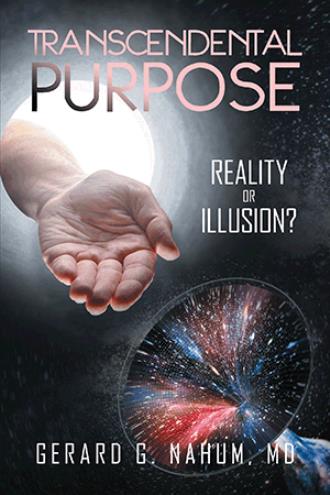
Transcendental Purpose
Reality or Illusion?
by
Book Cover & Preview Text
Formats



Book Details
About the Book
The forensic mystery begins with a bizarre death, but it quickly evolves into a philosophical and scientific investigation of causality, explanation, and the limits of human understanding. Justin Brinker, a former insurance executive turned private investigator, is hired to examine the demise of Arnold Charter, a respected engineer who was found almost entirely incinerated inside his locked home. Authorities discover that a small, intensely localized fire occurred, but even after a full investigation, they are at a loss to explain what happened. The coroner ultimately lists his cause of death as “Spontaneous Human Combustion,” a term unfamiliar to the insurance company and unacceptable as an explanation. Justin’s professional life is built around predictability, mechanisms, and quantifiable risk. During a detailed investigation, he finds the circumstances surrounding Arnold’s death do not conform to normal expectations. Nonetheless, they are far from unique: hundreds of similar cases share a striking resemblance across the centuries—the victims are alone, the fires are localized, they reach scorching temperatures, and there is no evidence of any flammable material. The coroner deepens the mystery by explaining that causes of death always involve two different questions: how and why. The “how” of what occurred is often straightforward—a heart attack, trauma, major organ system failure, etc. But the question of “why” always devolves into an infinite regress of questions pointing to a web of antecedents rather than a straight line. What follows is an interrogation of the foundations of explanation itself. The story proceeds through investigations in philosophy, physics, thermodynamics, mathematics, quantum theory, relativity, cosmology, information science, and theology—each discipline offering a partial lens on causation, the illusion of continuity, and the overarching imperative of purpose. Justin discovers that the world does not operate according to the smooth, mechanistic causal chains that most people imagine exist. Instead, reality is permeated by discontinuities, hidden antecedents, and informational architectures that challenge conventional notions of reality and existence—all supporting the notion of a transcendental purpose residing in a higher-dimensional realm.
About the Author
Gerard G. Nahum is an American author whose work spans multiple genres. Across nonfiction, fiction, educational texts, children’s literature, scientific articles, and metaphysical syntheses, he develops a single, coherent intellectual project: Reality is informational, relational, and purposeful. In his early nonfiction, Predicting the Future, he examines the limits of prediction resulting from incomplete information, quantum uncertainty, resonances, entanglement, coherence, and chaotic dynamics. In How to Make the Future Into What You Want It to Be, he extends this analysis to practical agency, showing how individuals can act effectively within these types of structural constraints. In his science fiction novel The Prime Network, these ideas are dramatized in a world that is constructed from the dynamics that occur in higher-dimensional informational networks. His children’s book When You Were Small introduces purpose and meaning in an accessible form, while Things You Can Think teaches conceptual literacy to adolescent readers. In this culminating work, he presents a unified metaphysical framework where reality is posited to be informational, causation is emergent, agency is fundamental, and purpose is foundational.