
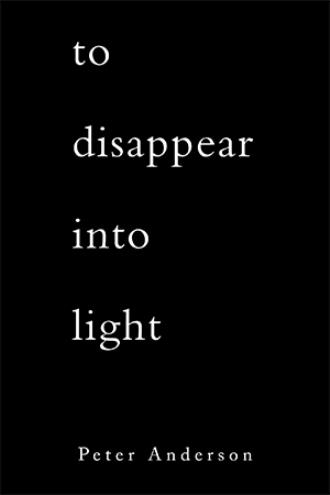
to disappear into light
by
Book Cover & Preview Text
In all comic tedium, Kooser, Lance-Corporal Kooser, thinks he is king. Watch him. Cap tilted down so low on his nose that he holds his head back like a camel, he walks, cake walks, over to his baby — he calls it his baby. This big bald thing with a pot belly, beak pointing up at the sky, that churns out the concrete we pour. "Mm-mm," he hums aloud, his yum-yum song. We know what he’s going to do. We’ve seen it all before. He’s going to go and sit on a splatter of dried concrete under that bloated iron belly, draw up his knees, pull a spoon out of his boot, and look around. Noon. Time for lunch. Boiled potato and a wet slap of cabbage. "Mm-mm-mmm." He’s in high spirits, is Klaas Kooser. Promoted last week, and so pleased with the yellow V where the state has wiped its butt on his sleeve that he likes to twist round and eye it. Watch. He keeps up his swanky walk, this way and that, and then, just as expected, sits down under the bulge of his baby's belly. Nothing to do now but wait. My wheelbarrow lies where I left it, overturned, empty, elbows in the air. You can smell the raw cement. Up above is clear blue sky, nothing to hold onto there. In my head, a foot sloggers' song from a war a world away and long ago: we're here because we're here because we're here because we’re here in barren good cheer. The winter sun burns fierce and white, very distant, cold. Now and then, a thin wind blows. I stand clicking together, rolling round, a handful of crushed and broken gravel stones from the sprawling mound behind me, rattling them round in my fist. I could pitch them to the ground, maybe. Roll the dice, take a chance. Kooser waves the bent spoon he has pulled from his boot, beckoning. "Hey, Kafkop .” My name is not Kafkop. I open my hand but guard it from him. On the Skeleton Coast, they say, you can walk forever, and see no other living being, only cast-up whale bones, seal bones, sea-scoured, bleached. You will also see, gaunt and towering, the black and rusted hulk of one wrecked ship after another. Then, when the tide draws out, you may find, if you look, diamonds in the sand. All you need do, they say, is keep an eye out for the gleam. No such luck around here, though. My name is Niemand, Ekhart Niemand, called Ekko. I am, as they say, of no fixed abode save Tant Grietjie’s boarding house in Booysens, Johannesburg. Hefty Tant Grietjie, with her phlebitis of the leg, and the bandages sagging down about the ankles. She owns two cats: Skroppie, the marmalade tom always on the prowl, and Bokkie, the black cat with the white bow tie; also a dog, a spiteful little Pomeranian who happens to hold a very high opinion of himself and look like a plump feather duster. In order to earn enough, but just enough, to live on — small change, so to speak — I do deliveries for Speedy's Same Day Dry Cleaners. Which is all right with me: it gives me time to read. I own a hundred and thirty-four books. I used to be at the university. Spent only too many years studying, among other things, literature and philosophy. Got entranced with Plotinus. Then I met Gina, she of the broad-brimmed black hat, the lines of wisdom and laughter about her mouth, and politics. She smokes cheroots. But I don't want to talk about it (her) now. Kooser is growing restless, showing signs of annoyance. "Ag , no, Kafkop, man! Don't make like you don't hear me." "Korporaal?" He makes a menacing swipe with his spoon. "Ja, jong! Come when I call." Unclipping the part of his water bottle that doubles as a mug, the bottom, he holds it out with a grin. His two front teeth are missing, but he likes to press his tongue into the gap and wiggle it. "Deh," he says — a grunt, not a word — meaning: "There. Take it." "Tea, korporaal?" "Of course, ja! What do you think?” He squints up at me, wiggling his tongue. “Also, listen, troop , some of those nice clean white potatoes, and a big piece of cabbage. Cut it up, the cabbage, make it into neat little strips for your corporal, so he doesn't have to chase it all around with his spoon if it slips." Pig pans. That's what we call the pressed steel trays that our rations get dished up in. This is where we are then, the lot of us, stuck out on the edge of the Namib in the middle of a war that is not happening, although there are rumors of skirmishes to the north. Sand, boulders, and the odd patch of dry grass. Otherwise, nothing. Except, at the foot of the slope, if you trouble to look, a sunken chain of interlinked pools, grey as lead, unmoving, fringed with toxic-looking emerald-green reeds: Hamerspruit . On aerial maps it shows as an obstacle. Which is why we got trucked out here in the first place. To throw up a bridge. As yet, no such thing exists — only a length of rope slung sagging from this slope to that, and two pairs of wooden towers, cheap plank structures patched together to hold the wet concrete in shape until it sets. Construction will be over soon enough and the bridge will stand stark and bare, flat and straight, white as quick lime under the sun. Then, within days, led by a scudding, Yank-looking jeep, the first convoy will roll up: stertorous grunting army trucks, nose to tail as if on parade, towing bulky artillery draped in desert camouflage, and in between the trucks, now and again, one or two of those squat, bloated armored cars we call hippos, each with a soldier in beret and dark glasses sticking up from the hatch. Finally, maybe, far behind, long lines of foot sloggers with floppy hats and shouldered rifles, marching, or more likely trudging, too tired to do anything but trudge. No tanks, though. No groaning, rattling behemoths. The dead-eyed men in the capital — that whited sepulcher, its jacaranda-lined, well-policed streets so distant from us here as to be better blanked out, forgotten — the dead-eyed old men of the capital long ago drew a worldwide arms embargo down on our heads. Because we’re here.
Formats

Book Details
About the Book
South Africa, 1974. Apartheid has hardened into a suffocating stasis. Beneath the outward calm of white supremacist rule, however, forces are gathering that will soon erupt in the townships. Ekko and Gina are white university students, rivals, lovers, and restless spirits. Meeting in secret, they read Frantz Fanon’s The Wretched of the Earth, whose uncompromising vision begins to overturn everything they thought they understood. As Fanon’s ideas take hold, the unthinkable begins to seem not only possible, but necessary. If violence sustains an unjust state, can violence also help to bring it down? Convinced that they must act, Ekko and Gina embark on a course that will test the limits of political resistance— and of what they are willing to become. A searing political novel and a profound reckoning with spiritual transformation, To Disappear into Light is Peter Anderson’s morally arresting call-and-response to his earlier novel, The Unspeakable.
About the Author
Peter Anderson is a critically acclaimed South African novelist, a prize-winning poet, and a strikingly original visual artist. A recovering academic, he lives alone in a small town notable for its defunct railway lines.