
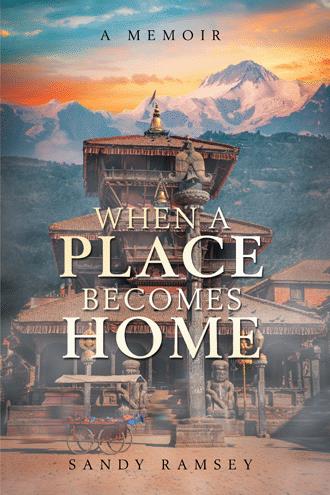
When a Place Becomes Home
A Memoir
by
Book Cover & Preview Text
Leaving Without Wanting to Leave By the time I reached the Kathmandu airport on March 9, 2020, I had already said goodbye too many times. The last several days had been filled with lunches and dinners. Friends kept feeding me, hugging me, putting tikas on my forehead, and asking when I would return. At Northfield Cafe, I listened to sarangi music for what I believed might be the last time. Then there was one final lunch, one more tika, and a white farewell scarf placed around my neck. I had lived in Nepal for several years. I had arrived with one carry-on suitcase and the idea that I might stay for five months. Now I had given away my kurtas, packed and shipped the objects I could not leave behind, taken pictures off the walls, emptied my kitchen, and closed the door on another apartment. Every time I moved, I swore it would be the last time. I had been swearing that for years. The airport was almost empty. Holi should have filled Thamel with bodies, color, water, laughter, and tourists who had no idea what they had agreed to when they stepped into the street. Instead, the streets were nearly deserted. News about a virus was spreading faster than the virus itself, or perhaps not. No one really knew yet. The airport floors were being scrubbed. Workers wiped surfaces. Passengers kept their distance from one another without knowing that distance was about to become the organizing principle of the world. My plan was to fly through Dubai to Dublin, spend some time with Hira in Ireland, and then return to the United States to be near my children, grandchildren, and mother. I was seventy years old. My family had been pulling at me for some time. So had Nepal. I did not want to leave. That is the part a travel itinerary cannot show. A ticket can tell you where a person is going. It cannot tell you whether they want to go. On Facebook, I wrote about making a difficult personal decision to be near my family. That was true. I wrote that I was confident the projects would continue without me. I hoped that was true. I said I did not expect to return to Nepal to live. That turned out not to be true, at least not inside me. I was not leaving because Nepal had stopped being home. I was leaving because people I loved were in another home, and I had learned that love does not always allow the clean choice. Sometimes it gives you two true things and no way to honor both at once. I had not planned to leave Nepal in pain. I had not planned to resign from the school I had helped develop. I had not planned to spend months trying to arrange a conversation with Mina and failing to have it. I had not planned to dismantle the apartment, distribute the life I had built, and leave with so much unfinished. Then again, life had never shown much respect for my plans. I had not planned to live in Nepal either. Years earlier, I had retired, packed one carry-on, and told my adult children I was going to keep traveling. Nepal was one stop on a larger journey. I had been there before. My nonprofit had worked with organizations there, especially Women for Human Rights, which supported widows. I knew people. I knew enough about Kathmandu not to mistake arrival for discovery. I also had a tourist visa and a five-month plan. The plan did not survive contact with my life. At the airport, I stood with the scarf around my neck and the last tika still visible. I was headed toward Ireland and did not yet know that COVID would lock me there for nearly six months. I did not know that I would return to Kathmandu in 2021. I did not know that I would email Lily and tell her I was moving back, even though that move would not happen. I did not know how many more years family needs would keep me in the United States, or that I would spend those years saying the same thing to Lily every few weeks. I am coming back. What I knew was simpler. I was leaving a place I loved, and I did not want to go. To explain why, I have to return to the beginning. Not the first time I visited Nepal. The beginning came later, when a place I already knew stopped being a destination and became the center of my ordinary life. It began with four flights, one carry-on suitcase, and a plan to stay five months
Formats

Book Details
About the Book
What makes a place feel like home? Is it where you were born, where your family lives, or the place where you feel most alive? In When a Place Becomes Home, Sandra “Sandy” Ramsey shares the story of leaving the familiar behind and building a life in Kathmandu, Nepal. Through lively, tender, and sometimes humorous memories, she writes about teaching children, challenging harmful traditions, training teachers, responding to the devastating 2015 earthquake, navigating constant cultural confusion, and finding joy in ordinary moments, from buying vegetables at a street market to listening to music drift through her kitchen window. This is more than a travel memoir. It is a story about courage, belonging, grief, purpose, and the surprising discovery that home may be waiting for us far from where we began. Sandy’s experiences invite readers to consider what it means to truly belong and whether the life that feels most authentic might exist beyond the boundaries of what is comfortable and expected. Sometimes we travel to see a different part of the world. Sometimes we travel and discover a different version of ourselves.
About the Author
Sandra “Sandy” Ramsey, MA, LMFT, LPC, is a therapist, educator, writer, and lifelong traveler. After raising four children and building a career devoted to helping people create more authentic lives, she moved to Kathmandu, Nepal, where she spent nearly eight years working in education, training teachers, supporting children and families, and participating in earthquake-relief efforts. When a Place Becomes Home grew from her experiences of discovering that home is not always the place where we were born. Sometimes it is the place where we feel most awake, most connected, and most fully ourselves. Sandy currently lives in the United States but plans to return to Nepal, the country that captured her heart and taught her what it means to belong.