
Exceptional Endeavors
by
Book Cover & Preview Text
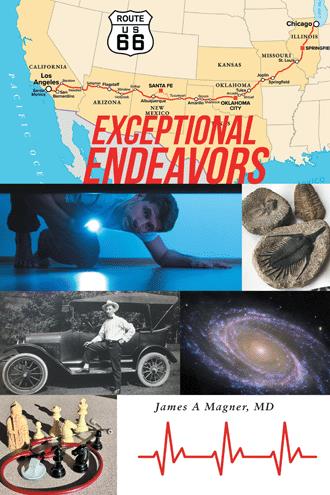
They brought me one evening to the surgical intensive care unit where a middle-aged woman lay intubated on a respirator with multiple IV lines, a foley catheter, a chest tube, etc. She had been shot in the chest and abdomen four times by her husband and had been stabilized in surgery that day. The surgeons told me to watch her all night, keep track of all the central lines, IVs, medications, blood transfusions, urine flow, chest tube output, vital signs, respirator settings, blood gases, etc. and give them a call if I had any serious problems. I was thrilled by this opportunity to manage a complicated and very ill patient along with a skilled nursing staff, and, characteristically and quite understandably, the surgeons were thrilled to leave these medical tasks to a bright student so that they could get back to the operating room. Different people are just naturally inclined to different sorts of challenges. All went well until midnight, when a hospital security officer peeked into the intensive care unit to see me. “Hey, doc, got to talk to you,” he whispered, and although I was wearing a white coat, I was not a doctor, just a fourth-year student. “We just got a call that this lady’s husband found out she is still alive, so he has grabbed his gun and is on his way to the hospital to finish her off.” “Oh,” I replied numbly while holding two clipboards and three flowcharts. “Just wanted to let you know, doc, so that you can be ready if a man comes in here.” He shrugged and then added, “The Chief asked me to sit down the hall for a couple hours, so I’ll be there.” ……. Merle was just bringing the tow truck back to the shop right now, and he would be happy to tow us into a place he knew in Little Rock that could fix our Dodge. In a half-hour a very large tow truck pulled in driven by a very muscular young man. I helped Glenda up the high step into the front seat next to the driver, then I stepped up, slid onto the seat, and shut the door. Off we went to retrieve our sick car. Merle told us to take any other valuable things out of the car, since he would drop the car at the dealership, and then drop us at a nearby motel. This time as I reached into our Charger I had a couple of minutes to stuff the Communist newspaper into one of my small bags out of sight. I didn’t want that in my car where the workmen would see it. Merle raised the front wheels of the Charger and hooked it up, we climbed back into the front seat, and off we went to Little Rock. It was now dark, and within a couple minutes I realized that we were going about 85 mph. I looked back and, yes, our car was still dragging along behind. Next, I realized that on the dashboard in front of our driver was a large black pistol without a holster, and next to that there was a three-inch thick stack of bills secured with a couple of rubber bands. “I guess you are ready for any trouble,” I said in a loud voice to be heard above the roar of the truck as I pointed at the gun. “Yep,” said Merle. “OK if I put on the radio? My favorite show is on now,” he added. Not being in an argumentative mood, I agreed, and he clicked the button. The church choir was just starting “Holy, Holy, Holy,” and Merle turned the volume up higher as the engine roared. I think he also picked up the pace to 90 mph. Our car, remarkably, was still attached. The next few minutes were quite memorable as we raced along the highway in the dark, swerving around slower traffic, with the church choir on the radio at full blast. Soon we were at the dealership where we dropped the car by the front door. A few blocks away at the motel we bid farewell to Merle with our sincere thanks and a small tip ---- small since Glenda and I at that point barely had any money in our checking accounts. Merle did his job well, and he did it in style. Arkansas style! ……. In about 2011, while on a Southwest flight to Denver, a medical emergency was announced about ninety minutes before landing. No other doctor responded so I identified myself and was taken to see a 30-year-old man who seemed to be poorly responsive in a window seat. Two strangers got up out of my way, and I quickly determined that he was mumbling and had cold, clammy skin. I immediately ordered a man to help me lift him out of his seat and we gingerly lowered him flat on his back in the aisle while I instructed a flight attendant to elevate his feet to her waist level. They brought me a small bag with a stethoscope and blood pressure cuff. I asked for a flashlight. His initial pressure was 80 systolic but within two minutes it was up to 100 and he could answer questions. His pupils were equal and reactive. He said he was not diabetic and took no insulin or other medications. He stated that he had severe diarrhea for 24 hours, but he thought he was doing a little better that morning and he didn’t want to cancel his trip. By then we were going to be landing, so I directed him to stay on his back in the aisle, and a medical team should take him off the plane first. The announcement was made that passengers should stay in their seats to allow emergency technicians to stretcher him out of the plane first, and everyone cooperated nicely. I told the emergency techs what I knew and my assessment – probably just dehydration from diarrhea – and directed them to check his fingerstick glucose and give plenty of normal saline with standard potassium on the way to the ER. As I walked out with the stretcher, the Southwest gate agent called me aside and made a brief note as he looked at my driver’s license and medical license. He then profusely thanked me and said that in a moment I would be given a certificate for $100 value off a future Southwest flight, but I had to sign a form to receive it, which I gladly did. ,,,,,,,, The 1924 Ford Model T coughed as steam wafted from under the hood. Frank slowly pulled off the New Mexico dirt road. He gave an exasperated glance at his wife beside him. Helen showed no signs of distress. It had been one small problem after another for more than a week, but she was taking it all in stride – this was an adventure of a lifetime. Frank stepped out of the car and looked forward and backward along the rutted dirt road. No traffic at all today on this deserted segment of Route 66, “The Mother Road.” Since opening a year ago in November 1926, some called it “The Main Street of America.” At age 41, Frank stretched his tired limbs and took off his sweaty driving gloves knowing that his muscular frame, used to labor on the Illinois farm, would recover quickly. The sun was low in the west -- almost time to stop for the day anyway. They had been on a gradual climb in Northeast New Mexico in recent hours, so the three-year-old car, which was in pretty good shape, just needed to cool off. “Helen, I think we’ll call it a day and pitch our tent here. I’m ready for supper anyway. We made good progress today.” ……. I always have a slight feeling of pity for the man with no knowledge of chess, just as I would pity the man who has remained ignorant of love. Siegbert Tarrasch (1862-1934) In the laboratory the gambits all test unfavorably, but the old rule wears well, that all gambits are sound over the board. William Ewart Napier (1881-1952) I would rather have a pawn than a finger. Reuben Fine (1914-1993) People the world over like games. They watch game shows on TV and hours of sports. But most Americans like action rather than puzzle-solving. They enjoy the baseball slugger at the plate in the ninth inning, the crack of the bat, the roar of the crowd, the determined outfielder racing toward the left field wall. They are on their feet when the football running back slices through the flabbergasted defense. The audience appreciates superb athletic performances as seen in Olympic sports. But many people like somewhat less the rigorous strategic and tactical thinking that is required in many games.
Formats


Book Details
About the Book
The author contends that nearly everyone has undertaken exceptional endeavors. Eleven mostly independent chapters recount wide-ranging, remarkable experiences of the author or his family members. These include surviving physician medical training in the USA, raising a desperately ill infant as well as a normal daughter, providing emergency care in exceptional circumstances on airplanes and at the roadside, pursuing scientific research, admiring ancient life forms, driving on unpaved Route 66 from Illinois to California in 1927 in a Ford Model T, searching for hidden cash in the home of a deceased relative, pursuing amateur astronomy, and taking on difficult chess opponents (tips plus 28 games). The fascinating, memorable and instructive chapters are based on actual occurrences and adhere closely to the facts except for dialogue invented in the Route 66 adventure that likely reflects the 1927 conversations, and several details in the hidden cash tale.
About the Author
James Magner, MD, is an endocrinologist and retired Professor of Medicine who studied thyrotropin during his 14-year academic career. He evaluated people in the Marshall Islands exposed to atomic bomb fallout. He was a pharmaceutical medical researcher for 19 years. He is married with two daughters. Photo by Peter Hvizdak, Connecticut Magazine.