
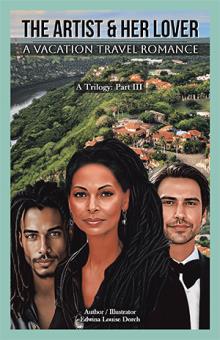
THE ARTIST & HER LOVER
A VACATION TRAVEL ROMANCE (A Trilogy: Part II)
by
Book Cover & Preview Text

Autumn descended the winding staircase to the foyer, walked down a hallway of floor-to-ceiling windows with a view of a botanical garden, and joined Ghali in the casino area of the Casa Blanca. As Autumn walked towards Ghali, she heard Jim Hall’s interpretation of Rodrigo’s “Concierto De Aranjuez” on the speaker system above her head. Her father, John, was a jazz aficionado, and through him she’d learn to identify major jazz pieces. Ghali’s casino featured ten slot machines, games, and poker tables. A thirty-two-inch roulette wheel was in the middle of the room. He asked her to call a number and color, and he spun the wheel; the ball dropped. She called the number six and on red, and mimicked a pout when she didn’t win. Mina served couscous prepared with meat and vegetables, flavored with saffron and turmeric, and topped with chickpeas. “Halal is that which is lawful,” Ghali said. “Haram is that which is unlawful, which includes blood, pork, and alcohol. Something may be halal, but it may not be tayyib and thus should still be avoided. Islam teaches that the condition of the body affects the condition of the spirit, and thus, great care should be taken to keep one’s body healthy and fit. Islam further teaches that all food should be taken in moderation, and nothing should be indulged to excess.” “Jim Hall is accompanied by trumpeter Chet Baker and alto-saxophonist Paul Desmond on this piece,” Autumn said when the ceiling speakers began to play. “Ah, this song is part of my jazz playbook because my father lived in Oran, a port city full of nightclubs and bordellos where jazz musicians played and where a type of jazz influenced the emergence of Algerian Raï music. Mina took their dishes away and served them a port as an after dinner drink. “Although this instrumental seems too slow to dance to, a couple can dance Bacha Tango to it. I’m sure you know how to tango, but do you Bacha Tango?” “My father took dance lessons in retirement, and I was his practice partner many an evening. So yes, I know that dance,” she answered. Bacha Tango involved a close embrace, slow, smooth, and elegant movements—all the basic steps of tango, as well as more advanced tango moves like sacadas, giros, and boleos. He stood, walked to a console, pressed a button on his sound system, and Chris Botti’s “Contigo En La Disfancia” began. He stepped towards her and held out his hand. She raised an eyebrow, understanding he wanted to assess her ability to dance. When he pulled her towards him, she fluttered her eyes and looked away. It was an intriguing nonverbal cue of some sort. “Was the eye fluttering subconscious? Was it innocent? Or was it a coquettish manipulation?” he wondered. “Dance is body language,” he said as he stepped backward. “The way you move tells me if you are present, attentive… responsive. The way your weight shifts tells me if you trust me, if we have a connection, if you are flexible and adaptable.” He put his arm around her waist, and his clean-shaven face touched hers. He felt her double eyelashes fluttering like butterfly kisses on his cheek. He looked at her face, at her cheekbone structure, but she defied his gaze with hooded eyelids dusted with maroon-colored eye shadow. He allowed her to sway in his arms two times to catch the rhythm. “Rumi’s mother was your concubine. Why?” Autumn asked. The Bible says Solomon had 700 wives and 300 concubines,” he responded, suppressing his annoyance at her question. He held her less closely and looked at the far wall rather than at her. She felt his psychological withdrawal, pulled away, and walked to the winding staircase. Wounded and perturbed, he followed her into the foyer but stopped, compelled to watch her as she ascended the staircase. Her breasts were heavy with milk, but her strides up the stairs were fluid, creating an illusion of effortlessness. As he studied her, he was captivated by her lithe figure, and leaping two steps at a time, he caught up to her as she walked to her bedroom, but turned to look at him. “Did my body tell you I am afraid of you?” she asked. “Because I am.” “No, I felt you wanted me,” he said, looking her in the eyes without smiling. “Can body language lie?” she asked as she arrived at her bedroom door. “No,” he said, staring at her mouth. She opened and closed her door. As part of his wudhu, Ghali sat in his steam room with his head in his hands. With the birth of his son, the death of his concubine, and the entrance of Autumn into his life, his emotions seemed… irrational, and his confusion led him to rumination. From the moment he saw her feeding his son, his attempts to regulate his emotions had been ineffective. He had never been prone to limerence, love intoxication, and frequent intrusive thoughts about a potential sexual partner. Usually, he was emotionally hot-and-cold and varied between being available and unattainable. Only a small subset of people could trigger limerence in him. Yet she did, and he worried she might think he was clinging, or worse, controlling. His thoughts were difficult to process or appraise, and he sought intimacy with her to tame his emotional dysregulation and worry—about his son and their future. He puzzled over the fact Autumn didn’t seem to understand his inner motivations. Autumn couldn’t understand why he chose to have a son with a concubine. But he had thought long and hard about why. He did it because he didn’t want to be involved in polygamy or monogamy. He’d heard tales of the emotional turmoil, anger, jealousy, and competition among women in his father’s harem. Wives competed for their husbands’ attention and resources, leading to rivalry and tension. Children of polygamous men competed for both affection and inheritance, which were usually unevenly distributed among siblings. He didn’t want to be involved in that. And he had seen how abandoned his mother had been during her marriage to his father, and he didn’t want that either. For all these reasons, Ghali had chosen a concubine to give him a son, and with a woman he hadn’t loved.
Formats


Book Details
About the Book
This is a travel romance involving a love triangle.
In this part of the series, Autumn Simmons, an American artist, lives with her lover, Colin Acieta, in a chateau in Amalfi, Italy —a seaside village with small bays, picturesque cliffs, and hundreds of uphill stone steps overlooking the Mediterranean Sea.
However, Acieta, a photographer, is compelled to travel to the parched and barren Sahara Desert to rescue his siblings from a migrant trafficker. But his noble mission is thwarted when he is held hostage by local domestic terrorists.
To negotiate Acieta’s release, Autumn follows him to the Sahara Desert. And it is there that she meets Brahim Ghali, a Muslim Berber, dressed in an ankle-length thobe and kufiyah headdress, who has a harem of women. Even so, Autumn becomes a ‘limerence’ to Ghali, who becomes tragically obsessed with her.
Which of Two Sigma Males Will Win Autumn’s Heart?
and
Will she return to Italy or remain in the Sahara?
About the Author
The author, Edwina Dorch, is a Ph.D. psychologist who lives on a barrier island in Florida. She has written four novels and one trilogy for a total of seven novels.
In 2023, she won the American Writing Award for Best Inspirational Novel, and in 2024, she was a finalist in the murder mystery category.
She illustrated her YA (young adult) graphic novel and created the book covers for half of her books of fiction.
And not only does she illustrate, but she also displays her paintings in local art galleries along the A1A highway in Florida.