
Salvaging Germany
Time War Correspondent Alfred Kornfeld's Dispatches From the Rubble of Occupied Germany
by
Book Cover & Preview Text
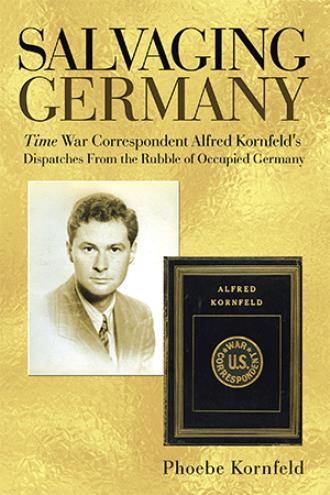
Kornfeld’s dispatches are arranged here thematically, although they were presented to his father in chronological order as set forth in Appendix III. There can be no doubt that to effectively convey the noteworthiness of Kornfeld’s reporting it was important to organize his work topically, but by doing so, the driven nature of his personality that they otherwise exude becomes somewhat muted. A review of one week in April 1946, for example, shows Kornfeld writing about the repatriation of German POWs from Italy, his observations in the French zone of occupation in Austria, a description of the US zone counterintelligence school, events from two important days at the Nuremberg War Crimes Trial, and an interview with Leni Riefenstahl. The energy that went into the pursuit of those stories was enormous. Kornfeld’s ability to marshal the background information, to travel in those challenging postwar conditions, to capture the details and essence of the experiences in twenty-four pages of reports substantiates the description of him by a Time-Life executive of as “young with lots of drive in a breathless sort of way.” When the dispatches are read as a whole, it becomes clear they were written by a knowledgeable individual who was sifting through the omnipresent rubble for signs of whether anything of the once highly respected Germany could be salvaged after the country had sunk to unfathomable depths while following the course set by the Nazi regime. Kornfeld was seeking evidence of whether the people who had just experienced twelve years of a racist, violent, and militarily aggressive totalitarian regime could move forward and create the political, social, and economic infrastructure that would enable it to be accepted into the community of the newly formed United Nations. Kornfeld was in Berlin during the summer of 1945 when Clement Attlee, Joseph Stalin, Harry S. Truman, and their foreign policy teams met in nearby Potsdam and agreed on a protocol for the initial management of occupied Germany. That Potsdam Agreement set out the zones of occupation to be controlled by the UK, USSR, US, and France and addressed the objectives to be pursued by the occupying powers, including disarmament, demilitarization, and denazification of Germany. The signatories also agreed on a plan for expropriations to meet reparations claims and professed the intent that democratic governance by the Germans themselves should replace the defeated totalitarian regime. The implementation of such principles was never likely to be straightforward, and Kornfeld’s dispatches reflect that. Not only was the scale of devastation experienced by all parties to World War II beyond historical comparison, but the Allied collaboration that had enabled Germany’s defeat was already splintering. Nevertheless, the Potsdam Agreement set the framework against which progress, or lack thereof, toward a postwar normalization of life in Germany could be measured. Daily, Kornfeld reported about unfolding events relating to the complicated implementation of the Potsdam Agreement’s principles. He served as the eyes and ears for the distant Time editors, describing the maelstrom of developments in the occupied country. There are many indications that Kornfeld would have agreed with Albert Camus’s 1944 definition of a journalist as “a historian of the moment” with truth “as his primary concern.” Thus, even eighty years after Germany’s defeat, Kornfeld’s dispatches remain important. On the one hand, their depiction of the horrors of the aftermath of war should serve as a deterrent to those considering waging it today. At the same time, they preserve details of the challenges on the path to democratic governance faced by the occupation forces, Germany’s citizens, and the survivors of Nazi persecution and remain a roadmap of the foreseeable obstacles in any such regime change. With those thoughts in mind, I have organized much of the material under the umbrella of President Roosevelt’s 1941 characterization of the fundamental components of democracy that all people deserve to enjoy, namely, freedom from fear, freedom from want, freedom of worship, and freedom of speech. Surely, Kornfeld would have been aware of FDR’s Four Freedoms speech delivered by radio and then in the newspapers after his unprecedented reelection for a fourth term in office. The four freedoms are, of course, interlinked, especially considering that freedom from fear is partly dependent on the existence of the other freedoms. Thus, certain of Kornfeld’s dispatches could easily be categorized differently than I have chosen to arrange them. The book concludes with a final section of Kornfeld’s dispatches depicting the path to freedom from occupation as a further acknowledgement of the Potsdam Agreement’s overriding objective to return democratic governance to the hands of the Germans. When reading Kornfeld’s dispatches, I came to hear his voice as “a historian of the moment” seeking to identify in the rubble-strewn country any salvageable elements for the foundations of a democracy in an unoccupied Germany.
Formats


Book Details
About the Book
“Yesterday the court was under the spell of one of the greatest personalities to set foot in the courtroom so far. For two full days… Dr. Hans Bernd Gisevius had the court in complete control...When Gisevius left the stand, as fresh as the minute he had entered it, he had unfolded one of the most amazing stories told about Germany so far…—Germany’s struggle against Hitler from within.” Alfred Kornfeld, April 27, 1946 “I believe it to be most important to tell the readers that reparations, production figures, and calories are not all that spells out Germany— it is pressure, insecurity, worries about whether you will see tomorrow morning’s sunrise…that are foremost in German minds today.” Alfred Kornfeld, November 28, 1946
About the Author
Phoebe Kornfeld is a retired international lawyer and author of Passionate Publishers. The Founders of the Black Star Photo Agency. After earning a BA at St. Lawrence University, a PhD in political science and a JD at Duke University and its School of Law, she conducted legal research in Berlin as a Federal Chancellor’s Fellow of the Alexander von Humboldt Foundation. Her fluency in German and years spent living in German-speaking countries contribute significantly to her research and writing.