
Cracks in the Foundation
Kids in Care
by
Book Cover & Preview Text
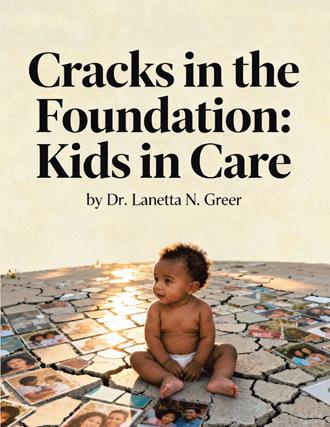
Every child deserves a safe and stable foundation. Yet for children in foster care, cracks often appear early—sometimes even before birth. Cracks in the Foundation explores the roots of attachment and separation: how children develop, why early caregiving matters, and what happens when bonds are broken.
Drawing on pioneers like Freud, Bowlby, Winnicott, and Ainsworth, alongside modern neuroscience and federal child welfare policy, this book blends theory with practice. Each chapter includes Practice Pivots—actionable insights for caregivers, foster parents, and professionals who want to translate research into healing.
The story of a child’s development does not begin with the first cry in the delivery room. It begins long before that—inside the womb, where nutrition, stress, mental health, and environment combine to shape the earliest building blocks of human potential.
For families who later struggle to maintain custody, these conditions are often not the result of lack of love but lack of support. Limited access to prenatal care, gaps in health coverage, and systemic inequities can make preparing for a baby impossible. These cracks in the prenatal environment are the first to appear in the foundation of human development.
Practice Pivots: Building Strong Foundations
• Advocate for universal access to prenatal care, nutritional support, and maternal mental health services.
• Train foster parents and caseworkers to interpret crying, feeding difficulties, and sleep disruptions as possible signs of early attachment insecurity.
• Limit placement changes wherever possible; emphasize matching that prioritizes long-term fit.
• Support policies that strengthen families’ contexts—housing, employment, child care—before removal becomes necessary.
Before birth, the foundations of a child’s life are already under construction. For children in foster care, the cracks that appear in the earliest stages are not their fault, but they become their burden. If we are to repair the foundation, we must begin at the beginning—recognizing that healthy development starts not on the day a child enters foster care, but in the womb.
Formats




Book Details
About the Book
Cracks in the Foundation: Kids in Care explores the hidden roots of attachment and separation faced by children in foster care, blending developmental psychology, personal narratives, and modern policy insights. Drawing on pioneers like Freud, Bowlby, and Winnicott, Dr. Lanetta Greer reveals how early caregiving—beginning before birth—shapes outcomes long into adolescence. Each chapter offers actionable Practice Pivots for professionals, foster parents, and advocates, serving as a bridge between theory and healing practice. Through vivid examples and research, readers gain a deep understanding of how trauma, systemic inequities, and disrupted bonds impact youth and families, while learning how stability and sensitivity can rebuild trust. Designed for caregivers, educators, and anyone dedicated to changing foster care systems, the book provides a roadmap for repairing broken foundations, nurturing resilience, and restoring hope—reminding everyone that “attachment is not optional.”
About the Author
Dr. Lanetta N. Greer is a social worker, researcher, and director of “Home 4 the Heart,” a residential program for girls in out-of-home care. Drawing from her memoir and her research, she weaves together personal story, qualitative data, and spiritual insight to explore what happens when young women “age out” of systems that were never designed with them in mind.