
The Oceans and Deserts Stock Exchange
Financing Planetary Equilibrium With Humanity
by
Book Cover & Preview Text
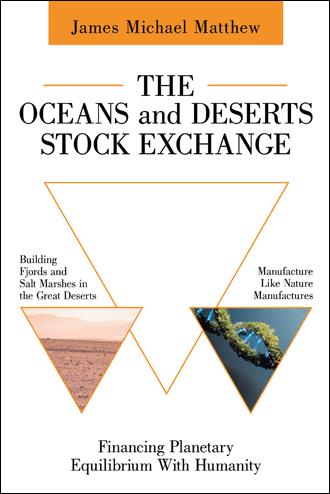
What is Humanity? What does it mean to be Human? Does Humanity have a purpose? If yes, what is that purpose? If not, then are we simply wandering mammals destined to take from the planet until nothing is left of Humanity or the Planet? Or are Humans unique and do we have a special purpose to take care of the Planet?
I wrote this book from the perspective that Humanity has a purpose and an OBLIGATION to take care of the planet. We must continue God’s work. We must protect and continue the work of billions of years of natural evolution. We must be the caretakers of biodiversity, the oceans, the rivers, the groundwaters, the lands, and the atmosphere. If we do not accept this responsibility, this purpose, or this challenge, then Humanity is already doomed.
I suspect that if you asked 1 million people from all parts of the planet, this question: “Would you like to care for and nurture the Planet”, at least 99 percent would say yes. The problem they would quickly follow with is just how could we do that? They would also likely say any small contribution we could make will not matter. So therein lies the dilemma – right? How can we develop a global plan, including billions of people that really does enable Humanity to take care of the Planet, and more importantly, how can we build a global society where Humanity is in a constant symbiotic equilibrium with the Planet? Such a plan would have three parts. It would be part philanthropic, part economic, and part spiritual. In my Book 2, “Reject Self-Serving Power”, I wrote that nothing is philanthropically sustainable until you “Build a Business Around It”. This Book 9 is a business plan to develop the economic part and how to build a business around creating this symbiotic equilibrium between Humanity and the Planet. This business plan and economic model will enable the billions of people on the planet to be a part of this symbiotic equilibrium. After we demonstrate how the economic part can and will work, the philanthropic and spiritual parts will follow on their own.
Creating and building “The Oceans and Deserts Stock Exchange” hereafter referred to as the “ODSE”, will be the economic platform we will need. The ODSE will begin as an options or commodities style exchange but will quickly add trading specific types of stocks, real estate and other assets to its platform. The ODSE’s core strategy will be to embrace the intersection of my plans for “Building Fjords and Salt Marshes in the Great Deserts”, as set forth in my Book 8, with The Biotechnology Industrial Revolution. The ultimate ODSE structure and business model will undoubtedly go through a series of evolutionary stages.
As a society, we are facing changes that are hard to ignore. We are witnessing one of the greatest industrial transformations in human history, namely a moment that will define the nations, corporations, and the individuals who will lead the next century. Those who are in control of the access to advanced raw materials of the future will determine the economic, technological, and geopolitical landscape. On the other hand, those who cannot adapt will collapse into irrelevance.
Humanity has been extracting what it needs from the planet without thinking twice about the impact it’s having on the earth, whether that’s stone, iron, oil, or rare-earth metals. And yes, this has been happening for thousands of years! The industrial economy we live in today was built on fossil fuels and mined materials. But that foundation is breaking apart. Resources are finite. The global supply chains that feed our industries are fragile, and we’re learning our lessons more and more every day. China and Russia have weaponized raw materials to assert dominance, while Western economies scramble to find alternatives. Yet are they really to blame? After all, this is how most of the developed world came to be leaders. Now, however, the battle for the future is not about who has the biggest armies or the most powerful corporations, but rather about who owns, invents, and controls the next generation of materials. This chapter imagines breaking free from scarcity. It is about manufacturing like nature manufactures, creating materials that do not need to be extracted from deep underground or shipped across oceans. It is about moving from linear extraction economies to full-cycle regenerative economies. The cycle begins with base raw materials that are grown, then “refined” and then manufactured like nature manufactures, through molecule by molecule self-assembly. This completes the raw material part of the cycle which creates a stockpile for manufacturing an endless number of final products, all of which are endlessly reusable and can be placed back into the raw material development cycle. Different end products will require different types of stockpiled raw materials. Each of their unique specifications can be invented and grown backward through the raw material cycle. This is not science fiction. It is the next industrial revolution – the biotechnology industrial revolution.
Formats



Book Details
About the Book
If you asked one million people if they want to be better caretakers of the Earth, almost everyone would say yes.
But how can we do that … and how can we overcome the idea that the contributions of individuals toward achieving that goal don’t matter?
James Michael Matthew, the founder and chair of JM Prophecies Corp., tackles those questions and more. He answers questions such as:
What would a business plan and economic model that would allow billions of people to live in harmony with the planet look like?
How can we nurture the planet while also safeguarding our spiritual health?
What is our collective purpose as human beings?
The author contends that we have a special purpose to take care of the planet and are not simply wandering mammals destined to consume resources until nothing is left.
We must protect and continue the work of billions of years of natural evolution. We must be the caretakers of biodiversity, oceans, rivers, and the atmosphere. If we do not accept this responsibility, then we’re already doomed.
About the Author
James Michael Matthew is an award-winning author, financial executive, and industrialist. He is the founder and chair of JM Prophecies Corp., which is on a mission to tackle the major challenges of our times and build the selfless economy. He graduated from The Johns Hopkins University with a master’s in biotechnology enterprise and entrepreneurship, an MBA from Michigan State University, and a bachelor’s from the University of Illinois-Springfield. He also completed a variety of postgraduate studies and is the author of several other books, including Prophecy Before Vision; Reject Self-Serving Power; and Building the Climate Change Bridge.